
By KACE KIESCHNICK, Tiger Rag Staff Reporter
Although LSU’s 41-player transfer class in year one under Lane Kiffin may be an anomaly, expect the “Portal King” to continue his reign in Baton Rouge with likely smaller numbers.
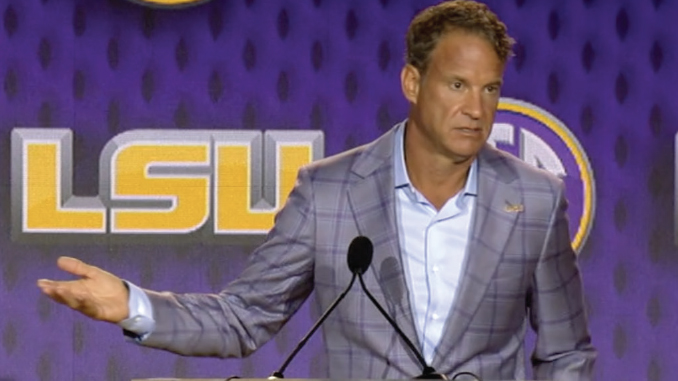
At Southeastern Conference Media Days, Kiffin gave some insight into how he plans to build his rosters in the future at LSU.
“We’re coming to LSU to sign the best players in the country out of high school and then mix that with the best portal players in the country and put them together,” Kiffin said. “That’s led us into this roster that we have now, which is a really good mixture of that.”
In addition to the No. 1 transfer class Kiffin and Co. also welcomed 16 freshmen and three junior college transfers (not to be grouped with the transfer portal). That includes five-star defensive linemen freshmen Lamar Brown and Richard Anderson in 247sports.com’s 11th-ranked recruiting class.
“We put together a roster that can win now, but as I look at when you build the program where it really will go to another level is how you build your depth,” Kiffin said.
That depth will come largely from both the blockbuster group of underclassmen portal transfers and top true freshmen. Kiffin said people need to reframe how they think of the transfer portal.
“The portal is thought so much about like every portal player is a senior or a one-year player,” he said. ”That’s not the case. A lot of times you sign a portal player, they may have two, three years of eligibility left. So, then you have them in your program. Now you go into year two, you’ve coached them already.”
Many portal players may not even see the field their first year in the program. Of LSU’s 41 incoming transfers, 35 have more than one year of eligibility remaining, and 19 have three or more years.
Kiffin said college coaches cannot rely solely on high school classes with the beginning of the no-sit-out portal in 2021.
“A couple schools have done that, and it’s not working out well,” he said. “They can leave after year one when they don’t play as much as they like or they want more money, or they do play and then they want more money.”
Georgia, though, did win national championships in the 2021 and ’22 seasons with very few portals coming in or going out. But that was early in the portal era.
The program Kiffin was not-so-subtly alluding to is likely Dabo Swinney’s Clemson team, which will be in Tiger Stadium to open the season on Sept. 5 (6:30 p.m., ABC).
Swinney has long criticized the portal and brought in very few transfers from 2021-24. But he welcomed 13 for this season.
And Clemson has suffered. He went from undefeated national champions in the 2018 season, a second straight title game appearance in 2019 and seasons of 10-2 and 7-1, 10-3 and 6-2, 11-3 and 8-0 from 2020-22 to a drop as the portal era took over. Swinney slipped to 9-4 and 4-4 in 2023 for his first single-digit-win season and non-winning mark in the Atlantic Coast Conference since 2010. He followed that with a 10-4 and 7-1 in 2024, but dropped to 7-6 and 4-4 last year – his worst season since the 6-7 and 4-4 in 2010.
Swinney’s Tigers are by no means irrelevant, but his recent rosters are a far cry from their former dominance.
Kiffin is determined not to let modern college football leave him behind, even with LSU’s storied high school recruiting success. He is off to a great start toward his 2027 class as it is ranked No. 10 by 247sports.com with 16 commitments, including a pair of five-star players.
“Even though we can sign great, elite, top-100 high school players like we just did, like what’s committing to us,” he said, “we’re still going to build a lot through the portal until they balance out the system and they balance out how contracts work.”
Kiffin’s dilemma is that unproven, young talents who may not see the field immediately, compete for the same revenue-share and Name, Image, and Likeness dollars as seasoned upperclassmen. Why invest in a raw high school prospects when you can pay the same amount to a productive veteran?
“You study the NFL, and they say the best teams over time will sustain the longest by building through the draft and supplement through free agency,” Kiffin said. “Because that’s where the long term contracts are at the lower prices. But our system doesn’t have that.”
He suggested the NCAA limit the earnings of incoming freshmen similar to how the NFL lowered the rookie contracts dramatically not long after LSU quarterback JaMarcus Russell signed as the first pick of the draft with the Oakland Raiders – coached by Kiffin – in 2007 for a six-year, $61 million contract with $32 million guaranteed. Russell, who was picked by Oakland because then-owner Al Davis ordered it, became one of the biggest first-pick busts in NFL history and was out of the league by 2010.
“Now, if you could fix it where the high school kids, in my opinion, are lower paid,” Kiffin said. “I was in the NFL when we drafted JaMarcus Russell before they moved down the rookie salary cap, and then they made the slots for the draft. Because the rookies were getting paid more than the 10-year vets. Well, they got that fixed.
“That in our system is a little bit screwed up, in my opinion. The kids who haven’t played at all coming out of high school should be making less, and there should be a freshman cap, like a rookie cap. And then the max slots per position that they make. And then they’re signed to multi-year contracts. So, then you build through high school because that guy can stay longer.”
Until that happens, and the system is fixed. Kiffin will continue to take advantage of the transfer portal to snag, not just immediate impact players, but fill out the entire roster.That does not mean he plans to abandon high school recruiting, though.
The healthy mix will continue.


Be the first to comment