
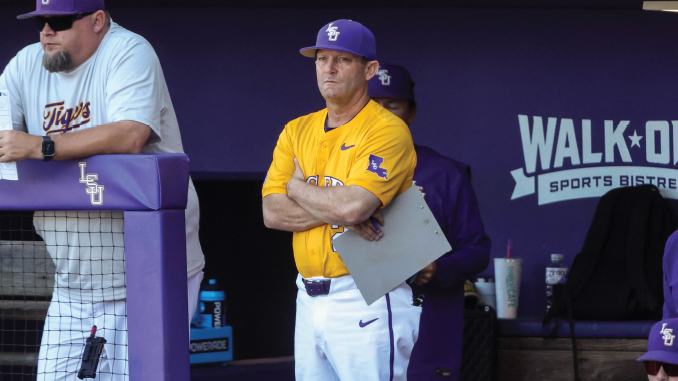
By TODD HORNE, EXECUTIVE EDITOR
For LSU baseball people, the easy conversation is always talent.
This roster has it. Jay Johnson said so himself before the season, calling it the most talented team he has ever had. Fine. But by now, talent is not the question. Talent has not been the question for a while.
The question is whether Johnson can make that talent submit to a standard.
That is why this Kentucky weekend feels bigger than a late-March SEC series.
That is why Saturday mattered.
And that is why Sunday matters even more.
LSU’s 7-0 win over Kentucky on Saturday was not just a needed response. It was a snapshot of what this team has to become if this season is going to be more than flashes and frustration. William Schmidt gave LSU 5.1 scoreless innings, working through traffic and refusing to let Kentucky turn pressure into runs. Zac Cowan took the rest of the game and ended it with force, allowing one hit over 3.2 innings while striking out seven. Together, they authored the shutout.
That was the story of the day.
Not Cowan alone.
Not Schmidt as some setup act.
Schmidt and Cowan together.
Schmidt gave the game shape. Cowan slammed the door. That is what winning baseball looks like in this league when a team is trying to steady itself. Johnson said afterward that Schmidt is “emerging into one of the best pitchers in the country,” and he called Cowan “exceptional.” That was not postgame fluff. That was exactly what happened.
But Saturday also revealed something bigger than one pitching performance.
It revealed the beginnings of what may become Jay Johnson’s best coaching job yet.
Not because this is his best team.
Not because this is his easiest path.
Because this team may require more actual coaching than any LSU team he has had.
That is the point hardcore baseball people should understand immediately. The challenge here is not discovering talent. The challenge is forcing talent to play winning baseball. There is a difference, and this team has lived in that difference too often.
Saturday hinted at what it looks like when Johnson starts winning that fight.
It looks like run prevention.
It looks like structure.
It looks like the best players on the field dragging the rest of the team toward a harder edge.
And it looks like a coach who is no longer interested in waiting for gifted players to eventually figure it out.
That last part matters.
Because Steven Milam is at the center of it.
At the halfway point of the season, and in only his second year at shortstop, Milam is playing like the best defensive shortstop in the country. Saturday was another reminder. LSU turned two double plays, and Milam again made difficult plays look routine. Johnson called him the linchpin of the defense afterward, and that was exactly right.
Milam is not just having a nice season.
He is forcing an identity onto this team.
Because otherwise, LSU’s infield defense has been subpar too often. That is just true. Milam is the exception, and because he is the exception, he is also the standard. Every time he turns chaos into an out, every time he settles an inning instead of letting it speed up, every time he makes a hard play feel expected, he is pulling LSU toward the kind of baseball it is going to have to play to win big.
That matters because identity does not always arrive cleanly.
Sometimes it arrives through one player who refuses to play loose.
Sometimes it arrives through one arm that will not let the game unravel.
Sometimes it arrives because the head coach starts making hard choices and stops protecting talent from consequence.
That is where the Omar Serna Jr.-Cade Arrambide contrast comes in, and it may tell you as much about Johnson’s coaching right now as anything else on the roster.
Serna keeps looking more and more like a player LSU can trust. His 2-for-4 day with a walk on Saturday was another sign of that. He is not just filling a spot anymore. He is giving LSU steadier at-bats, more reliable rhythm and better control inside the flow of a game.
And on the other side sits Arrambide.
One of LSU’s most talented offensive players has effectively been benched for three straight games. Johnson has said it is not injury-related. Which means the message is obvious. Arrambide was not taking disciplined enough at-bats, and Johnson has responded the only way a serious coach can respond when a talented team is still learning how to become a winning one.
He sat him.
That is not a minor lineup adjustment.
That is coaching.
That is a head coach telling his team, in the clearest language possible, that ability is not enough. Not here. Not now. Not in this league. Not on a team still trying to become what it thinks it can be.
And that is why this may be the beginning of Johnson’s best work.
Because the coaching job here is not about drawing up a lineup card and letting talent do the rest. It is about confronting a gifted roster that has too often played in fragments and forcing it to live by a real standard. It is about teaching this team that discipline matters more than potential, that run prevention matters more than style points, that timely offense matters more than empty swings, that defensive reliability matters more than theoretical upside.
Saturday looked like that kind of baseball.
LSU had nine hits, drew nine walks and scored seven runs without playing reckless. Mason Braun drove in four. Milam doubled in two. Zach Yorke added a sacrifice fly. It was not wild offense. It was useful offense. It was offense that understood what the pitching performance required.
That is the formula.
Schmidt giving the game shape.
Cowan ending it.
Milam controlling the middle of the field and forcing the defense toward competence.
Serna earning trust.
Arrambide sitting until discipline returns.
A coach making it clear that talent is welcome, but only if it submits.
That is why Sunday is vital.
Because now LSU has seen what its baseball has to look like.
The question is whether Johnson can get this team to live by it again.
If LSU takes the series, then Saturday becomes more than a good afternoon. Then it becomes part of a real turn. Then it becomes evidence that Johnson is starting to get this team to stop playing like a collection of gifts and start playing like a team that understands exactly how it has to win.
If LSU loses Sunday, then Saturday changes meaning.
Then it becomes another isolated performance in a season that has had too many of them. Another glimpse of what LSU can be without enough proof of what LSU is. Another day when the standard showed up, only to disappear again.
That is the tension in this season.
Not whether the talent is there.
Whether the coaching can force that talent into identity.
And if it can, then this may indeed become Jay Johnson’s best coaching job yet.
Not because he found greatness where none existed.
Because he demanded more from a gifted team than gifted teams usually want demanded of them.
And because he made them either accept that standard or sit and watch.



Be the first to comment