
By TODD HORNE, Tiger Rag Executive Editor
If you want to know where LSU athletics is headed in 2026, you didn’t need another hype video or mission statement — you only need two dates.
November 30, 2025: The day LSU ripped off the Band-Aid and hired Lane Kiffin to replace Brian Kelly as football coach. That was when the Tigers declared they were done managing decline and ready to swing for the fences.
It’s over. Lane Kiffin is LSU’s next football coach. Press conference introducing him set for Monday at LSU.https://t.co/kTRsVE78Of
— Glenn Guilbeau (@SportBeatTweet) November 30, 2025
April 23, 2026: The day the plan came into razor-sharp focus.
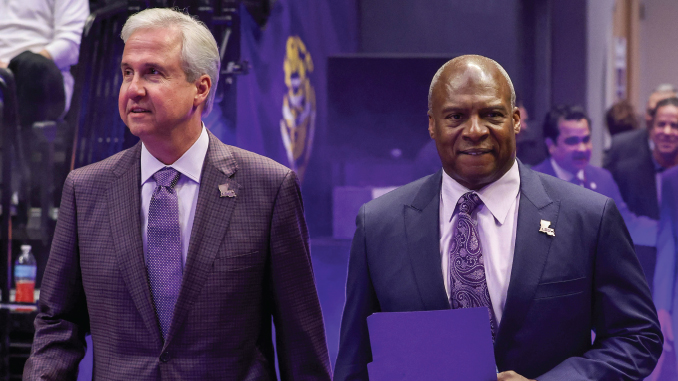
On paper, April 23 looked like a routine board meeting: Verge Ausberry officially named vice president and athletics director. Heath Schroyer, formerly McNeese State’s athletic director under president Wade Rousse turned LSU president last November, slotted into a senior athletic director external-relations post. Billy Glasscock installed as football general manager. Will Wade and his new men’s basketball staff approved. Assistant women’s basketball coach Bob Starkey’s new contract, new assistant women’s basketball coach Fitzroy Anthony green-lighted. Ticket, parking and Tradition Fund hikes rubber-stamped. Standard governance choreography.

But this was no bureaucratic exercise. It was LSU laying its cards on the table. Kiffin’s arrival was the opening move; April 23 was the institutional blueprint. In one sweep, the university showed how it intended to organize, fund and prioritize its athletics empire in the modern era. It was a watershed moment — not because of fireworks or dissent, but because the architecture of a new LSU was exposed for anyone sharp enough to look beyond the names.
Another one is perhaps coming early next month with two summits of the key donor “families,” if you will, at the Governor’s Mansion.
Start with football, where the reset truly began. Bringing in Kiffin wasn’t just swapping head coaches. It was a posture shift: an aggressive bet on offensive juice, relentless recruiting, roster magnetism and national relevance. Kiffin is the first true offensive coordinator as in play calling and direction LSU has ever hired as head coach. LSU acknowledged that college football is now faster, more transactional and brutally competitive — and decided half-measures wouldn’t cut it.
Then came the structure around him. Ausberry wasn’t a hometown nod; elevating him to AD redefined the role itself. Today’s athletic director is part CEO, part strategist, part negotiator, part fundraiser, part crisis manager – a C-suite executive running a live commercial enterprise inside a public university. By installing Ausberry, LSU signaled that the old, coach-centric model was dead.
Schroyer’s external-relations portfolio mattered more than most realized. It meant LSU finally understood that revenue streams, political capital and brand stewardship can’t linger in the shadows — they have to be built into the organizational spine. This wasn’t just hiring around sports. It was staffing around the business conditions that now govern sports.
There was a lot going on at Will Wade’s introductory press conference, other than re-introducing Wade. … Only at LSU. Column:https://t.co/6GmHQK0FHt
— Glenn Guilbeau (@SportBeatTweet) April 3, 2026
Football gave itself away again with Billy Glasscock as general manager. This wasn’t window dressing. College football is now a roster economy, complete with NIL math, transfer portals, scholarship calculus and constant attrition. By embracing a GM model, LSU admitted the sport has professionalized, and so must its operations.
Men’s basketball was the loudest line item outside football. Wade’s rehiring wasn’t a courtesy call; it was the centerpiece of a full-scale reboot. LSU put its money where its impatience was, assembling a staff designed to drag the program back from irrelevance.
This wasn’t incremental tinkering — it was a blunt declaration that the Tigers intend to matter in the winter as much as they do in the fall.
But the smartest play of all was what LSU refused to sacrifice. It didn’t rebuild men’s hoops at the expense of women’s basketball. Bob Starkey and Fitzroy Anthony weren’t afterthoughts — they were part of the same blueprint. Kim Mulkey had already pushed LSU women’s basketball into the national spotlight. Neglecting that momentum in pursuit of fresh glory would have been institutional malpractice. By affirming both programs, LSU made clear that broad-based excellence was non-negotiable.
And then came the giveaway: ticket, parking and Tradition Fund increases for both men’s and women’s basketball. That was more than an addendum — it was the day’s financial punchline. LSU wasn’t merely ratifying commitments; it was positioning itself to generate more from them. More spending paired with higher returns — that is the anatomy of a real reset. Not nostalgia. Not emotion. Economics.
That, above all, was April 23’s message: LSU athletics has outgrown yesterday’s assumptions. The old, loose-knit, coach-centric department is out. In its place stands a more professional, more expensive and more honest enterprise — aware of what college sports have become and prepared to act accordingly.
November 30 was the first shot across the bow. April 23 was the full reveal. That blueprint may be the most important move LSU athletics made all year: the university showed its hand – and there’s no folding now.
For more, grab a copy of the July issue of the Tiger Rag Magazine’s Year In Review end issue that is everywhere in Baton Rouge now.
Look for the headline, “The Year LSU Changed EVERYTHING” or click onto it at the right on this website.


Be the first to comment