
By GLENN GUILBEAU, Tiger Rag Editor
Bob Pettit, the first LSU athlete to have his number retired and the first to lead the Tigers to the Final Four before becoming an 11-time NBA All-Star and retiring as the No. 1 scorer in NBA history, died on Wednesday at the age of 93, his family confirmed.
“Dad passed away very peacefully at his home in Metairie, on Wednesday, September 23,” the family said in a statement on Thursday. “He was the most amazing father. The most kind, humble and gentle soul. We are so blessed to have him in our lives and we will miss him dearly.”
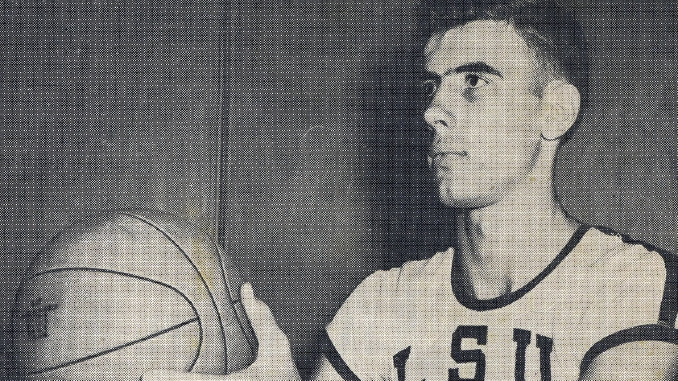
Pettit, a Baton Rouge native who went to Baton Rouge High, wore No. 50 at LSU from 1951-54 as the 6-foot-9, 205-pound forward/center dominated the Southeastern Conference for his three seasons. A three-time All-SEC player and two-time All-American, he led the league in scoring in all three of his seasons – 25.5 points a game in 1951-52, 24.7 in 1952-53 and 31.4 in 1953-54. The Tigers won the SEC title and reached the Final Four in 1953 in a 22-3 (13-0 SEC) season and repeated as SEC champions in 1954.
After his senior season, LSU retired Pettit’s number. He finished his LSU career with 1,916 points, which remains sixth in school history behind No. 5 Shaquille O’Neal with 1,941 points. Pettit’s 1,039 career rebounds is fourth all-time at LSU.
The second player picked in the 1954 NBA Draft by the Milwaukee Hawks after the Baltimore Bullets took Frank Selvy, Pettit won Rookie of the Year in 1955 when he averaged 20.4 points and 13.8 rebounds. After the Hawks moved to St. Louis the next season, Pettit became the first NBA Most Valuable Player in history as he won the NBA scoring title with 25.7 points a game and finished second in rebounding wiht 16.2 a game.
Pettit led the Hawks franchise to their only NBA championship in 1958 with a rare title series victory over the Boston Celtics. He later became the first NBA player in history to score 20,000 points in his career. When he retired in 1965, he was the all-time leading NBA scorer with 20,880 points.
“He was the giant of LSU basketball before Pete Maravich (1967-70) and Shaquille O’Neal (1989-92),” said former Louisiana Lieutenant Governor Jay Dardenne, who is an executive producer of the Billy Cannon documentary that premiered recently.
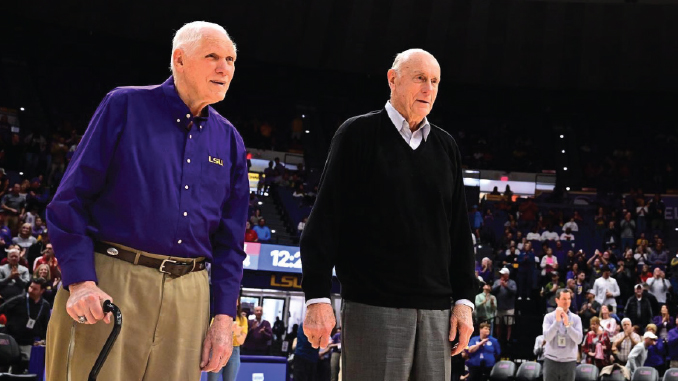
Pettit was perhaps the most accomplished LSU athlete from Baton Rouge before Cannon went to LSU from Istrouma High in 1956.
And a quarter century before Michael Jordan was cut from the varsity team at Emsley A. Laney High in Wilmington, North Carolina, as a sophomore, Pettit was cut from the Baton Rouge High basketball team as a freshman and sophomore. Pettit grew several inches before his junior season, made the team and led the Bulldogs to the state championship in 1950. Jordan grew four inches before his junior season, made the varsity team, and the rest of that story is history, too. Pettit and Jordan were named to the NBA’s 50th and 75th anniversary teams in 1996 and 2021, respectively.
“Bob Pettit was LSU basketball,” Dardenne said. “And such a gentleman. He always stayed very involved in the Baton Rouge community and was just a model athlete.”
Former LSU basketball player Collis Temple Jr., who played at LSU from 1971-74, stayed close with Pettit and often visited with him during LSU games at the Pete Maravich Assembly Center.
“I was like a younger brother and good friend to Bob Pettit,” Temple said in a statement on Thursday. “He was older, but played at LSU and always reached out and supported me. We stayed close, and he leaves behind a tremendous legacy in the LSU basketball brotherhood.”
Pettit remains one of the greatest NBA players in history as he is one of only four players named to all four NBA Anniversary teams – the 25th in 1971, 35th in 1980, 50th in 1996 and 75th in 2021. The other three are Bill Russell, Bob Cousy and George Mikan.
“Bob Pettit knew what he could do, and he knew what he couldn’t do,” NBA great Oscar Robertson once said of Pettit.
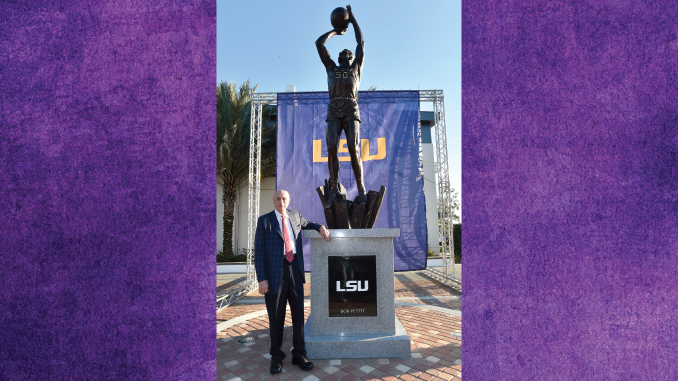
“Yeah I think that’s pretty true,” Pettit said of that comment when his statue was unveiled outside the Pete Maravich Assembly Center on Feb. 27, 2016. “I scored well. If things got tough, and I wasn’t hitting the jump shot, I went harder than ever to go to the board. It was whatever it took to get the ball and put it back in and get fouled. I realized if my jump shot was hitting, I was going to have a big night. I knew what I did well. I was very aware of my abilities and very aware of my limitations. I did everything I could.”
And that included beating the Boston Celtics and Russell in the NBA Finals – the first of just five championship series Boston has lost amid 18 world titles.
The Celtics won an NBA record eight consecutive titles from 1959-66 with Russell at center, but it would have been 10 in a row without Pettit. After the St. Louis Hawks and Pettit lost game seven of the 1957 NBA title series to the Celtics in the Boston Garden, Pettit made sure his team won the title in game six in 1958 at Kiel Auditorium in St. Louis. Pettit scored his LSU number with an NBA championship game record 50 points along with 19 rebounds in a 110-109 victory. The Hawks’ franchise has never won another NBA title.
Meanwhile, Russell scored only eight points with eight rebounds in the game as he dealt with a sprained ankle from game three in the series. Pettit had 31 points through the first three quarters and took over the game in the final period, scoring 19 of his team’s final 21 points.
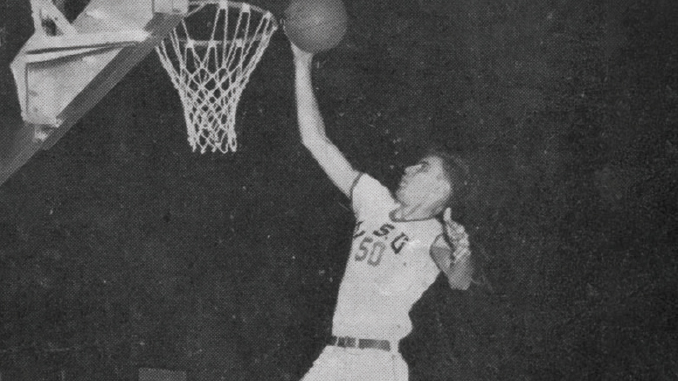
Pettit went on to play in 11 NBA All-Star games in his 11-year career from 1954-55 through 1964-65 with the Hawks and was named to the 25th, 35th, 50th and 75th NBA Anniversary teams.
After his playing days, Pettit worked in the banking industry in Baton Rouge before moving to New Orleans in the 1980s and becoming a financial consultant. He retired from Equitas Capital in 2006 and remained in the New Orleans area.
The second statue erected behind the Pete Maravich Assembly Center was Pettit’s in 2016, right next to the O’Neal statue, which went up in 2011. The “Pistol” Pete Maravich statue went up in 2022, followed by Seimone Augustus in 2023.
“I really appreciate it,” Pettit said at the statue ceremony. “It’s just hard to realize at this time how significant that is in my life. I’ve had quite a few honors over the years, but I don’t think there’s really anything that compares to this. I’m very excited and very appreciative of all the people that were involved in this and in making it happen and particularly the LSU family. They’ve been terrific, and I couldn’t ask for anything more.”
A street in the Tigerland neighborhood near LSU was named Bob Pettit Boulevard in the 1970s.
Not bad for someone cut from the Baton Rouge High basketball team.
“I never dreamed in my wildest dreams that something like this would happen,” he said standing below his statue at its unveiling. “I have found in my life and probably in other people’s lives as well, as you start something, you set a goal for yourself. You reach that goal and then you ratchet up that goal up to another level. If you reach that, you ratchet it up again. But from down here, you never realize where you’re going. When I got cut from the high school team, my ambition as a sophomore in high school was to win a letter by the time I was a senior. That’s all I wanted was to win a letter, and here I am this many years later with a statue next to Shaquille O’Neal. I’m very flattered. Did I ever dream it? No.”
Pettit’s wife Carole died in 2010. He is survived by three children and 10 grandchildren.

Be the first to comment