
Judge William Jorden grants protection for the 2026 season but declines to impose contempt sanctions after a marathon hearing featuring Greg Sankey, Dae’Quan Wright and Zxavian Harris
BATON ROUGE — Judge William Jorden granted a preliminary injunction Thursday night preventing the NCAA from using its eligibility rules to keep the named plaintiffs from competing during the 2026-27 academic year.
Jorden also continued protection against the Southeastern Conference for the remaining plaintiffs with SEC connections, preventing the conference from using its adopted NCAA eligibility requirements or threatened institutional penalties to make those athletes’ judicial relief unusable.
The decision means the NCAA cannot declare the protected athletes ineligible under the disputed rules, and the SEC cannot punish a member university, coach or administrator for signing, rostering or using one of the SEC-connected plaintiffs covered by the order.
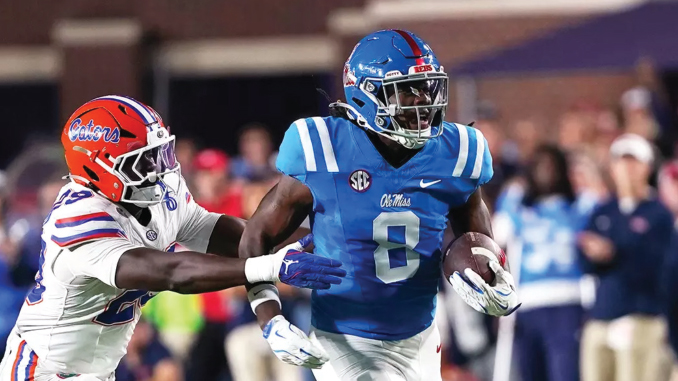
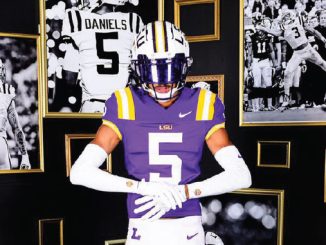
For LSU, the ruling provides immediate protection involving former Ole Miss players Dae’Quan Wright and Zxavian Harris. The university faces a Friday deadline to submit its football roster to the SEC before opening the season against Clemson on Saturday night in Tiger Stadium.
Jorden limited the injunction to the current academic and athletic year. He indicated that any attempt to stay his order would have to be taken to Louisiana’s First Circuit Court of Appeal or the Louisiana Supreme Court.
The judge declined to impose contempt sanctions against either the NCAA or SEC, finding that neither organization had taken a sufficiently concrete action violating his previous temporary restraining order. Jorden nevertheless expressed considerable concern about the SEC announcing severe potential penalties after he ordered the NCAA not to interfere with the athletes’ ability to return.
He compared the SEC’s announcement to displaying a weapon as a warning.
“I’m showing you I’ve got a big gun,” Jorden said, describing the message conveyed to member schools. “I’m showing you, if you feel froggy, go on and leap.”
The ruling concluded more than nine hours of testimony, argument and deliberation inside a courtroom filled to capacity at Louisiana’s 19th Judicial District Court. Approximately 40 plaintiffs attended the hearing, which began shortly after 11 a.m. and continued into Thursday night.
SEC Commissioner Greg Sankey spent approximately three hours and 10 minutes on the witness stand defending the conference’s authority to keep former professional athletes from returning to college competition. By the time he stepped down, Sankey had testified that he received approximately $4.8 million in compensation during the previous tax year, acknowledged traveling to Baton Rouge aboard a private plane and repeatedly defended the conference’s attempt to preserve a boundary between college and professional sports.
“The NFL is not a recruiting ground for college football,” Sankey testified.
Louisiana Attorney General Liz Murrill offered a different explanation during a 30-minute recess.
“I think this is about power and the fact that their power and their rules have been challenged, and they don’t like it,” Murrill told Tiger Rag. “It’s that simple.”
Jorden finds arbitrary application
In explaining his decision, Jorden acknowledged that courts ordinarily avoid interfering with the internal affairs of private associations. Louisiana law permits judicial intervention, however, when an association’s proceedings are not conducted fairly and honestly or when its actions are arbitrary, capricious or discriminatory.
Jorden said the evidence presented during Thursday’s hearing met that threshold.
He questioned why the NCAA waited until June to enact its new age-based eligibility system after discussing the possibility of a five-for-five model throughout 2024 and 2025. He also pointed to different treatment across sports, professional leagues and categories of athletes.
The testimony included examples of athletes who competed professionally overseas or in the NBA G League before receiving college eligibility, along with softball players who were permitted to accept professional compensation or compete against college athletes in exhibition games.
Other plaintiffs testified that brief experiences with professional organizations—including receiving approximately $190 in travel or gasoline expenses—were being treated as permanently disqualifying.
“It doesn’t make any rhyme or reason,” Jorden said. “It doesn’t make any sense.”
The judge repeatedly asked the attorneys to define where college competition ends and professional athletics begins. After hours of testimony, he said he remained unable to identify a consistently applied line.
Jorden also focused upon NCAA Rule 12.6 in the new manual. The provision states that an athlete’s period of eligibility is limited to five years beginning with full-time collegiate enrollment or the year following the athlete’s 19th birthday.
The published rule does not expressly state that athletes who entered college in 2022 are excluded.
Jorden found that, at minimum, the named plaintiffs demonstrated a likelihood of succeeding on their claim that the rules had been applied arbitrarily or inconsistently. He also found recognizable harm in the loss of playing opportunities, education, development and potential name, image and likeness compensation.
Judge narrows the SEC plaintiffs
Before testimony reached the larger eligibility dispute, Jorden narrowed the group of athletes pursuing claims against the SEC.
The conference argued that most of the lawsuit’s plaintiffs had no direct relationship with an SEC institution and therefore could not combine their claims against the conference with those of athletes who previously attended or intended to attend SEC schools.
Attorneys for the athletes agreed that only seven plaintiffs would continue pursuing claims against the SEC.
“Judge, I think if someone slipped and fell in Walmart, you couldn’t bring a suit against Costco,” SEC attorney Jason Williams said.
Jorden therefore declined to grant an injunction against the SEC for plaintiffs who had withdrawn their conference-related claims. The NCAA portion of the order applies to the named plaintiffs who demonstrated standing, while the SEC protection applies to the remaining plaintiffs with a direct conference connection.
Sankey defends the professional boundary
Sankey testified that the principle barring professional athletes from returning to college competition dates to at least 1911. He said allowing athletes to return after participating in NFL training camps could create competitive inequities and displace other college athletes from limited roster positions.
“The line between professional sports and college sports needs to be maintained,” Sankey said.
Attorneys for the athletes challenged both the substance of that position and the process through which the SEC acted. They questioned Sankey about the relationship between SEC and NCAA eligibility requirements, the timing of the conference’s actions and the severe potential penalties announced for schools, coaches and administrators who use athletes crossing specified professional thresholds.
Those consequences could include a fine equal to 50% of a sport’s operating budget, a head-coach suspension of up to half a season and the loss of a university’s voting privileges within the conference.
Sankey maintained that the SEC acted independently rather than in coordination with the NCAA. He said conference presidents and chancellors believed they needed to establish a clear division between professional and college competition and meaningful consequences for institutions that crossed it.
He was also questioned about why the SEC policy specifically identifies athletes associated with certain American professional leagues—including the NFL, NBA and WNBA—without expressly addressing every overseas professional league or women’s professional soccer. Sankey indicated that the conference had not had sufficient time to examine every professional organization.
Jorden credited Sankey for personally appearing while no NCAA executive testified.
“For him to actually come down here, that was a big deal, and that took guts,” Jorden said.
The judge remained troubled, however, by the SEC’s decision to announce potentially devastating institutional penalties after entry of the temporary restraining order.
Murrill: ‘It’s not about Lane Kiffin’
Murrill rejected the suggestion that the athletes’ case was primarily a product of LSU coach Lane Kiffin’s attempt to strengthen his first Tigers roster.
“It’s not about Lane Kiffin,” Murrill told Tiger Rag. “It’s about these individuals who want to play.”
She said college athletics has changed rapidly while the SEC continues to rely upon concepts developed under a substantially different economic structure.
“There hasn’t been a whole lot of recognition from the commissioner about how much everything has changed,” Murrill said. “They are changing on the fly, and yet it affects these students dramatically.”
Those consequences, she said, extend beyond whether an athlete eventually reaches the NFL.
“It affects their economic opportunities—not just in the future, but today, right now,” Murrill said. “In fact, some of them have greater economic opportunities right now playing in college than they will when they get out of college.”
Plaintiffs’ attorney Tony Clayton said Murrill’s presence alongside the athletes’ legal team reflected her responsibilities as Louisiana’s attorney general.
“She has a commitment to the Constitution and making sure the kids are being treated fairly,” Clayton told Tiger Rag. “This is a constitutional issue.”
Clayton also said SEC attorney Jason Williams attempted to disrupt his examination of Sankey.
“I think he tried his best to keep me unbalanced, where I wouldn’t be able to cross-examine Sankey,” Clayton said. “I don’t think he did a good job with me. I got what I wanted out of it.”
Murrill challenged the credibility of Sankey’s testimony concerning his familiarity with the rules at the center of the dispute.
“I don’t even think that was a credible statement,” Murrill said. “With all the litigation that has been going around and around about the five-for-five rule, I don’t think it is credible that he hasn’t even read the rule or read the book or knows what the bylaws are. If that’s true, then he’s getting paid way too much.”
Wright and Harris take the stand
Former Ole Miss players Wright and Harris testified after Sankey completed his appearance.
Wright, a tight end who enrolled at LSU and began practicing this week, testified that he earned more than seven figures through name, image and likeness compensation during his college career.
He signed with the Philadelphia Eagles after going undrafted, was waived, claimed by Cleveland and subsequently released by the Browns. Wright testified that he suited up for Cleveland but was not paid by the organization.
He said he wanted to “just be treated fairly” and receive the fifth season now available to athletes under the NCAA’s new eligibility structure.
Harris, a defensive tackle who signed with the New Orleans Saints after playing at Ole Miss, also testified that he earned seven figures during his college career but was not paid by the Saints.
Asked whether he wanted to return to college football if permitted, Harris answered, “Yes.”
Both players testified that they would not have entered the NFL process if they had known another college season might become available.
Their testimony exposed one of the complications beneath the SEC’s attempt to preserve a traditional boundary between college and professional athletics: Both athletes earned substantial compensation while playing in college but received no pay from the NFL organizations whose contracts or rosters could have disqualified them.
The arguments that decided the case
Closing arguments reduced the dispute to two fundamentally different descriptions of the NCAA’s transition to five years of eligibility.
Attorneys for the athletes argued that the NCAA arbitrarily excluded one class from the new system after allowing other former professionals, junior-college players and athletes receiving waivers to compete under materially different standards.
They emphasized that the NCAA’s new manual states that an athlete’s eligibility period is limited to five years beginning with full-time college enrollment or the year following the athlete’s 19th birthday. Nothing in the published rule expressly excludes athletes who entered college in 2022.
“The NCAA wrote the rules,” an attorney for the athletes argued. “They published the rules. They can live with the rules they wrote.”
The athletes’ attorneys also argued that the SEC could not enforce NCAA restrictions covered by Jorden’s order merely by incorporating those restrictions into conference policy.
“The SEC said the question is, can the SEC make its own rules?” plaintiffs’ counsel said during rebuttal. “That’s not the question. The question is, can the SEC say it is going to enforce NCAA rules that have been enjoined by saying they are our rules, too?”
The NCAA countered that the athletes never clearly identified which manual created the contractual right they claimed had been violated.
Its attorneys argued that the 2025-26 manual governed the athletes when their eligibility expired and that the 2026-27 age-based system was adopted prospectively. Because all members of the affected class were treated consistently, the NCAA maintained, its application was not arbitrary.
The SEC framed its position more narrowly. Its attorneys argued that 16 member universities may voluntarily establish common standards for conference competition and enforce those standards equally.
SEC counsel maintained that the conference was not threatening to punish the athletes directly. Its enforcement provisions applied to universities, coaches and athletic-department personnel who recruited or used athletes prohibited by conference policy.
The conference also argued that the commissioner’s disciplinary authority existed before Jorden issued his temporary order. Its attorneys cited Article 4.4.3 of the SEC Constitution, which authorizes the commissioner to impose fines, suspensions and other penalties upon institutions and athletic personnel who violate SEC or NCAA rules.
The SEC warned that an injunction could transform NFL roster-cut day into another college recruiting period. Once one program began signing players released by professional teams, the conference argued, competitive pressure would force the other 15 members to consider doing the same.
Its attorneys asked Jorden to consider athletes not represented inside the courtroom—high school prospects seeking their first scholarship and current college players awaiting their first meaningful opportunity.
“For these players, the case might be about one more opportunity,” SEC counsel argued. “But for some, Judge, it’s about the first.”
The athletes answered that prediction by describing the dispute as a unique, one-time consequence of the NCAA changing its eligibility structure after the plaintiffs had been told their college careers were finished.
“These guys are not professional athletes,” their attorney argued. “They did not choose to leave college to go pro. Their eligibility was determined to have ended, and they moved on with their lives.”
Jorden ultimately concluded that the named athletes had demonstrated sufficient likelihood of success and irreparable harm to justify preliminary relief for the current season.
He stopped short of holding the NCAA or SEC in contempt. Although the judge regarded the SEC’s threatened penalties as an unmistakable warning to its member institutions, he found that neither organization had yet crossed the line from warning to punishable action.

Be the first to comment