
Todd Horne | Tiger Rag Vice President & Executive Editor
Eighteen months before Warren Morris changed LSU baseball forever, I had moved to Los Angeles to begin my career at Primedia.
That was my new life then. New city. New job. New start. A long way from Louisiana, Alex Box Stadium and the rhythms of LSU baseball.
Then, in June of 1996, a friend called me on a Wednesday.
He did not offer a long explanation. He did not need one.
He said he thought LSU was going to win the whole thing. I needed to catch a plane and meet him in Omaha.
So I did.
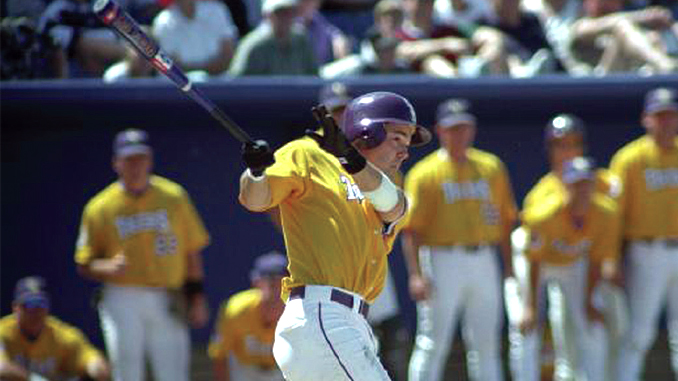
That decision put me in Rosenblatt Stadium a few days later, seated along the right-field foul line, when Warren Morris’ legendary baseball whizzed right before my eyes on its way just barely over the right-field wall.
Thirty years later, I can still see it.
That is the thing about certain sports memories. They do not age the way normal memories do. They stay sharp because they are connected to something bigger than the play itself.
Morris joined us this week on Tiger Rag Radio as LSU prepares to honor the 1996 national championship team this weekend against South Carolina.
The conversation was supposed to be a look back.
It became a reminder of what LSU baseball was, what it still means, and what is harder to preserve in the modern version of college sports.
From my angle in the bleachers, that home run did not look like a myth.
It looked like a street fight.
The wind was howling in from left-center that day, holding up a Pat Burrell blast earlier that should have been a grand slam. But Morris’ ball found the only seam the elements would allow. It was a line drive with just enough life, hit by a player who had spent the season limited by a wrist injury.
When the ball whizzed past me, the geometry was so close I could see the red seams spinning in a blur. But it was the sound I will never forget: a faint, sharp hiss as the spin of those seams ripped through the heavy Omaha air, fighting for every inch of carry the wind would concede.
It did not soar.
It fought.
Morris told us he did not even know it was gone.
He was running hard, thinking double.
“The home run was the last thing on my mind,” Morris said on Tiger Rag Radio.
That makes sense. He had spent much of that season in the dugout, recovering from surgery. He returned to the lineup batting ninth, trying to slap at the ball and play good defense.
But on that championship Saturday against Miami, he told Skip Bertman during batting practice that he finally felt like himself again.
Good timing.
Before the home run, Morris had already played a complete game. He threw out a runner at the plate. He scored three runs. He singled. He doubled.
But nobody remembers the box score first.
They remember two outs in the bottom of the ninth. They remember Billy Koch on the mound. They remember Miami leading. They remember the injured second baseman in the ninth spot. They remember the ball slicing through that Omaha wind.
Then the stadium changed.
My favorite part of the story, however, is not the dogpile.
It is what happened after the interviews ended.
In the chaos, the team bus left without the hero.
There was Warren Morris – the man who had just hit one of the most famous home runs in college baseball history – still in full uniform, walking through people’s backyards near Rosenblatt Stadium to find his dad’s car.
No security. No handlers. No NIL branding agents.
Just a college kid in cleats trying to get back to the hotel.
That is almost too perfect.
And it is where the conversation turned from nostalgia to something more current.
I asked Morris what his career might have looked like today, in the age of the transfer portal, NIL and revenue sharing.
Morris’ career is the perfect test case for what has changed.
He redshirted. He waited. He stayed.
“I didn’t want to be 50 or 60 years old wondering what might have happened if I had not taken the chance,” Morris told us.
In today’s game, “wondering” has often been replaced by “resetting.”
If a player is not in the lineup, leaving is easier. If a role does not arrive quickly enough, there is another roster somewhere else. Patience has been devalued. Development has become less romantic.
Morris pointed out that the portal is not all bad. LSU landed Paul Skenes that way, and Skenes helped deliver the Tigers another national championship in 2023.
But Morris also talked about the bond of that 1996 team.
They were not a roster assembled overnight. They were a family built over time. They were the ones who found those championship gold jerseys as a surprise in their lockers before the regionals and decided they could not lose in them.
They didn’t.
That is why the gold jerseys still matter at LSU. They are not just uniforms. They are a memory stitched into fabric.
Warren Morris’ story required time.
It required staying.
It required belief before reward.
I did not know, when I got on that plane from Los Angeles to Omaha, that I was flying into one of the great scenes in sports history. I only knew a friend believed.
Thirty years later, I am still glad I listened.
I was there, down the right-field line, close enough to watch the baseball fly past me, to hear its seams rip the air and to see it land in forever.
Warren Morris still remembers the walk through the backyards.
I still remember the flight of the ball.
And LSU should remember what made the moment possible.
Be the first to comment