
By Jim Engster, President
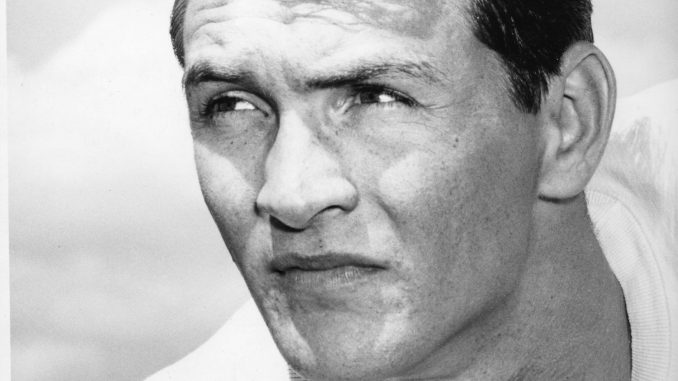
President Trump pardoned Billy Cannon and four other professional football stalwarts last week for offenses against the United States. Cannon again dominated headlines because of his compelling back story of magnificent athletic prowess, personal magnetism and uncommon redemption.
Eight years ago, there was a request in this space to President Trump to forgive counterfeiting sins committed by the man who catapulted LSU football into the modern era with Paul Dietzel, a telegenic coach who like Cannon, was saturated with charisma.
A representative with the U.S. Justice Department contacted me about the pardon request in 2018, months after Cannon’s death on May 20. The cleaning of the slate is complete for a man who participated in a caper which involved the printing of $6 million in $100 bills.
Cannon was fighting substantial debts related to poor investments when he discarded federal law and darted into criminal territory. With his blinding speed and brutal power, Billy frequently outran and outmuscled defenders on the field. When the U.S. Secret Service knocked on his door, he quickly pleaded guilty and served two and a half years in a Texas prison.
As the scandal erupted, he was perched in his undershorts on his kitchen floor when his longtime friend Boots Garland came to check on him and asked if he was okay. “Yeah Boots,” replied Cannon. “But do you have change for a hundred?”
Cannon lived life in the fast lane and was not averse to short cuts. After the 1960 Sugar Bowl against Ole Miss, he signed a $50,000 contract to play with the Los Angeles Rams, who had the first pick in the 1960 NFL Draft. Cannon was all smiles under the goal posts at Tulane Stadium as he inked the deal with Rams General Manager Pete Rozelle.
The Houston Oilers of the fledgling AFL then offered more money and Cannon signed with them. A judge ruled in Billy’s favor and scolded Rozelle, the future NFL commissioner for taking advantage of an unsophisticated country boy.
When Cannon’s pro career ended, the first LSU game he attended at Tiger Stadium was the 1972 clash when Bert Jones connected with Brad Davis on the final play to give LSU a 17-16 victory over Ole Miss, the second most memorable win over the Rebs in LSU history.
Cannon reached legendary status 13 years earlier against the Rebels when he raced 89 yards into the north end zone and wrote an indelible chapter in Death Valley with “The Run.”
After retiring from the game, Cannon was an accomplished orthodontist approaching middle age at 45. He detailed his financial woes to a neighbor, who was the LSU boxing undefeated lightweight champion in 1955.
John Stiglets, who had a history with federal gumshoes, was regarded as the most talented counterfeiter in the world. He was so good at printing phony money, the bills were almost undetectable. When some suspicious $100 bills started floating around Baton Rouge businesses, it did not take long to connect the scheme to Stiglets, who was living a few yards from Cannon.
Both men admitted guilt, served time and died in Louisiana. The end came for Stiglets at 75 in Zachary on July 9, 2005. The U.S. Army vet had been living at the Louisiana War Veterans Home in Jackson.
A lesson for men in financial distress is to not reside down the street from counterfeiting kings.
Cannon’s pro career was unheralded as he led the AFL in rushing in 1961, and as a tight end averaged 20 yards per catch and ten touchdowns for the 1967 Oakland Raiders, who went 13-1 and lost Super Bowl II to Green Bay.
Cannon ran 88 yards for a touchdown in the first AFL Championship Game on Jan. 1, 1961 as Houston beat the Chargers 24-16, two years removed from Cannon’s pass to Mickey Mangham to beat Clemson 7-0 in the 1959 Sugar Bowl. A year later, No. 20 scored the only touchdown in Houston’s 10-3 victory over the Chargers of Sid Gillman as the Oilers repeated as AFL champions.
That victory gave Cannon his third title in four years. LSU would have also won the 1959 NCAA crown if officials in Knoxville had not erroneously ruled Billy did not pierce the goal line on a two-point conversion attempt that preserved a 14-13 triumph for Tennessee to keep Dietzel and the Tigers from a second consecutive NCAA title.
Houston lost 20-17 in overtime in the third AFL Championship Game, meaning Cannon was six points from five straight titles. Billy was a competitor like few others, who was dispatched to the scrap heap in 1983.
Just as he was not to be denied on Halloween of 1959, the consummate winner was determined to never be branded as a loser in life.
Billy Cannon is no longer a convicted felon. Fifteen years ago, he was named by Tiger Rag the most influential athletic figure in the first 150 years of LSU. No. 20 retains his No. 1 distinction with a cleansed record.
Is Ben McDonald the New Shot Doc?
Bob Brodhead served nearly five years as LSU athletic director with the nickname “Bottom Line Bob.” An accountant by trade, Brodhead was a critic of deficit spending, but he told this writer the greatest truism in 1980s college athletics was, “You get what you pay for.”
This philosophy is evident in the current paths of LSU men’s and women’s basketball. The men’s program makes more than $2 million annually for the university while the women’s program loses almost $8 million a year.
Matt McMahon is fighting for survival with another subpar season while Kim Mulkey is a rock star with another national championship contender.
The recommendation here is for LSU President Wade Rousse to allow the men’s program to rack up the same deficit as Kim’s crew and see what happens.
Mulkey would be wise to invest in a free throw accuracy specialist. As a fantastic guard with national champion Louisiana Tech, Kim converted 64-percent of her free throws. LSU was at 61-percent in its 18th straight loss to South Carolina.
Mulkey is urged to assign former LSU baseball and basketball icon Ben McDonald to instruct her team on better performance. Big Ben was 19 of 21 from the line while playing for Dale Brown in 1987, that’s 90.5 percent.
Words of wisdom from the two-sport legend could help as LSU prepares for a possible post-season rematch with South Carolina. USC’s coach Dawn Staley was successful on more than 80-percent of her free throw attempts while playing at the University of Virginia. Her team connected at 88-percent in the Valentine’s night win over the Lady Tigers.
Be the first to comment