
Todd Horne Column
LSU’s $750,000 Tuneup
BATON ROUGE — LSU got its money’s worth, right down to the last snap. For $750,000, the Tigers bought an evening to polish their offense and brush up their defense, then turned a roster estimated to cost nearly $50 million loose on their Louisiana sibling from Lake Charles. McNeese State had a guaranteed payday and the prospect of a pardon from the sky. The forecast had promised lightning. None materialized to save the Cowboys from the wrath that became a 63–14 LSU victory.
The Tigers ran 101 offensive plays, more than any LSU team had ever run in a single game, and gained 731 yards, the second-largest total in school history. The old play record, 99 against Tulane in 1969, had endured through generations of coaches and offensive fashions. The yardage record, 746 against Rice in 1977, survived by 15 yards. LSU also collected 39 first downs, another school record, surpassing the 37 it had amassed against Clemson in September. The Cowboys had come to collect a check. The Tigers kept collecting opportunities to snap the ball.
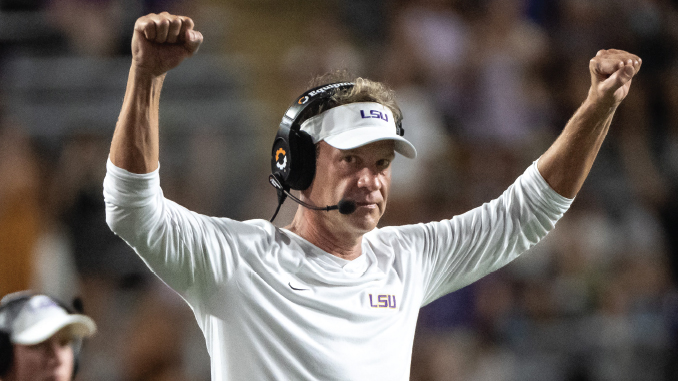
Even an invitation to shorten the evening found no sympathy on LSU’s sideline. Coming out for the second half with his team ahead 35–0, Lane Kiffin was asked whether he wanted a running clock in the third and fourth quarters. He declined, then challenged his players to keep playing physically and meet LSU’s standard, whether they belonged to the first team, the second or the third. “I don’t believe in that,” he explained afterward. His players would determine the ending: “We decide when the game’s over,” he said, through the way they played.
McNeese knew something about an early departure from Tiger Stadium. In 2015, lightning stopped the game after 4 minutes, 52 seconds of football, and the eventual cancellation left the Cowboys with their full guarantee. This visit required a complete evening’s labor. LSU rushed for 367 yards and passed for 364, a balance so tidy it looked as if somebody had drawn a line down the middle of the bill. The weather supplied no escape, and Kiffin had no interest in surrendering the work that remained.
There were seven reasons for his insistence, all of them SEC opponents. LSU is 4–1 overall and 1–1 in the league, with seven straight conference games left and four of them on the road, beginning Saturday at Kentucky. An open date on Halloween provides one remaining rest stop. Before the Tigers reach it, they must visit Lexington, host Mississippi State and travel to Auburn. Afterward come Alabama and Texas at home, followed by consecutive trips to Tennessee and Arkansas. The men receiving extra snaps against McNeese might soon be needed in circumstances considerably less forgiving.
“They’re going to need to play with the injuries that we have,” Kiffin said of his reserves. Establishing a lead and evaluating those players had been the point of the evening. He had removed starters early with health and depth in mind, and he said he did not think LSU had sustained any major injuries. On a team managing Sam Leavitt’s hamstring, the absences of Trey’Dez Green and Whit Weeks, and the season-ending loss of Dashawn Spears, that initial assessment was welcome. Jackson Harris had returned after limping off in the second quarter; Corey Barber Jr. had taken a hard hit late. The score had provided room to distribute the work.
Leavitt’s appearance required more care than his passing line disclosed. He completed 18 of 23 throws for 176 yards and three touchdowns, with one interception, and LSU reached halftime ahead 35–0, with a 347–31 advantage in yardage and 20 first downs to McNeese’s two. The quarterback could look comfortable throwing from the pocket without being comfortable moving beyond it. “He really didn’t move very much during the week at all,” Kiffin said. An efficient evening had not restored the full menu of plays.
Leavitt had been required to complete at least seven-on-seven work Wednesday before the staff would allow him to play. He had improved from the previous week, Kiffin said, but remained limited in what LSU could call. Offensive coordinator Charlie Weis Jr. adjusted plays to McNeese’s defensive looks and used protections the staff trusted to keep the quarterback from being hit. Kiffin also corrected the suggestion that Leavitt had played the entire first half. Landen Clark had taken work, including a 3-yard touchdown run, and Leavitt had returned for selected calls. His participation had been managed possession by possession and play by play.
Dilin Jones supplied the early weight of the running game, gaining all 79 of his yards and scoring his touchdown before intermission. Harlem Berry supplied its acceleration. His 46-yard run on LSU’s final touchdown drive of the half put the offense at the McNeese 16, and he finished with 125 yards and a touchdown on 15 carries. Berry had already been LSU’s No. 2 back against Texas A&M. Saturday extended his contribution while showing the coaches more of the running they had been asking him to produce.
The improvement, Kiffin said, was “getting vertical in the run game.” A young back accustomed to outrunning everybody can spend too much time trying to take each carry outside. Berry was learning to accept the opening in front of him. “Take what was there and get vertical,” Kiffin said of what he saw. He was pleased with how Berry had earned his opportunities, too: “Sometimes you get demoted,” the coach said, and the work must earn them back. LSU’s investment had assembled talent. The running back still had to demonstrate how he would use his.
Barber gave the passing game a young face to remember. The five-star true freshman caught seven passes for 83 yards and two touchdowns, securing every one of his seven credited targets. He converted a fourth down near the sideline in the first quarter and caught scoring passes of six and 12 yards in the second. Kiffin said two dropped touchdown opportunities had prompted the staff to put Barber in, and Barber performed well enough to start a subsequent series. He “stepped up and did a really good job,” the coach said. The recruiting stars had acquired useful company: catches, first downs and points.
Roman Mothershed supplied another answer in an offense adjusting to Green’s absence. Newly converted from receiver to tight end, Mothershed caught two passes for 11 yards, including the 1-yard touchdown that gave LSU a 14–0 lead. A game bought for polishing purposes had given the Tigers a chance to examine how the young receiver and the new tight end could help fill jobs that injuries had made more urgent. Their production would give the coaches something concrete to consider when the opponent could better contest those throws.
LSU answered Kiffin’s halftime challenge promptly. Deuce Geralds, the freshman defensive lineman who had already contributed a sack, took a direct snap and scored from a yard out to finish the opening possession of the second half. The defense forced a punt, and Berry’s 11-yard touchdown on the ensuing drive made it 49–0. Kiffin had praised that response in his brief SEC Network interview immediately after the game. In his press conference, he returned to the satisfaction of seeing his players emerge from the locker room ready to work instead of treating five first-half touchdowns as sufficient.
Geralds’ sack carried more weight for the season ahead. He now has five through five games, moving closer to LSU’s freshman record of 7.5 by Harold Perkins Jr. in 2022. Three more would put him beyond it. “I want to go crush that and get that record,” Geralds said after the game. His pursuit has seven regular-season opportunities remaining, all against SEC opponents, where an interior rusher must earn his way through protections designed to account for him.
Listed at 6-foot-1 and 285 pounds, Geralds is doing that work against older, larger blockers. Linebacker Davhon Keys had described the benefit earlier in the week: “They’re taking up doubles,” he said of the defensive line, and “we’re going through untouched half the time.” Geralds’ ability to occupy two blockers, defeat a protection or leave a linebacker free could help sustain LSU through the schedule ahead. Geralds credited older teammates, including Princewill Umanmielen, Stephiylan Green and Malik Blocton, with teaching him along the way. “They’ve been real role models to me,” he said.
The touchdown furnished a memory of its own. Geralds had handled that sort of offensive assignment in high school, but doing it in Tiger Stadium gave the familiar work a different weight. The true freshman from Suwanee, Georgia, had come to LSU to disrupt somebody else’s offense. For a yard, he got to finish a drive for his own. “I’m going to cherish that for the rest of my life,” he said afterward.
His excursion into the end zone had also sent Kiffin into LSU’s history. Before meeting reporters, the coach had asked whether a Tiger had previously recorded a sack and an offensive touchdown in the same game. The answer he received was Anthony “Booger” McFarland, who caught a touchdown pass against Florida in 1995 and shared a sack. Kiffin said he called McFarland to confirm the story and tease him about Geralds having a full sack to go with his score. McFarland reminded him that his opponent had been the Gators. Kiffin saved another observation for the room: “He did lose that day, though. We didn’t remind him.”
Umanmielen had supplied his own sack Saturday, bringing his season total to eight. Kiffin credited defensive coordinator Blake Baker’s movement, multiple looks and different fronts with helping him, and credited the player with better preparation. After uneven practice consistency a year earlier at Ole Miss, Umanmielen had put together a strong offseason and become a more focused, consistent worker. The staff had shown practice clips during the week of him chasing plays down, “playing a hundred miles an hour.” That pursuit gave the coaches something to trust beyond the opponent and the score.
The third quarter also gave them something to correct. McNeese turned a screen pass into a 43-yard touchdown and a misdirection run into a 64-yard score, both by Jamaal Levi. Those two plays accounted for 107 of the Cowboys’ 196 yards. A defense that had conceded two first downs in the first half had surrendered two touchdowns on plays demanding better work on the perimeter. Baker’s film would contain those mistakes alongside LSU’s three sacks, seven tackles for loss and long stretches of control. A 49-point victory could not erase either long gain.
Clark and Husan Longstreet likewise left an assortment of plays to study. They combined to complete 13 of 25 throws for 188 yards, and Longstreet added 32 rushing yards. Their work after Leavitt’s departure included the productive opening of the half, three consecutive third-quarter possessions ending in punts and the fourth-quarter recovery. The coaches got to examine what happened when the preferred answer at quarterback was out of the game, a useful exercise for a team whose preferred answer had spent the week struggling to move.
Stacy Gage supplied the recovery’s most emphatic work, scoring on fourth-quarter runs of 46 and 39 yards and finishing with 110 yards on only six attempts. Between them, Gage and Berry gained 235 yards and scored three times on 21 carries. Kiffin singled out both 100-yard performances and credited his reserve quarterbacks with making plays. LSU produced 384 yards in the second half, and its defense held McNeese scoreless in the fourth quarter. There was productive work well beyond the first names on the depth chart, along with enough interruptions to make the film useful.
Kiffin had not treated the matchup as permission to withhold every starter. The staff had shown the players a list of roughly 10 FCS victories over FBS opponents, including ranked teams. He wanted LSU to take the game seriously, establish control and then make room for the evaluations. Big wins are expected in such meetings, he said, but they are not automatic; neither is a good third quarter after a good first half. McNeese’s check guaranteed its payday. LSU’s preparation still had to deliver the intended return.
The records interested him chiefly for what it took to produce them. “We’ll break all these,” Kiffin said, but the appealing part was “the way that you play.” So much yardage meant many players had carried out their assignments successfully. He pointed to the previous week’s performance against Texas A&M as evidence that his satisfaction extended beyond overpowering an FCS opponent. “It means a lot of players are doing things well,” he said. Saturday had produced a substantial body of that evidence, spread across 101 offensive snaps.
He was equally willing to describe the other sort of victory, the one rescued by a late field goal, an opponent’s turnover or a failed two-point try. Such a result could put a win on the schedule without persuading him that LSU had outplayed or outcoached the other team. He expected there would be a day when he would say so. Saturday allowed a more satisfying assessment: “The players are prepared really well, and they’re executing really well.”
Four of LSU’s first five games have been played in Tiger Stadium. Its one trip ended in a 32–24 loss at Ole Miss. The Tigers responded by beating Texas A&M 35–6, then used McNeese to give young receivers, running backs and reserve quarterbacks more work. At Kentucky, they will begin finding out how much of that improvement travels. The Wildcats will be coming off a 35–34 overtime victory over South Carolina. The assignments will have to be executed in Lexington, then repeatedly through the final stop in Fayetteville, with fewer chances to repair a mistake before it becomes consequential.
LSU had paid $750,000 for the chance to polish its offense and brush up its defense. It received a school record for plays, another for first downs, the second-largest yardage total in its history and a longer list of players who had made a case for more work. McNeese received its guarantee, endured the full evening and never got the lightning that might have shortened it. Kiffin would not shorten it himself. He needed the snaps. Seven SEC games remain, four on somebody else’s field, and the first of them arrives Saturday.
Be the first to comment