
By ANDRE CHAMPAGNE, Tiger Rag Staff Reporter
Izzy Besselman arrived at the LSU women’s basketball facility for a light practice in the fall of 2024.
But she struggled from the moment she began stretching. She felt extreme fatigue and soon turned blue in the face, prompting trainers and the team doctor to send her to the hospital. After several visits to multiple doctors and hospitals throughout the next 10 months, Besselman finally got answers in the summer of 2025 during a trip to the Cleveland Clinic in Ohio.
“They gave me an echocardiogram, and they put me to sleep and did a scope of my heart – all those types of things just to kind of rule out there was nothing structurally wrong with my heart,” Besselman, a senior guard from Episcopal High in Baton Rouge, told Tiger Rag in a recent interview.
Doctors diagnosed her with Inappropriate Sinus Tachycardia (IST), which causes the heart to beat rapidly without a clear reason. The condition falls under Dysautonomia, a nervous system disorder that can cause the heart rate to spike or drop unpredictably. Both are commonly associated with Postural Orthostatic Tachycardia Syndrome (POTS).
Baton Rouge Internal Medicine physician David Fontenot said POTS affects the body’s ability to regulate blood flow when standing. When someone with POTS moves from sitting or lying down to standing, their
heart rate can increase by 30 beats per minute or more without a significant drop in blood pressure.
Besselman said symptoms vary from day to day, and living with the condition is a constant challenge. Particularly since she is not able to play for the No. 5 and No. 2 seed Tigers (27-5), who begin play in the first round of the NCAA Tournament on Friday (5 p.m., ESPN) against No. 15 seed Jacksonville (24-8) at the Pete Maravich Assembly Center.
“It’s so weird,” Besselman said. “Some days I wake up and it feels like I’m in quicksand, where I just can’t move, where my body just cannot get going. I still have days where I feel just awful, and I have no energy. I’m tired no matter how much I sleep. It’s like when you have the flu, and you just have that fog. That’s something I deal with. You’re just kind of moving in slow motion. And I still have the heartbeat rises and the dizzy spells and numbness in my hands.”
Although doctors didn’t immediately rule out basketball last year, they warned her how difficult living with the condition could be. Besselman ultimately stepped away from the game to focus on her health. The decision was heartbreaking. The 5-foot-10 shooting guard entered her senior season in 2025-26, but wouldn’t be able to play in games.
“It was very difficult, especially when I would have played a lot of minutes,” she said. “I just watch them have so much fun, whether we’re up by 40 or in a tight game. That was hard to watch.”
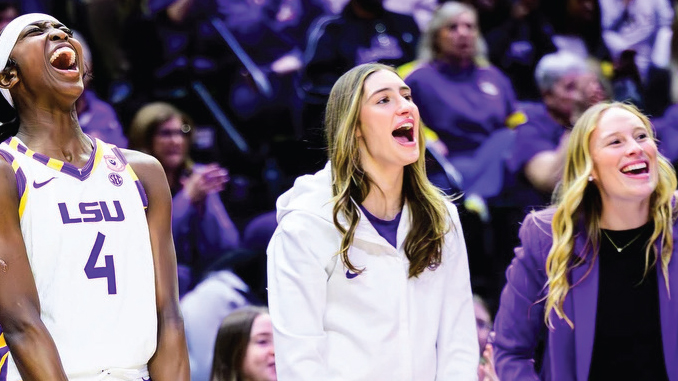
Instead of stepping away from the team entirely, Besselman found other ways to contribute. She attends every shoot-around, film session and practice and contributes on game days.
“I’m keeping stats, and I’m holding the little play cards,” she said. “And I’m seeing, ‘Oh, we need to reverse the ball here. We need to run this,’ and that is something I take very seriously. Any way that I can help, and I think that they value that.”
They do. LSU coach Kim Mulkey and staff have asked for her input on game preparation and in-game decisions. She’s an important voice on the team.
On senior night against Tennessee, Besselman surprised her family and the fan base by playing one last time in a brief appearance.
“I talked to coach Mulkey before, and she was like, ‘Can you go in for a little bit? I’m not going to put you in there for long. Just let the fans recognize you.’ And I was like, ‘Yeah,’” Besselman said.
“So, I put on my uniform, but I didn’t tell my parents. I kind of wanted it to be a surprise,” she said. “And they were. My dad was crying, my mom was crying, and coach Mulkey knew how much it meant to me and my family.”
The moment meant more than just returning to the court. Besselman hopes it serves as a message to others facing adversity.
“I just want to be a good example for all the little girls and guys all over the world, but really in Baton Rouge – just that you can do that,” she said. “You can dream, and you’ll have obstacles. You’ll have adversity, but to just stick through it. I think that that moment coming back to the court kind of showed
people that things might not always go your way, but you’ve just got to keep fighting.”
Even though she can no longer play basketball, Besselman has developed an interest in coaching after graduation – a path she never imagined pursuing until after her diagnosis.
“I’m interested in staying around the sport, staying around sports in some capacity,” she said. “I’m going to finish my master’s, and I’ll be here for another year, so definitely that’s something in the future I wouldn’t be opposed to.”
Be the first to comment