
By GLENN GUILBEAU, Tiger Rag Editor
Apparently, the “Ruston Rifle” was just that.
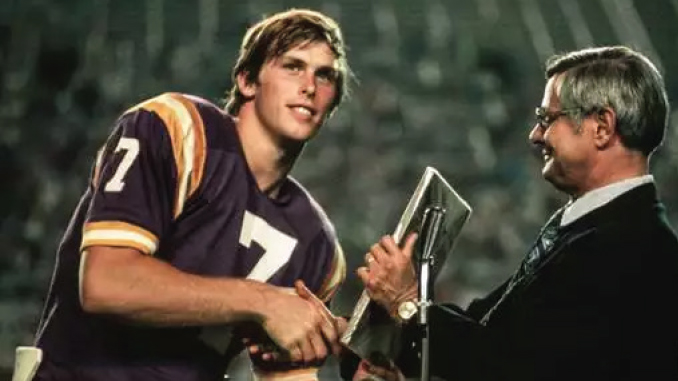
Bert Jones, who became LSU’s first All-American quarterback in 1972, was from Ruston and given the rifle nickname when playing for Ruston High School in the late 1960s.
And while at LSU, Jones went out to an empty Tiger Stadium with friends and teammates on occasion to “toss” the football around.
“Yes, I could throw it 100 yards,” Jones told Jim Engster, host of the statewide “Talk Louisiana” radio talk show, when asked on Friday morning’s show. The show will be repeated at 9 p.m. Friday statewide on stations that carry the show or by clicking below:
LISTEN TO BERT JONES ON “TALK LOUISIANA” WITH JIM ENGSTER
And Jones said he threw the football 100 yards “multiple times on multiple bets.”
Engster said he previously confirmed the 100-yard passes via eyewitnesses who were LSU teammates of Jones – running back Al Coffee, wide receiver Ben Jones, who is Bert’s younger brother, and kicker Mark Lumpkin.
Engster said one of the eyewitnesses told him Jones actually threw it from one goal line past the other and into the end zone of Tiger Stadium.
“Yeah, I think that was at an intramural throwing contest that we had,” Jones said. “I went out and did that, and I think it was 106 or 107 yards. And so, yes, I set the record.”
In front of a full Tiger Stadium and other Southeastern Conference stadiums and the like, Jones threw shorter distances for a then-LSU record 3,255 career passing yards from 1970-72. He also left LSU as the career leader at the time in touchdown passes with 28, attempts with 418 and completions at 220. Jones helped lead the Tigers to a 26-6-1 record in his three seasons with the SEC championship in 1970 at 9-3 and 5-0 in the league. LSU was 9-3 and 3-2 in 1971 and 9-2-1 and 4-11 in 1972 before Jones became the second pick of the NFL Draft by the Baltimore Colts.
As reported Wednesday, Jones’ No. 7 will be ceremoniously retired and his name and number will be placed on Tiger Stadium’s south side facade on Nov. 14 when the Tigers host Texas. He will join the other LSU greats already represented on the facade – 1959 Heisman Trophy winning running back Billy Cannon (No. 20), 1962 Heisman runner-up running back/returner Jerry Stovall (No. 21), defensive back/returner Tommy Casanova (No. 37), who was LSU’s only three-time All-American from 1969-71, and 1977 and ’78 All-American running back Charles Alexander (No. 4). Only Cannon’s No. 20 is actually retired and cannot be worn by other players. The other numbers have continued to be worn by other players.
“This is really a big deal in my mind,” Jones, 74, told Engster. “There is nothing greater. And I’ve received a lot of accolades and had a lot of good things happen to me. Some of them were part of my doing, but most of them were because of my surrounding cast of supporters. But this is the top of the ladder. Just being in the ring of honor with the great players – Billy and Jerry and Charles, and especially my roommate, Tommy Casanova. This is as big as it gets in my world.”
Jones went on to become one of the best quarterbacks in the NFL during his time from 1973 through 1981 with the Colts before ending his injury-riddled career with the Los Angeles Rams in 1982. Jones is the last LSU player to win the Associated Press’ NFL Most Valuable Player Award, which he did in 1976 when he led the NFL in passing yards with 3,104 and threw a career-high 24 touchdowns.
The only other A.P. NFL MVPs from LSU are quarterback Y.A. Tittle (1944-47 at LSU) in 1963 with the New York Giants and running back Jim Taylor (1954, ’56-57 at LSU) in 1962 with the Green Bay Packers. Tittle also won the award in 1963, but not by the A.P. The Sporting News and United Press International named Tittle in 1962.
“I can say I was the best in the business at the time I was there,” Jones said. “It is what it is. It was a lot of fun.”
And few can say they could heave it 100.

Be the first to comment