
Tiger Rag
The Bible of LSU Sports
Todd Horne’s Pick
Why LSU Will Survive Oxford’s Fury, Then Break Ole Miss, 47–21
The Rebels have the home field, the more proven backfield and a former Kiffin lieutenant who knows where LSU can be hurt. The prediction here still calls for a rout—but only after the most dangerous portion of the night has passed.
OXFORD, Miss. — Nobody does hate quite like the Southeastern Conference, and perhaps nobody has ever spent 293 days fermenting it as deliberately as Ole Miss has for Lane Kiffin.
The get-in price for Saturday night has climbed north of $600. ESPN’s “College GameDay” will spend the morning in the Grove. Mississippi is assembling the largest law-enforcement presence in the state’s college-football history. Princewill Umanmielen was served with court papers outside LSU’s football facility four days before kickoff. A national fan map made Louisiana look almost alone. LSU quarterback Sam Leavitt began Wednesday as doubtful, moved to questionable Thursday and disappeared from the SEC availability report altogether Friday night. In the conference’s reporting language, that means he is available. A top-10 football game spent 48 hours as an amateur investigation of Kiffin’s intentions before its largest uncertainty vanished.
The ugliest people involved dragged Kiffin’s daughter, Landry Kiffin, into it with vulgar banners that crossed the line between rivalry theater and cruelty. The rest of Oxford has prepared something more traditional for her father: three hours of concentrated noise, contempt and grievance.
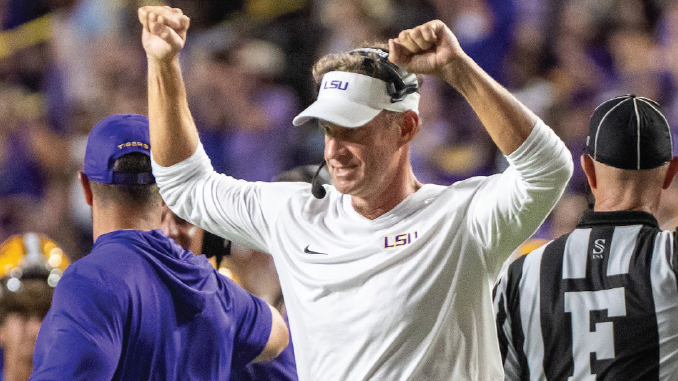
This is No. 7 LSU against No. 8 Ole Miss at 6:30 p.m. Saturday on ABC, but the rankings barely begin to explain the temperature. Kiffin left Oxford after leading the Rebels to an 11-1 regular season and their first College Football Playoff appearance. Ole Miss promoted defensive coordinator Pete Golding and advanced to the national semifinal without him. Kiffin took the LSU job, his offense, eight members of his initial 11-man group of coaching additions and four former Ole Miss players.
Count beyond the on-field coaches to include analysts, strength personnel, administrators, recruiting employees and players, and 34 people moved between the two programs after last season—25 from Ole Miss to LSU and nine in the other direction. This is not merely familiarity. It is football espionage made legal by employment contracts and the transfer portal.
The market sees a field goal. LSU was favored by 2½ points at the time of this writing, with a total of 57½. The prediction here sees something much larger: LSU 47, Ole Miss 21.
That score does not dismiss the home field or Ole Miss’ talent. Its largest medical qualification was removed Friday night when Leavitt came off the report. LSU will have its starting quarterback. Linebacker TJ Dottery remains questionable, and his availability still bears directly on the predicted margin. If Dottery cannot move laterally and strike through contact, Kewan Lacy’s path through the middle of LSU’s defense becomes much cleaner. But the premise no longer rests on two uncertain stars. Leavitt is available, stabilizing both Kiffin’s offense and the pick.
The remaining health contingency is Dottery. LSU can win without him, but a 26-point margin becomes harder to defend if its best interior linebacker cannot play. The 47–21 prediction also depends on LSU surviving the first quarter, because the opening 15 minutes will be the most dangerous stretch of the night.
Ole Miss has a real way to win
Vaught-Hemingway Stadium will not be decorative noise. It will attack LSU at the point where Louisiana Tech found weakness: communication in pass protection.
LSU surrendered five sacks last Saturday. Its failures were concentrated at guard, right tackle and running back rather than spread evenly across the line. Left tackle Jordan Seaton earned an 89.1 PFF pass-blocking grade, but right tackle Weston Davis finished with a 43.3 overall grade before leaving with an injury. Running back Dilin Jones received a 27.2 pass-blocking grade over nine protection snaps. The sample is small. The invitation it gives Golding is enormous.
Golding spent three years hearing Kiffin identify the pressures and coverages he least liked facing. He can put six defenders near the line, rush four and make LSU determine which two are leaving. He can threaten both interior gaps, drop one defender and bring another from the edge. He can force the guard, tackle and running back to exchange assignments while 65,000 people make ordinary communication feel like a transgression.
If LSU falls behind the chains, Leavitt begins taking hits and the Tigers commit the kind of four-turnover half they produced against Louisiana Tech, the Grove will not become a burden to Ole Miss. It will become a power source.
The Rebels also own the most accomplished offensive backfield LSU has faced. Trinidad Chambliss led the SEC with 3,937 passing yards last season. Lacy ran for 1,567 yards and 24 touchdowns. Against Charlotte, Chambliss produced a 91.0 PFF passing grade, while Lacy earned an 85.7 rushing grade. Tiger Rag’s snap-weighted analysis gave Ole Miss the advantage at quarterback, running back, receiver and offensive line.
Ole Miss can win by keeping Lacy ahead of the chains, making LSU’s safeties descend toward the box and forcing the Tigers’ cornerbacks to defend Caleb Cunningham and Deuce Alexander without dependable help. Chambliss is mobile enough to punish a pass rush that loses lane integrity. He ran for 71 yards against LSU last season, and mobile quarterbacks have repeatedly stressed Blake Baker’s defense.
Ole Miss has already won a close game against a ranked opponent, beating Louisville 41-38 after driving into position for a 48-yard field goal on the final possession. That experience matters. So does a 13-game home winning streak. Anyone predicting an LSU rout without acknowledging those facts is writing a wish, not an argument. The argument for 47–21 begins where Ole Miss’ best path ends.
LSU can attack without gambling
Baker spent his first two LSU seasons manufacturing pressure because his defense could not consistently create it with four rushers. Every additional blitzer removed a defender from coverage and exposed the middle of the field. This season, LSU can threaten the quarterback without repeatedly borrowing from the secondary.
Umanmielen has five sacks through two games. He generated six pressures and three sacks against Louisiana Tech. Defensive tackle Deuce Geralds earned a 92.3 overall PFF grade and created four pressures in 29 snaps. Dottery earned a 95.1 overall grade, forced two fumbles and did not miss a tackle. Whit Weeks graded at 82.6, while safety Tamarcus Cooley finished at 87.4 overall and 88.7 in coverage.
Those numbers came against offenses that do not resemble Ole Miss, and they should not be treated as prophecy. They do reveal the shape of LSU’s defense. Its best players occupy the middle: Geralds inside, Dottery and Weeks behind him, Cooley above them. Baker does not need to empty the back end to become aggressive. He can move Umanmielen before the snap, place Geralds over Ole Miss center Brycen Sanders—the most accessible piece of the Rebels’ highly graded offensive line—and make Chambliss reset the protection.
LSU does not need six sacks. It needs Chambliss to move his feet before he intends to. A quarterback with a 91.0 passing grade will not be defeated by coverage alone. The internal clock must change. One hurried throw on third down can remove the field from Lacy, quiet the stadium and give Kiffin the possession on which the game begins to tilt.
Baker’s restraint is especially important against Chambliss. The Tigers must rush without opening escape lanes, set the edge without chasing the first fake and keep enough eyes behind the front to tackle the quarterback when he pulls the ball. LSU’s defensive advantage is not that it can create more chaos. It is that, for the first time in Baker’s tenure, it may be talented enough to create chaos while remaining structurally sound.
The 6-foot-7 answer to Golding’s questions
LSU’s offense does not enter Oxford without visible defects. The Tigers struggled to run against Louisiana Tech when Leavitt’s yards and one 46-yard Jones carry are removed. They repeatedly failed to create movement near the goal line. Leavitt has thrown four interceptions in two games, including three last Saturday. He no longer carries an injury designation, but a quarterback who spent Wednesday and Thursday on the official report should not be asked to rescue every possession on third-and-long.
LSU does not need another 309 rushing yards, the number it produced while demolishing Clemson. It needs four dependable yards on first down. It needs enough interior movement to keep Golding from turning every passing situation into an exam on LSU’s protection rules. Ole Miss ranks No. 103 nationally in rushing defense at 152.5 yards allowed per game. That is an opening, not a guarantee.
The more distinctive answer is Trey’Dez Green. At 6-foot-7, Green is too long for most safeties at the catch point and too fluid for most linebackers through the seam. He caught six passes for 104 yards against Louisiana Tech and produced six first downs. Ole Miss safety Edwin Joseph earned a 35.1 coverage grade against Charlotte. Anthony Robinson III and Andy Jaffe were better, but neither presented the kind of individual answer that should persuade Kiffin to leave Green attached to the formation and play conventionally.
Green can become a coverage detector. Send him across the formation before the snap. If a safety follows, Leavitt receives evidence of man coverage. If a linebacker widens, LSU can run into the space he abandoned or send Green vertically beyond him. Split Green outside and Ole Miss must choose between a smaller corner at the catch point and a safety rotation that changes the coverage available against LSU’s receivers.
Golding knows Kiffin’s preferences. Green gives Kiffin a way to make Golding disclose his answer first.
That is how LSU can keep Leavitt out of the obvious passing situations where the crowd and Golding become most dangerous. Move Green. Change the formation without changing the personnel. Throw early on a run look. Run behind Seaton when Ole Miss widens to account for Green. Use Winston Watkins Jr., one of the former Rebels, in space against defenders who know exactly how fast he is and still must tackle him.
Kiffin has participated in this kind of separation against elite opposition before. As Alabama’s offensive coordinator, his teams beat No. 8 Georgia 38-10 in 2015, shut out No. 3 Michigan State 38-0 in the College Football Playoff and beat No. 9 Tennessee 49-10 in 2016. His No. 11 LSU team opened this season by dismantling unranked Clemson 51-10.
Those games do not predict this one. They establish that 47 points against a highly regarded opponent is not alien to a Kiffin offense once the defense begins providing extra possessions and the play caller gains control of the sequence.
Why a close game can become a rout
The prediction is not that Ole Miss will enter Saturday intending to surrender. It is that the emotional structure around this game becomes dangerous for the Rebels if LSU survives it and then creates separation.
For nine months, Ole Miss has been told that this is the night it can punish Kiffin, validate Golding, defend Oxford and reclaim the story. That emotion can sharpen a team. It can also consume oxygen. If Ole Miss leads or remains within one possession, the crowd carries some of the load. Every stop becomes an exorcism. Every Lacy run confirms the story everyone arrived hoping to tell.
But imagine LSU leading by 10 in the third quarter. Imagine Umanmielen beating a former teammate for a sack, Green converting another third down and Watkins turning a short throw into a touchdown in front of people who once cheered him. The emotion does not disappear. It changes direction.
The crowd begins waiting for rescue. Ole Miss players begin feeling not only the score but the accumulated expectation attached to it. Golding must coach the game in front of him while the stadium reacts to the game it fears. Chambliss presses for the explosive play. Lacy gets fewer carries because the clock has become an opponent. LSU’s front stops defending the entire playbook and begins hunting the passer.
Football teams do not usually quit through a collective decision. They quit by fractions.
Football teams do not usually quit through a collective decision. They quit by fractions. A pursuit angle widens. A receiver’s clear-out route loses two steps. A lineman remains on the ground an extra second after the whistle. A tackle becomes a lunge. A safety who spent the first half arriving with violence begins arriving with his arms.
That is not an accusation of cowardice. It is what physical exhaustion, scoreboard pressure and collapsing belief can look like when they appear together. The margins are almost invisible until every fraction joins the next one and a close game no longer behaves like a close game.
LSU is built to make those fractions compound. Its defensive line can force hurried possessions. Its offense can play at tempo after a first down. Kiffin will not become sentimental if the score opens. The most unpopular man in Oxford will understand that allowing the game to become quiet is safer than allowing it to remain dramatic.
Ole Miss’ best opportunity arrives early. Golding must confuse LSU’s protection, Chambliss must turn Baker’s discipline against him and Lacy must keep the Rebels out of obvious passing downs. LSU must protect the football, establish just enough of a running game and prevent the first emotional wave from becoming a two-score deficit. If LSU fails there, Oxford may carry Ole Miss through four quarters and the Rebels may win the taut, ugly game the betting line anticipates.
The prediction is that LSU will not fail there. With Leavitt cleared, the Tigers will absorb the opening noise, use Green to identify Golding’s intentions and gradually make the Rebels defend the entire width of the field. Umanmielen and Geralds will disturb Chambliss without Baker sacrificing the structure behind them. Ole Miss will remain dangerous into the third quarter. Then LSU will produce the possession—and the defensive stop—that changes the emotional force inside the stadium.
Once LSU separates, Ole Miss will begin going through the motions so gradually that no single player will recognize the moment it started. Kiffin will recognize it. He has spent his career searching for that moment, the instant when an opponent stops solving problems and starts enduring them.
That is where a 2½-point road favorite becomes a 26-point winner. The pick: LSU 47, Ole Miss 21.
Be the first to comment