
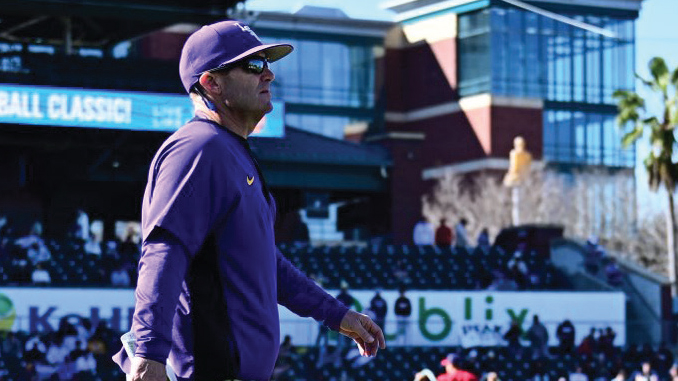
By GLENN GUILBEAU, Tiger Rag Editor
At the moment, there is no place else in the world that Jay Johnson would rather be professionally than coaching the baseball team at LSU.
He won two national championships in his first four years as LSU’s coach. And he has an excellent chance of winning his third in his fifth season this year. The Tigers are ranked No. 1 in the nation and are 8-0 going into Tuesday night’s game against McNeese State (6:30 p.m., SEC Network+).
This season, Johnson could be the first repeat national champion in college baseball since South Carolina’s Ray Tanner in 2010 and ’11 and LSU’s first since his idol and mentor Skip Bertman in 1996 and ’97.
And at only 48, it is simply realistic to project that Johnson could pass Bertman and former Texas and Cal State Fullerton coach Augie Garrido in national championships as each have five for second place on the all-time list behind USC’s Rod Dedeaux, who won 10 between 1958 and ’78. And it’s not unrealistic to think he could pass Dedeaux as well.
Johnson is the highest paid college baseball coach in the country at $3.05 million a year, according to his new seven-year contract as of last fall. He will make $3.65 million in the last year of that deal.
But Johnson’s program may not be at the top of the country or the Southeastern Conference in roster spending in the early stages of the new annual $20.5 million revenue share. At LSU, as advised by the SEC office, football is to be receiving 75 percent, men’s basketball 15 percent, women’s basketball five percent and all the other sports get a concoction of the remaining five percent.
“It’s a really hard topic,” Johnson told Tiger Rag in an extensive interview recently. “What I’m going to say is, school’s are going to decide what sports they want to excel in.”
Asked if they have already been doing that, Johnson laughed and said, “Tough question. But all I’m going to say is schools are going to have to decide what sports they want to be really good in. And there are some schools that are all in on baseball. And we need to be one of those schools. We’re not there yet.”
By this fall or winter, Johnson should have his answer, and he will need to know that for his next recruiting class. And he believes he needs to be “one of those schools” if he is going to keep LSU at dynasty level.
Deep Dive Interview with new LSU Athletic Director Verge Ausberry on Lane Kiffin hire, Matt McMahon status and deficits:https://t.co/8dRUPywjHy
— Glenn Guilbeau (@SportBeatTweet) February 19, 2026
LSU athletic director Verge Ausberry, also in a recent interview with Tiger Rag, said LSU was in the process of deciding the pecking order of sports at LSU.
“Don’t know yet,” he said. “That’s going to be over time and about who’s winning and doing well and who’s not. When you prioritize these things, you’ve got to sit there and say, ‘Hey, look, what are we going to be great at? What do we have to be great at?’ And that’s the football team. Kim Mulkey can take care of herself, Jay Johnson can take care of himself, Jay Clark can take care of himself.”
Women’s basketball coach Kim Mulkey (LSU national champion in 2023), gymnastics coach Jay Clark (LSU national champion in 2024) and Johnson (LSU national champion in 2023 and ’25) actually can’t take care of themselves for long, though, if they fall behind in roster money from revenue share and LSU’s various donor sources.
“We’re looking at what are we going to be successful at?” Ausberry said. “How are we going to be successful? And what is it going to cost us? And that’s very important. We have to realize there is donor fatigue. There is NIL-donor fatigue, ticket prices fatigue from our customers. We can’t just keep going up, going up and asking donors for this and that. We’re straining the whole system. This system we’re sitting in today is not sustainable. Not at all.”
What could hurt LSU Baseball’s future in this new world of roster budget crunches because of Name, Image & Likeness and revenue share is its success. LSU Baseball has been so dominant under Bertman (1991, ’93, ’96, ’97 and 2000 national champions), Paul Mainieri (2009 national champion, 2017 runner-up) and Johnson (2023 and ’25 national champion) that LSU powers may decide that program is so good, it doesn’t need as much help. Hence, Ausberry saying, “Jay Johnson can take care of himself” along with Mulkey and Clark.
“Baseball doesn’t make a lot of money,” Ausberry said. “Jay is the highest paid coach, which is deserving. But the program’s not much in the black, or right under, which is still a win. What he does for LSU and its brand is very important. LSU baseball loses money because of his salary, because it’s so high. But it makes itself up, and we get close to it (a profit). So, that’s a win, because other baseball programs lose a few million a year. You’ve got to look at it as how close you are to that bottom line.”
The problem with LSU Baseball is that of all the programs at LSU, if you had to pick one that would likely still succeed very much with less money, it would be baseball. LSU still gets players baseball players because of the LSU Dynasty, The Intimidator, Alex Box and the accurate ongoing perception that LSU is THE baseball program in the country.
But going into the 2025 season, LSU still lost several elite players to other programs because they were offering more money to players in the portal – left-handed pitcher Liam Doyle to Tennessee from Ole Miss, first baseman Andrew Fischer to Tennessee from Ole Miss, infielder Gavin Kilen to Tennessee from Louisville, left-handed pitcher Zach Root to Arkansas from East Carolina and left-handed pitcher Landon Beidelschies to Arkansas from Ohio State.
LSU still beat all of the above on the field last season anyway – Tennessee, two games to one in Alex Box, and Arkansas, two games to one in Alex Box and a two-game sweep in Omaha. And maybe LSU will keep on winning in such fashion even if it continues to lose a top player here and there. Maybe.
But there is another factor could hurt LSU down the road. In the process of deciding what sports to be really good at, as Ausberry said, some SEC programs have come to the conclusion that it can’t win a national championship in football. Those are Mississippi State, South Carolina, Vanderbilt and Arkansas, which are most often mediocre in football. And they want to pour more of the revenue share and other sources into another sport in which it can win a national championship – like baseball. All of the above but Arkansas have won national titles in baseball since 2011, and Arkansas is usually a threat to win it all in baseball.
Those schools could pose serious threats to LSU Baseball, which could be lagging seriously behind each of them in roster dollars. Because LSU obviously believes it can still win football national championships, having just won one in the 2019 season and expecting to contend for its fourth since 2003 in the near future under new coach Lane Kiffin.
Ausberry has a problem with schools that decide to cut their spending on football and put more in the others.
“If you’re not putting it into football, and I’m going to go ahead and say this,” Ausberry said. “You know what, then maybe the top schools (putting the money into football) need to get a portion of the distribution from the schools not going as heavy into football. Football drives the show. It’s not even close.”
Depending on how the money at LSU is distributed over the next few years and how much is available to Johnson’s roster could alter just how good the LSU Baseball coaching job is.
“We’re not there yet,” as Johnson said above.
If LSU wants to keep Johnson, it better get “there” soon.
Or the best place to be a college baseball coach in the country in a few years could be at another place – perhaps in another conference – that doesn’t spend as much on football and can spend a lot on baseball and more than, say, LSU.
So, there’s that.
And meanwhile, suddenly college baseball coaches are attractive to Major League Baseball.
Former Tennessee coach Tony Vitello, a major Johnson rival who won the 2024 national title, just last fall became the first sitting college baseball coach in history to become an instant MLB manager as he is now leading the San Francisco Giants.
“I think it’s great,” Johnson said. “Him going to MLB is great, because I think the connection between the college game and the professional game is closer and tighter than it’s ever been. And I hope he has success.”
And if Vitello does win or maybe even if he doesn’t, do not be surprised if another MLB team in a year or two or three looks to three-time national champion LSU baseball coach Jay Johnson as a potential new manager.
“The follow-up to that is,” Johnson laughed, “I’m very happy with what I’m doing. And I’m exactly where I should be in my life right now. And I’m OK with that being out there. And that’s why the revenue share thing is important to me. Because I put my chips in (with his last contract) before LSU has made a real commitment in this new era of college baseball. And so, I’m hopeful that LSU will do the same thing. Like, I want to do this. This is what I want to do.”
Ausberry knows the challenge to keep Johnson could happen.
“We just saw the Tennessee baseball coach go to Major League Baseball,” he said. “We’ve never seen that before. That could happen with Jay. That could be a new thing. MLB might start trying to get great college coaches. We have to be prepared for it. If that time comes, that would be a decision Jay would have to make – LSU or Major League Baseball.”
Or, LSU or another college baseball program that makes “a real commitment in this new era of college baseball.”
Be the first to comment