
By GLENN GUILBEAU, Tiger Rag Editor
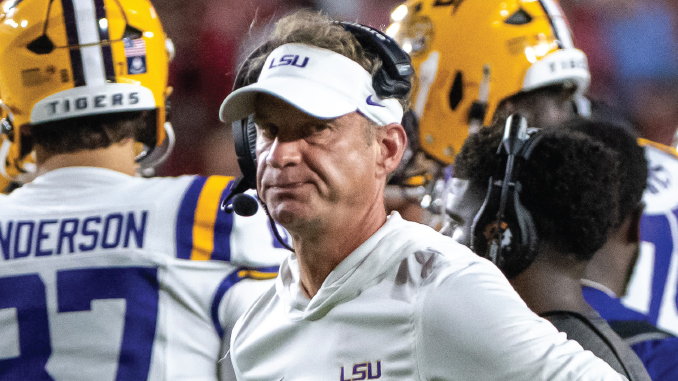
Lane Kiffin sounded like a man going through winning withdrawal on Sunday during his weekly teleconference with reporters.
That’s what a 6-5 detoxifying record will do to someone who was 11-1 last year at Ole Miss, 10-3 and 11-2 the previous two seasons there with an 8-5 in 2022 and a 10-3 in 2021. He was also 11-3 and 10-3 in two of his three years at Florida Atlantic and never won fewer than seven games in in three complete seasons at USC.
LSU (6-5, 3-5 Southeastern Conference) will mercifully end Kiffin’s first season with the Tigers at Arkansas (4-7, 2-6 SEC) on Saturday (11:45 a.m., SEC Network). It’s his worst season since going 5-5 during the COVID year of 2020 in his first season at Ole Miss. The Tigers lost their third straight game on Saturday at No. 9 Tennessee, 27-13. Kiffin has not lost three in a row since he lost four straight to end the 2022 season at Ole Miss.
“It’s really fun when you win, and it’s really not when you don’t,” he said Sunday. “Winning is like a drug, man. It can take you right up to the sun.”
Lane Kiffin’s F-ing 1st F-ing season at LSU continues as he’s headed to a F-ing F grade. https://t.co/930zDgBe7V
— Glenn Guilbeau (@SportBeatTweet) November 23, 2026
Winning at Ole Miss made Kiffin the most sought after college football coach in the country at this time last year as Florida State, Florida and LSU were trying to hire him at about the same time. And Ole Miss was trying to keep him. He is now the third highest paid college coach in the country at $13 million a year behind Georgia’s Kirby Smart (13.28 million) and Indiana coach Curt Cignetti ($13.2 million), according to USA Today.
“And it can leave you there and let you burn,” said Kiffin, whose team tumbled from No. 7 in September to out of the polls completely by mid-November.
“And for some reason, you want to go do it again and chase it again and again,” he said. “That’s part of what comes with it, and that’s why we try to surround ourselves with and keep surrounding ourselves with people like that.”
In this age of Name, Image & Likeness collectives paying many college players several million dollars a year, including several at LSU now, Kiffin is looking for players who still value winning as much as he does, regardless of how much money they make.
“People like Trey’Dez Green, who’s crying outside the locker room 30 minutes after the game (Saturday), because that’s how much it means to him to lose,” Kiffin said of his junior tight end. “And the hatred of that feeling of losing.”
Kiffin is taking solace in the fact that three of his five losses were by eight points or less, including a 22-21 loss to No. 6 Texas on Nov. 14 and a 35-34 overtime loss at Kentucky on Oct. 10. And in four of the five losses, LSU was ahead or tied in the fourth quarter – 24-24 at Ole Miss before 32-24 loss, ahead 27-24 at Kentucky before losing 35-34 in overtime, ahead 21-16 against Texas before losing 22-21 and tied 13-13 at Tennessee before losing, 27-13. And LSU led Alabama, 13-10, late in the third quarter before losing, 31-13.
“That’s why this season is so frustrating,” Kiffin said, “because I think if you would’ve said “6-5″ at the beginning of the year, you would’ve said, ‘Man, we must really be a bad team. And probably bad on offense and defense and really missed on a ton of players (in the portal) and got to restart the whole thing.’ And fortunately, it’s not. We were tied or ahead in (four of the five losses) in the fourth quarter. You wouldn’t guess that at 6-5. We don’t have a whole program problem of evaluation, of motivation, or of how guys start games. We have a fourth quarter problem. We have an end of game problem that we’ve got to fix.”
And Kiffin pointed inward.
“That starts with the head coach and coaching and finding different ways to motivate and coach better to close out games,” he said. “I’m glad that’s the problem versus if we were like, ‘Hey, we’ve got to learn how to start. We’ve got to get totally different players. We can’t play with the top teams.’ We’re right there with three of the top seven teams (Alabama, Texas and Tennessee) when the next (College Football Playoff) poll comes out. So, we’ve got to win them next year.”


Be the first to comment