
By GLENN GUILBEAU, Tiger Rag Editor
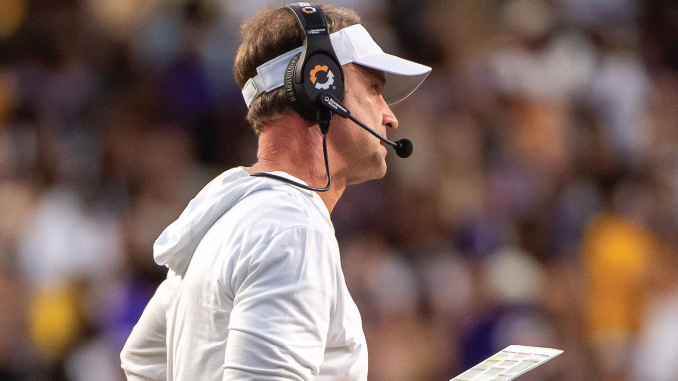
It has been a “F-ing” rough season for first-year LSU football coach Lane Kiffin.
Video has surfaced of the LSU Radio Network booth during LSU sideline reporter Gordy Rush’s halftime interview with Kiffin shortly after LSU defensive back Ty Benefield was ejected for targeting just before Tennessee took a 10-6 lead with 12 seconds left in the second quarter.
Benefield lowered the crown of his helmet before hitting Tennessee tight end DaSaahn Brame in the chest area, which was partly protected by the ball Brame had just caught. The call set up Tennessee quarterback George MacIntyre’s ‘s 2-yard touchdown pass for the Vols’ 10-6 lead with 12 seconds to go in the first half. No. 9 Tennessee (9-2, 6-2 Southeastern Conference) went on to win, 27-13, giving once-No. 7 LSU (6-5, 3-5 SEC) its third straight loss.
After a question by Rush, Kiffin said, “We’ve got to come back and have got to move the ball better on offense, and not get a f-ing bull (expletive deleted) targeting call.”
The video circulating on social media on Sunday shows LSU play-by-play announcer Chris Blair and analyst Jacob Hester listening to the interview from the booth while Rush is talking on the field with Kiffin. Just as Kiffin drops the F-bomb, Blair drops his head to the table.
Rush, vice president and general manager of Guaranty Media including LSU sports flagship station 98.1 FM, confirmed to Tiger Rag on Sunday that Kiffin indeed said what he said. The comments were not AI generated.
It marked the second time in less than a week that Kiffin dropped an F-bomb as he let go of two at his press conference last Monday in describing Texas’ last offensive play of the game on Nov. 14 in which it beat LSU, 22-21, at Tiger Stadium.
Kiffin kept his language clean on a teleconference with reporters on Sunday afternoon, but he was still upset about the call at Tennessee and said he spoke to Southeastern Conference coordinator of officials John McDaid about it earlier Sunday.
“That was a really interesting one to me,” Kiffin said. “Because they first said, which was confirmed today by the league, that they didn’t eject him (Benefield) because they think he did anything that would harm the offensive player. They ejected him because he might have harmed himself by how he tackled the player.”
That is what the SEC rules analyst said shortly after the targeting call on the ABC call of the game on Saturday afternoon. When the targeting call was first instituted several years ago it was for player safety, particularly concussions. Defenders leading with crown of the helmet can give themselves a concussion as well as their target.
“Like, that’s a lot now,” Kiffin said. “You’re going to start kicking people out of the game, because they think he’s going to hurt himself? He lowered the target where he hit. He didn’t hit him in the neck, head, shoulder area. He hit below that, which is what we coach them to do. And then you’re going to say, ‘Well, this part of his helmet hit him.’ Well, how do you tackle?”
The rule states that players need to keep the crown of their helmet vertical at impact.
“I told him at the time, and I told McDaid again today, ‘So, you’re going to tell me you want to start pulling up the film and watch how many dozens of tackles all game long (to see if) helmet hits on someone’s thigh, or hip, when they go to tackle? But on this one, you’re going to kick him out of the game, in which it totally changes the game?’ It takes your best player out of the game. I’m not saying that because we lost. It gives them a first down, because he might have harmed himself? What do you think, he’s going to keep hurting himself?”
Benefield, a senior transfer from Boise State, made eight tackles in the first half, including a sack that caused a fumble that he recovered to set up an LSU field goal in the first quarter, which the Tigers led 6-0. Benefield had been playing the star position (defensive back/linebacker combination), a critical part of LSU coordinator Blake Baker’s defense, since DaShawn Spears was lost to a knee injury at Ole Miss on Sept. 19. The loss of Benefield completely scrambled Baker’s personnel the rest of the game.
“So, I really struggled with that,” Kiffin said. “Still struggle with it. In no sense was he harming the other player. And he’s kicked out of such a meaningful football game, and he’s such a good player.”
Benefield is third on the team in tackles with 57 and has five sacks.
LSU closes the regular season at Arkansas (4-7, 2-6 SEC) on Saturday. Kickoff will be at 11 a.m. on ESPN2 or at 11:45 a.m. on the SEC Network. The Tigers are in the midst of their worst regular season since a 6-6 finish in 2021.
Kiffin is in his 15th season as a college head coach at his fifth school. His previous worst regular season record was 5-5 at Ole Miss in his first season there in the COVID season of 2020 before going on to win 10 or more games four times from 2021-25, including an eight-win season. He had a 5-7 year at Florida Atlantic in 2018 between 11- and 10-win seasons. In 13 complete seasons as a college head coach before LSU, he won seven or more games 11 times.
“We’ll look at everything,” Kiffin said of his upcoming off-season on Sunday. “We always do, whether we are having 10- or 11-win seasons, or a season like this, which I don’t remember when I’ve had one like this. In the second year at FAU, I guess (and first year at Ole Miss). Or anything like this. But we’ll look at everything. That’s positions, that’s schemes, that’s coaches, that’s everything. That’s what we do. And knowing myself and knowing the program, you’ll see changes here very soon.”


Be the first to comment