
By KACE KIESCHNICK, Tiger Rag Staff Reporter
No. 14 LSU (6-3, 3-3 Southeastern Conference) was dominated on the scoreboard in a 31-13 loss to No. 5 Alabama (7-2, 5-2 SEC) on Saturday night, but an offensive comparison between the two teams tells a different story.
The Tigers outgained the Crimson Tide 457 yards to 285 yards, ran 28 more plays and gained 27 first downs compared to Alabama’s 13. LSU even finished with a better third down conversion rate than the Tide, going 5-of-14 on third down compared to Bama’s 3-of-11.
The difference in the game?
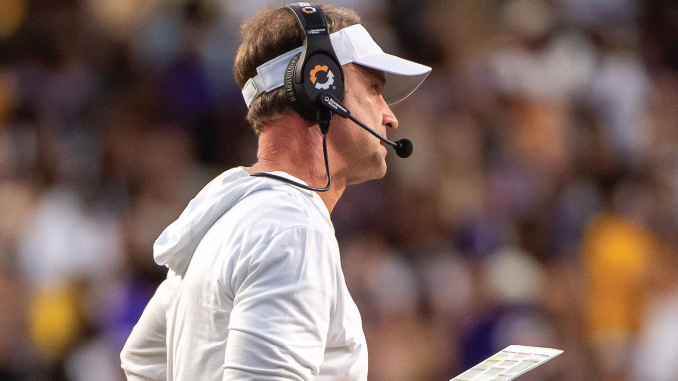
“It comes down to red zone and fourth downs,” LSU coach Lane Kiffin said in his postgame press conference. “We didn’t make any – 0-for-4 on fourth downs. And we got in the red zone more than they did, and so that’ll give you a problem on the scoreboard. You have a lot of yards and not many points when that happens.”
LSU found the scoreboard on two of its four red zone opportunities. Alabama turned its three trips inside the Tigers 20-yard line into three touchdowns.
LSU ran 49 plays (60%) in Alabama territory. Eight of its 10 drives made it to at least the Alabama 38-yard line. Those drives resulted in one touchdown, two field goals, a missed field goal, an interception and three turnovers on downs.
“They went really aggressive,” Kiffin said of what the Tide defense did to cause problems in a compressed field. “There’s a lot of blitz zero in there and man-to-man and really coming after us. There’s risk in that. We didn’t make them pay for it.”
LSU’s first missed fourth down came with 3:31 left in the first half . The Tigers trailed 10-3 after their first two drives resulted in a field goal from the Alabama 5-yard line and a missed 56-yard field goal that Scott Starzyk gave enough leg but hooked left of the uprights. Quarterback Sam Leavitt could not connect with tight end Trey’Dez Green, and the Tigers suffered their second straight trip to opposing territory with nothing to show for it.
LSU got another chance before the end of the half, but Leavitt forced a ball down the middle of the field.
“I thought (Leavitt) was really playing well, and then he had the poor interception at the end of the first half, which is just trying too much,” Kiffin said. “They’re dropping back in zone. You got to throw the underneath route, and probably gonna kick a field goal. So at least get a field goal going to the locker room at half. So really, that was the poor decision of the day.”
The next fourth down attempt came near the start of the fourth quarter as LSU needed to respond to a quick Alabama touchdown that snatched the momentum in “Death Valley” and put the Tide back up 17-13. The Tigers lined up for a fourth-and-three on the Alabama 36-yard line. Again, Leavitt’s pass attempt – this time intended for receiver Jackson Harris – fell incomplete.
“It kind of felt down there like it was probably going to be more high scoring than it ended up being through three quarters, and so just kind of felt like there was a time there where field goals weren’t going to win the game,” Kiffin said of his decisions to go for it on fourth down.
The final meaningful fourth down miss was the dagger in the heart of the Tigers. LSU had eight minutes of life left, but found itself down 11 points facing a fourth-and-one from its own 25-yard line. Leavitt was taken down for a 7-yard sack, his second of the four-play drive, and the breath was vacuumed out of Tiger Stadium.
“You can play just to try to keep the score low when you’re on your own 20, but you have no chance to win by punting really, analytically. So you go for it,” Kiffin said.
Instead of the high-scoring offensive battle it could have been, LSU remained in a tightly contested game late into the second half before letting it get away. Despite its repeated trips past the 50-yard line, LSU’s drives consistently stalled out. Whether the offense waited to show its ineptitude until the goal-line, the 20-yard line or the 30 did not matter.
Still, LSU moved the ball against easily the most talented defense it has faced this season. The Tigers were not far off their average performance of 510 yards per game this season even if their 13 points were 27 shy of its scoring average.
Kiffin found solace in that production.
“You’ve seen games where the offense can’t move the ball at all,” Kiffin said. “We’re up here with maybe that many points but you got 180 yards or something like that, and then you’re saying, ‘Well, we got a ton of problems. We can’t run. We can’t throw.’ That wasn’t the case. So in a way, that’s better.”
Leavitt finished 35-of-47 for 380 yards and an interception. Running back Dilin Jones took 17 carries for 56 yards and a score and seven catches for 36 more yards. Harris had 11 receptions for 166 yards, and Green hauled in 10 passes for 85 yards.
Unfortunately for Kiffin and the Tigers, you cannot take yards to the scoreboard.



Be the first to comment