
Tiger Rag · LSU Football · Opinion
TODD HORNE: LSU Finally Looks Like the Team Lane Kiffin Had in Mind
Trey’Dez Green returned to LSU’s offense Saturday and found more help than he had when he left. Jackson Harris had become a receiver defenses had to account for. Sam Leavitt had grown more comfortable throwing to him. Green’s absence had forced LSU to develop other answers. His return gave Leavitt another one.
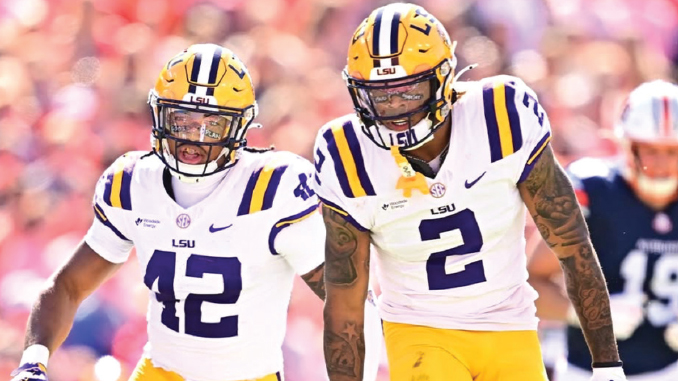
That was part of what made LSU’s 38–17 victory at Auburn so convincing. The Tigers gained 552 yards, allowed no sacks and collected seven of their own. Against a team that had physically beaten No. 1 Georgia in Athens a week earlier, LSU delivered its largest margin of victory ever on the Plains and ended an eight-game SEC road losing streak.
“This is what the whole thing was supposed to look like,” Lane Kiffin said.
Kiffin has spent much of October explaining why LSU needed time and healthier players before anyone could fairly judge what he was building. At Auburn, his offense supplied evidence for that argument, and Blake Baker’s defense made sure it carried beyond the possessions when Leavitt had the ball.
There is an open date now, then Alabama and Texas at home, Tennessee and Arkansas on the road. At 6–2, LSU has left itself little room after giving away Kentucky. But it goes into November with a better reason for optimism than the possibility that injured players might return. It has seen how much better the players already on the field can make it.
Leavitt completed 32 of 45 passes for a career-high 387 yards and three touchdowns, ran for another score and finished without an interception for the second consecutive week. Harris caught nine passes for a career-high 178 yards. LSU gained at least 10 yards on 26 of its 80 offensive plays, nearly one snap in three.
Auburn coach Alex Golesh explained why defending the Tigers had become so difficult. His defense was concerned about the deep ball, and LSU kept taking the yards that concern made available.
“We’re so worried about the shot plays that we’re not in the underneath stuff,” Golesh said. Leavitt found the flats and checkdowns. Four- and five-yard gains became nine and ten when Auburn failed to finish tackles. “That’s where I feel like they’ve grown as the year’s gone,” Golesh said.
Those completions required Leavitt to accept what the defense gave him and trust his receivers to do something with it. When Auburn challenged Harris directly, LSU had an answer for that, too. On third-and-five in the second quarter, Harris separated against press coverage on a short crossing route, caught the pass and ran away for a 70-yard touchdown.
As Kace Kieschnick reported for Tiger Rag, Harris has caught 31 passes for 517 yards and seven touchdowns over the last five games, after catching five passes in the first three. He emerged while Green was injured. Now Leavitt has both.
Green caught five passes for 50 yards and a touchdown. His most consequential reception came on fourth-and-two from LSU’s own 31. The 11-yard gain kept alive a possession that covered 95 yards and ended with Green’s 15-yard touchdown catch.
Kiffin called it a “butterfly effect.” Fail there, and Auburn takes over deep in LSU territory. Convert, and LSU can keep driving. Green gave Leavitt a target he could trust on a play that changed the possession and the field position with it.
“You just feel different,” Kiffin said. Green had addressed the team Friday night. Kiffin called him and injured linebacker Whit Weeks “the heartbeat of this team.” Weeks traveled but did not play. LSU still has someone important to get back, but Green’s return showed how much one player can restore when the rest of the offense has continued to develop.
Nine Tigers caught passes. Dilin Jones rushed for 92 yards and added 27 receiving. Leavitt, who missed spring work, was finding more ways to use the players around him.
He also supplied a reminder of what can undo it. Replay overturned an apparent first-half interception, but the decision that produced the throw remained poor. Kiffin told him, “We can’t have another one of those.” His message to the team was equally direct: “We’re going to dominate this game if we don’t screw up.”
LSU had enough advantages that it did not need to manufacture risky throws. Leavitt’s willingness to keep taking the available yards helped turn those advantages into sustained control.
The Tigers were hardly clean throughout. LSU opened the second half with a 20-yard vertical completion to Harris, but two holding penalties on Jordan Seaton and offensive pass interference on Green helped wreck the possession. LSU ran 20 plays to Auburn’s eight in a scoreless third quarter. There were points left on the field and mistakes better opponents could punish.
Kiffin kept pursuing the opportunities he saw. “I just really felt good about our matchups in this game,” he said.
Auburn had no comparable confidence when it had the ball. Jordan Ross’s speed and Princewill Umanmielen’s power presented different protection problems, and Golesh could not find an arrangement that consistently solved them. Auburn moved the pocket, tried quicker throws and kept extra protection. “When we were protecting with six, it didn’t look pretty,” he said.
Sending more receivers into routes exposed the protection, too. Individual losses, defensive twists and zero pressures Auburn failed to adjust to all contributed. “We couldn’t hold up,” Golesh said.
Baker’s front disrupted the running game as well. Auburn struggled to create movement inside, and LSU’s edges limited its alternatives. The defense finished with 12 tackles for loss, including the seven sacks, and held Auburn to 271 yards.
Byrum Brown’s 34-yard escape was the conspicuous failure: a lost rush lane followed by a missed chance to finish the tackle. His other 18 credited carries, including sacks, netted minus-13 yards. He finished with 160 passing yards and 21 net rushing yards.
“He’s just so strong, and he gets away from things,” Kiffin said. LSU wanted defenders tackling low, “hanging onto his legs and waiting for the rest of the guys to come.” Brown took six sacks. Davhon Keys collected the seventh against backup Tristan Ti’a, bringing LSU’s season total to 34.
A week earlier, LSU’s shutout of then-No. 16 Mississippi State required acknowledging the absence of quarterback Kamario Taylor and running back Fluff Bothwell. Auburn offered stronger evidence of how much the defense had improved. Its answer was convincing enough that Golesh found little to qualify.
“There’s no silver lining,” he said. “That was bad in every imaginable way.”
Kiffin declined to label this LSU’s best performance, pointing also to the Clemson opener and Mississippi State shutout. Auburn was its most convincing combination of offensive command and defensive disruption. LSU’s previous largest victory there was 20–6 in 1973. Saturday’s margin was 21, and the control was more revealing than the margin.
Kiffin explained that a game like this tells him more than a narrow escape because “a lot of people are doing things right.” He gives that more weight than a result decided by whether a late kick goes through. LSU has already learned how costly those afternoons can become.
The latest available ESPN Matchup Predictor, as of October 24, gives LSU an advantage in each remaining game: 52.4 percent against Alabama, 54.7 against Texas, 58.1 at Tennessee and 90.8 at Arkansas. The first three figures describe difficult games. Being favored in each guarantees nothing across all four.
Alabama visits November 7. LSU has two weeks to address the penalties and decisions that interrupted Saturday’s performance, and to see whether Weeks can return. “One game at a time,” Kiffin said. With the players available and the mistakes eliminated, “we’re really hard to beat.”
At Auburn, LSU made that case across 80 offensive plays and 65 defensive snaps. Green’s return helped. So did everything Harris and Leavitt had learned while he was gone. Baker’s defense gave Auburn little chance to keep up.
The team Kiffin has been describing is coming into view. Now LSU has four games to make Saturday’s performance its standard.

Be the first to comment