
Todd Horne Column · LSU Football
LSU’s Next Breakthrough May Be a Play Sam Leavitt Doesn’t Make
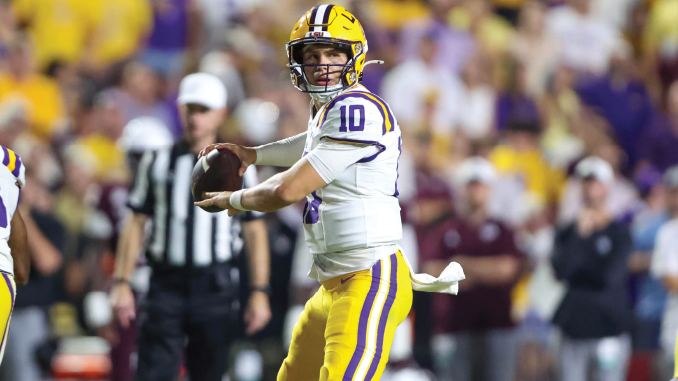
BATON ROUGE — Sam Leavitt has enough ability to turn a broken play into a touchdown. LSU’s next step may depend on how often he recognizes that a broken play should remain broken. There are Saturdays when a quarterback must rescue his team. There are also Saturdays when his most valuable contribution is allowing the rest of it to do its work.
That is the question LSU carries into Lexington. The Tigers have won four of their first five games under Lane Kiffin, but their only trip away from Tiger Stadium ended in a 32–24 loss at Ole Miss. Saturday night at Kentucky offers another opportunity to show that their offense can operate on somebody else’s field without repeatedly making its own job harder.
The numbers make the concern plain. Leavitt has thrown eight touchdown passes and seven interceptions through five games. Kentucky quarterback Kenny Minchey has thrown 11 touchdown passes and one interception. Those figures do not explain every decision or assign responsibility for every turnover. They do establish how differently the two offenses have protected their possessions.
Kentucky is 4–1 under first-year coach Will Stein and owns a plus-five turnover margin. Its defense has allowed at least 30 points in each of its three SEC games. There should be opportunities for LSU to score. The danger is supplying Kentucky with opportunities that require considerably less work.
Leavitt has already provided evidence of what a more settled version of his game can produce. Against Texas A&M, he completed 17 of 23 passes for 312 yards and two touchdowns in a 35–6 victory. After a hamstring injury restricted his movement, he stayed in the pocket and delivered the ball. Kiffin joked afterward about the unexpected effect: “he had to stay in the pocket and throw on time.”
An injury is an unfortunate way to reinforce a coaching point. The useful lesson was the offense functioning while Leavitt allowed it to develop. A quarterback who can escape pressure still has to recognize when his protection is holding. Leaving early can turn the protection his linemen have provided into an arrangement they can no longer maintain.
Nor did patience require LSU to abandon the big play. In the third quarter against A&M, Leavitt found Jackson Harris for a 57-yard touchdown on fourth-and-one. Kiffin’s offense attacked aggressively, and its quarterback delivered. LSU can ask Leavitt to make better decisions without asking him to become a less dangerous player.
Kentucky makes that especially relevant. South Carolina quarterback LaNorris Sellers rushed for 147 yards against the Wildcats last week. Texas A&M’s Marcel Reed gained 80 two weeks earlier. Leavitt’s legs belong in this game plan if his health permits. The task is choosing when to use them, preserving the designed run and the productive scramble while giving a developing pass play the time it needs.
Leavitt said this week that he expects to be fully healthy Saturday. If he is, LSU should gain options. The question is whether he can retain the patience he showed when those options were reduced. A sound hamstring can restore the ability to leave the pocket. It cannot determine whether leaving is the right decision.
That judgment extends beyond the pocket. A checkdown can keep a series moving. A legal throwaway can preserve manageable field position. Sometimes third down ends without a conversion, and the punt team has a job to do. Game circumstances govern those choices, but a quarterback does not have to treat every unsuccessful possession as an emergency.
Defensive coordinator Blake Baker’s unit gives LSU reason to accept that approach. It held Texas A&M to six points. Trusting that defense means giving it a field to defend, rather than asking it to repair the consequences of an unnecessary risk. Possession and field position allow both sides of the team to contribute to the same outcome.
Caroline Fenton identified the interceptions as her central reservation about LSU’s offense on Tiger Rag Radio this week. The concern is reasonable. LSU has shown enough offensive potential to invite ambitious projections. Reaching them will require more of the decisions that keep a good possession alive and fewer that turn a recoverable problem into the opponent’s ball.
Kiffin has a Kentucky memory that should discourage anybody from looking beyond Saturday. In 2024, his fifth-ranked Ole Miss team lost 20–17 at home to a Wildcats team that eventually finished 4–8. Asked about it this week, he recalled having to “sit in the misery.” That defeat helped leave the Rebels outside the College Football Playoff.
This Kentucky team has already matched that team’s season victory total, and LSU will meet it in a sold-out stadium at night. The Wildcats have ample reason to believe they can win. LSU’s responsibility is to make them earn the result over the full field and the full evening.
Leavitt will have chances to change the game with his arm and his legs. He should take them when they are there. But the next measure of his development may come when the receiver is covered, the escape route closes and the play has nothing left to offer. LSU needs him to recognize that moment, let the possession end if necessary, and trust that his team can win the next one.
Be the first to comment