
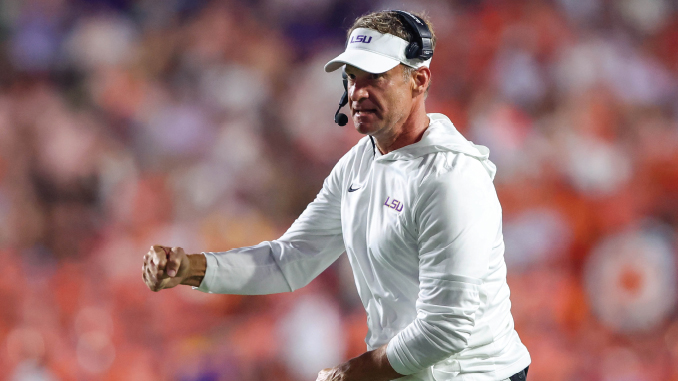
Todd Horne Column
The Other Side of Death Valley
Lightning sidelined Lane Kiffin’s LSU debut for nearly two hours, but it never cooled the fever in Tiger Stadium. When the storm finally cleared, the Bayou Bengals erupted, running Clemson out of Baton Rouge by a rolling 51–10 count.
By midafternoon Saturday, LSU’s campus was already boiling. Heat and humidity hung over at least 50,000 fans packed into tailgates while dark clouds gathered above them. “Callin’ Baton Rouge” blasted from every direction, one party picking it up before the last had let it go. LSU had hosted bigger games and championship games, but never a coaching debut with this kind of anticipation. Lane Kiffin had not yet walked down Victory Hill, and his first game already felt like an event unlike anything Baton Rouge had seen.
For Lane Kiffin it began a week earlier: a full dress rehearsal of the LSU experience. Hotel, meals, ride to campus, Victory Hill, locker room, entrance, fireworks, tunnel walk—he’d choreographed it all like a Broadway producer, determined to show that his retooled Tigers knew every beat. He had practiced it until players could do it blindfolded. What he hadn’t scripted was the day’s electric finale.
At 4:51 p.m., with the first Clemson players beginning their warmups and the stadium still largely empty, LSU officials warned that bad weather might be headed toward Tiger Stadium. At 5:10, lightning flickered nearby. A crack of thunder set off a curious cheer in the stands—LSU fans revel in football almost as much as they fear a losing season. By 5:46, sheets of rain washed the field clean as “Have You Ever Seen the Rain?” drifted from the sound system. In the press box, Kace Kieschnick quipped, “I think we can add God to the list of people Lane pissed off.” A cloudy smile, then another jagged flash.
Lightning delay. Please seek shelter immediately.
Only the Clemson contingent budged.
Twenty minutes, forty minutes, an hour slipped by. The original 6:49 kickoff expired like yesterday’s promises. The field sat empty. The scoreboards kept warning. The crowd kept waiting, stuck in an uneasy truce with Mother Nature. Finally, at 7:56, Kiffin appeared under the north end-zone uprights, calm as a preacher. Clemson head coach Dabo Swinney broke into a delighted sprint; Kiffin simply sauntered. They met at midfield, embraced like brothers reunited and smiled away the week’s public spats—two schemers delighted to be back in the trenches.
At 8:01, LSU’s full complement stormed out of the tunnel. On cue, “Callin’ Baton Rouge” detonated again, and 102,321 voices roared approval. ESPN sideline reporter Holly Rowe said the noise reached 129 decibels, nine higher than anything she had personally measured. The lightning delay had only stoked the crowd’s frenzy, giving the purple-and-gold faithful time to rebuild their fervor and crank it past eleven.
What happened next looked like a clinic. On LSU’s second play, a Sam Leavitt pass went through Malik Elzy’s hands and into Clemson’s at the LSU 33, setting up a Nolan Hauser 49-yard field goal. That 3–0 lead was all the visitors would see until garbage time. Scott Starzyk tied it at 3 with a 48-yard boot of his own. Then LSU went 89 yards in 12 plays, capping the drive with a bruising 1-yard plunge by Dilin Jones. Eighty-nine seconds later, defensive end Jordan Ross tiptoed into coverage, grabbed a Christopher Vizzina pass and galloped 30 yards for a touchdown—complete with a dunk through the basketball hoop mounted on LSU’s sideline, right over a Clemson paw. Suddenly it was 17–3, and the rout was only beginning.
Leavitt, who reached 100 yards rushing by halftime, tacked on two more touchdowns before the break—an 8-yard sprint in which he planted his foot to shake off pursuit, then a 13-yard burst just before the intermission. By halftime the scoreboard read 31–3. LSU led Clemson in first downs, 21–1, and in total yards, 336–54. Clemson’s only trip across midfield had been supplied by LSU’s interception. It was more than a half; it was a thrashing choreographed to perfection by Blake Baker’s defense and an offensive line that treated every Clemson defender like a blocking sled.
“Pretty good half,” LSU athletic director Verge Ausberry said in the press-box men’s room. “Another half to go, Todd.”
If the first half was lopsided, the second was outright mercy. Leavitt hooked up with Winston Watkins Jr. on a 32-yard strike, Jones punched in his second score of the night and, with the game out of reach, backup quarterback Landen Clark found Phillip Wright III for a 30-yard touchdown. Clemson finally found the end zone with 3:13 remaining, but by then most of Tiger Stadium had emptied. No thunder delay could rival a 41-point deficit.
The final: LSU 51, Clemson 10. Total yards, 644 to 145; rushing, 309 to 40; first downs, an LSU-record 38 to Clemson’s 8; sacks, four; tackles for loss, eleven. Clemson punted ten times.
The Bayou Bengals ground out third down after third down, wearing down their opponent with every snap. That relentless efficiency—38 first downs—was the true measure of domination.
Afterward, Kiffin praised his players’ focus. He lamented the early turnover and the backup unit’s lone lapse, warning that in a close game every miscue matters. He shrugged off the media circus and lawsuits, the Swinney barbs and the Finebaum firestorm. To him, distractions are overrated—players practice, coaches coach.
His sharpest remark came when he looked back at the delay. LSU waited in its home locker room; Clemson waited in the visitors’ quarters, the one Kiffin knew from years of trips with Alabama and Ole Miss. “That locker room sucks over there,” he said. When offered the chance to shorten the return-to-play period, he refused. Let them sit. Every extra minute in that room was another possible inch of edge for his team.
There he was: not just the headline-grabbing provocateur, but a coach who rehearsed every detail—even turning a storm delay into a weapon. Saturday night he marched down Victory Hill, crossed to the other side of Death Valley and watched his Tigers carve up Clemson so thoroughly that the thunderstorm became the second-most violent thing to hit Tiger Stadium all evening.
Some housewarming.
Be the first to comment