
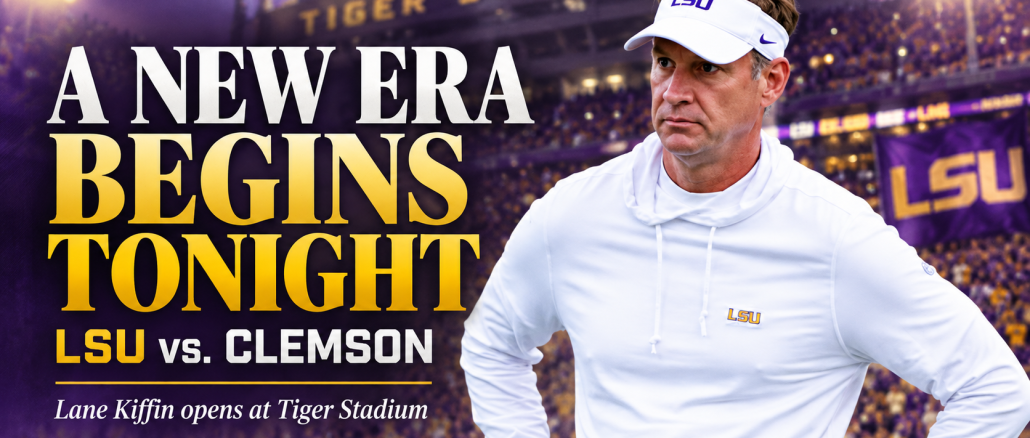
LSU Has Played Bigger Openers. It May Never Have Opened With More At Stake.
Lane Kiffin. Sam Leavitt. A rebuilt roster. Tens of millions invested. A sold-out Tiger Stadium. College GameDay. Clemson. After nine months of buildup, LSU finally has to put the whole idea on the field.
There have been more highly ranked teams standing across the field from LSU on opening day.
No. 1 Nebraska came into Tiger Stadium in 1976. No. 4 Alabama and Bear Bryant came in 1981. No. 7 Texas A&M came in 1986. Two years later, No. 10 A&M returned and LSU beat the Aggies 27-0.
LSU has played gigantic openers away from Baton Rouge, too. No. 4 LSU beat No. 3 Oregon in Dallas in 2011. No. 5 LSU opened against No. 8 Florida State in 2023.
So let’s not manufacture history by pretending No. 23 Clemson is the greatest opening-day opponent LSU has ever seen.
It isn’t.
But LSU may never have opened a season at home with this much riding on what happens next.
Because LSU isn’t simply starting another football season tonight.
It is unveiling Lane Kiffin, Sam Leavitt, one of the most aggressive roster reconstructions in school history and an enormous financial investment in getting LSU back into the national championship business.
It is doing it at night in a sold-out Tiger Stadium, on ABC, with ESPN’s College GameDay in Baton Rouge for its 500th road show.
It is doing it after Kiffin’s arrival generated more than 40,000 new season-ticket requests.
And it is doing it after one of the strangest final weeks before a season opener LSU has ever experienced — nine hours in a Baton Rouge courtroom, the SEC commissioner under oath, a preliminary injunction, another lawsuit filed by the conference and even Clemson inserting itself into the fight over LSU’s roster.
By late Friday, LSU decided that at least that particular drama would not spill directly onto the field tonight.
Dae’Quan Wright and Zxavian Harris will not be added to LSU’s roster for the Clemson game, despite Judge William Jorden’s preliminary injunction preventing the NCAA and SEC from denying their eligibility or punishing LSU for rostering them.
So, for a few hours anyway, we get football.
Start with Kiffin.
He will become the first LSU head coach since Nick Saban in 2000 to make his debut in Tiger Stadium.
That’s a pretty good historical marker by itself.
Then put Sam Leavitt beside him.
Only three times since 1962 has LSU opened a season with both a new head coach and a new starting quarterback: Jerry Stovall and Alan Risher in 1980, Mike Archer and Tommy Hodson in 1986, and Brian Kelly and Jayden Daniels in 2022.
Tonight makes four.
And those aren’t even the biggest changes.
Look at the football team coming out of the tunnel.
LSU’s official game notes list 44 players who were part of the 2025 team, 46 transfer portal additions and 21 high school signees. Only 13 players on the current roster started even one game for LSU last season.
Kiffin didn’t patch the roster.
He replaced most of it.
The portal haul includes Leavitt, the top-rated quarterback available; Jordan Seaton, the No. 1 offensive tackle in the portal; and Princewill Umanmielen, the No. 1 edge rusher.
Twenty of LSU’s transfers arrive with previous starting experience. Together, they have accumulated 276 career starts elsewhere.
That is what modern college football allows.
It is also what modern college football demands when a school decides waiting is no longer acceptable.
LSU did not hire Kiffin to embark on a patient three-year rebuilding project.
It hired him to accelerate time.
And it has spent accordingly.
The money committed to the coaching change, the roster and the infrastructure surrounding this program is extraordinary even by modern SEC standards. Kiffin arrived only weeks after LSU fired Brian Kelly and took on the enormous financial obligation associated with that decision.
Then LSU went shopping.
The result is the team we finally see tonight.
Until now, everything about Kiffin’s LSU has existed primarily as possibility.
Recruiting rankings.
Portal rankings.
Practice reports.
Depth charts.
Contracts.
Expectations.
Tonight there is a scoreboard.
Nobody needs Clemson to determine whether Lane Kiffin knows offense.
That case was closed a long time ago.
His Ole Miss teams averaged at least 33 points every season. They led the SEC in total offense four times in six years. His teams produced more rushing yards than any other SEC program during his time in Oxford.
And for all the attention paid to Kiffin’s passing schemes and quarterbacks, he has always understood something fairly basic about winning football games:
You better be able to run it.
That may be one of the most interesting things to watch tonight.
LSU rushed for only 104 yards a game last season, worst in the SEC. Kiffin inherits Caden Durham and Harlem Berry, adds help around them and has rebuilt an offensive line anchored by Seaton and center Braelin Moore.
If LSU suddenly looks capable of controlling a football game on the ground, we will know something significant before midnight.
Then there is Leavitt.
He isn’t a developmental quarterback LSU hopes might eventually become good enough.
He has already taken Arizona State to a Big 12 championship and the College Football Playoff.
Now Kiffin gets him.
That pairing — one of college football’s most inventive offensive coaches with one of the most coveted quarterbacks in the transfer portal — is one of the central reasons this season carries the expectations it does.
Tonight is the first public look.
Clemson is almost perfect for the occasion.
Not because Dabo Swinney’s current team resembles his national championship teams at their peak.
It doesn’t.
Clemson went 7-6 last season and enters tonight unranked in the Associated Press poll and No. 23 in the coaches poll. LSU is No. 11 in the AP poll.
But Clemson remains Clemson.
Swinney has won 187 games there. He has won national championships. The orange helmet still carries enough weight that beating Clemson on national television looks and feels like something.
And there is another oddity about tonight that somehow escaped history until now:
Clemson has never played LSU in Tiger Stadium.
The programs first met in the 1959 Sugar Bowl. They played in Atlanta in 1996 and 2012. They met in New Orleans for the national championship after the 2019 season, when Joe Burrow and LSU completed a 15-0 season with a 42-25 victory.
Last August, LSU finally traveled to Clemson and won 17-10.
Tonight, after all of that history, Clemson finally comes to Baton Rouge.
And it comes for an opener unlike almost any Tiger Stadium has hosted in decades.
This will be the first season-opening matchup between ranked teams in Tiger Stadium since 1988, when No. 18 LSU destroyed No. 10 Texas A&M, 27-0.
Verge Ausberry was LSU’s starting linebacker that night and made nine tackles.
Corey Raymond intercepted a pass.
Thirty-eight years later, Ausberry is LSU’s athletic director and Raymond is coaching its secondary.
The stadium is the same.
College football certainly isn’t.
There is also a warning sitting right in front of LSU.
We’ve seen this movie before.
Last season LSU traveled to Clemson after losing five consecutive season openers. The Tigers beat the No. 4 team in the country, 17-10, returned home 1-0 and eventually climbed to No. 4 in the nation.
Everything seemed fixed.
It wasn’t.
LSU opened 4-0, then lost four of its next five — at Ole Miss, at Vanderbilt, to Texas A&M and at Alabama, with only a victory over South Carolina interrupting the collapse.
The 49-25 Texas A&M loss in Tiger Stadium preceded Kelly’s dismissal. LSU eventually finished 7-6 and lost its bowl game to Houston.
So one game cannot prove everything.
That’s worth remembering tonight whether LSU wins by 30 or loses by three.
But opening nights can reveal things.
Is LSU’s offensive line really fixed?
Can it run the football?
Does Kiffin already have Leavitt operating his offense at full speed?
Can Blake Baker’s defense generate pressure without sacrificing the secondary?
Can 60-plus new players function as one team when the stadium gets loud and something goes wrong?
Those questions have been sitting there all summer.
Tonight we finally begin getting answers.
Kiffin understands that better than anyone.
He described opening night this week in terms he has used throughout his career: as a performance.
That’s exactly what this is.
Not an audition. LSU already gave him the job.
Not a referendum. One football game cannot carry that much weight.
But a performance before an audience that has been waiting for months to see whether all the money, recruiting, roster reconstruction, hype and belief have actually produced what LSU thinks it bought.
And the audience will be enormous.
College GameDay is here. ABC is here. Tiger Stadium is sold out. LSU has dealt with an extraordinary credential demand. More than 40,000 people reportedly asked for season tickets after Kiffin was hired.
People aren’t wondering whether LSU football still matters.
They’re trying to get inside the stadium.
LSU has won 21 consecutive nonconference games in Tiger Stadium and 70 of its last 71. It has won 23 of its last 25 night games there.
It hasn’t lost a traditional Saturday home opener since Texas A&M beat Curley Hallman’s team in 1994.
Kiffin knows the place from the other sideline. He went 2-0 here as Alabama’s offensive coordinator and 0-3 as Ole Miss’ head coach.
Tonight he finally walks onto the LSU side.
There have been LSU openers against better opponents.
There have been openers involving higher-ranked teams.
There have been individual opening games with enormous national championship implications.
But finding another home opener in which LSU simultaneously unveiled a head coach, a quarterback, almost an entirely new roster, a massive investment and the intended direction of the entire program is difficult.
That’s why this one feels different.
For nine months, Lane Kiffin’s LSU has been an idea.
Tonight, finally, LSU puts the idea on the field.
Be the first to comment