
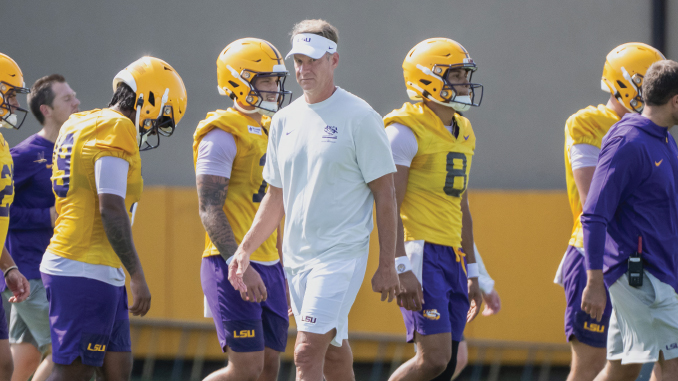
SEC School Leaders Are Exploring the Nuclear Option Against LSU. This Is No Longer Just an Eligibility Fight.
The fight over college football eligibility is no longer just about eligibility.
According to Yahoo Sports’ Ross Dellenger, presidents and general counsels representing the SEC’s other 15 universities are now exploring what they can do if LSU proceeds with plans to add athletes the conference considers ineligible under its newly adopted professional-player rules.
The possibilities being discussed are extraordinary: placing LSU on probation, prohibiting the Tigers from competing for SEC championships, individual schools refusing to compete against LSU, filing a federal lawsuit and, at the outer edge of the discussion, even expulsion from the conference.
None of those things has happened. The conversations are preliminary. Dellenger reports that they are “not league driven, but membership led,” and no formal action is expected before Thursday’s preliminary-injunction hearing in Baton Rouge.
That qualification is important because the headline possibilities are spectacular enough to obscure what is actually happening.
The SEC is not voting Monday afternoon to throw LSU out of the league. Fifteen angry presidents have not announced a boycott of Tiger Stadium. Greg Sankey has not declared war on Baton Rouge.
But the fact that university presidents and general counsels are seriously examining those options tells us how dramatically this dispute has escalated.
What began as a fight over whether several athletes should receive another year of eligibility has become a test of whether the Southeastern Conference can govern itself when one of its members is protected by a court order preventing enforcement of rules the rest of the membership believes it collectively adopted and has every right to enforce.
That is a much larger question.
LSU Is the Flashpoint, Not the Whole Problem
For most of the last week, this story has been framed as Lane Kiffin against Greg Sankey.
That was always too small.
LSU has unquestionably been the most aggressive SEC program in pursuing athletes who may become eligible through litigation. Kiffin has said publicly that he believes players were wronged by the timing of the NCAA’s new eligibility rules. LSU has left roster space available. Former Ole Miss players Dae’Quan Wright and Zxavian Harris have committed to LSU after signing professional contracts. Other possibilities remain alive.
But LSU did not create the legal environment surrounding them.
The NCAA itself says more than 300 athletes are now involved in roughly 60 eligibility lawsuits. Courts across multiple jurisdictions have issued inconsistent rulings. Some athletes have received temporary relief. Others have not. Some have won and then had that relief stayed on appeal. Conferences have responded by writing rules of their own, and athletes have responded by adding conferences and administrators to lawsuits.
The SEC’s new professional-player policy was part of that response.
Now the response has produced another response.
Dellenger reports that executives from the other 15 SEC institutions have spent the last 36 to 48 hours discussing how they might protect the conference’s rules if LSU uses a Louisiana court order to do something the membership believes those rules prohibit.
The lawsuits followed the authority to the SEC.
Now the SEC membership is asking what authority it retains.
The Most Important Word May Not Be “Expulsion”
Expulsion will dominate the reaction because it is the most dramatic possibility Dellenger reported.
It probably should not be the most important one.
Dellenger examined a recent version of the SEC’s bylaws and found no explicit provision specifically describing expulsion. What the bylaws apparently do provide is substantial disciplinary authority to the conference’s presidents and chancellors. They can place a member institution on probation, prevent it from competing for an SEC championship or participating in conference competition, and impose “any other penalty which they consider appropriate.”
That is broad language.
The more revealing development, therefore, is not that SEC leaders are supposedly preparing to kick LSU out. Dellenger’s reporting does not say that.
It is that presidents and university lawyers are now studying what powers they possess if the Louisiana court limits what the SEC office itself can enforce.
That moves this dispute into new territory.
The SEC has already agreed to comply with Judge William Jorden’s temporary restraining order. On Sunday evening, the conference made clear that compliance does not mean concession. The SEC said it and Sankey will contest the plaintiffs’ allegations Thursday morning and defend the conference’s rights “as a voluntary association” acting for its member institutions.
Now the member institutions themselves appear to be examining the same concept. What can a voluntary association do when one member obtains judicial protection from a collectively adopted rule?
That may become the defining question in this case.
Kiffin’s Monday Comments Add Another Layer
Kiffin addressed the roster controversy Monday during his regularly scheduled LSU media availability. His comments were not a response to Dellenger’s reporting about discussions among the other 15 SEC schools. He was answering questions about LSU’s decision-making, possible additions from professional football and his conversations with the conference.
What he said complicates the idea that LSU is simply preparing to defy the SEC.
Kiffin acknowledged that he struggled with whether LSU should add players this late, even if the courts ultimately make them available. His concern was not primarily how the decision would play nationally. He said he tries to make decisions based on what is best for the players already inside LSU’s team room.
So he asked them.
Kiffin said he met with LSU’s player leadership committee and asked what they wanted LSU to do if these athletes became legally available. According to Kiffin, every player was emphatic: “They can help us win, bring ’em.” One player compared it to professional football and the broader workplace, where organizations add people when those people can make the organization better.
Kiffin said hearing that made him feel better about a decision over which he had been “torn back and forth.”
Then came the more important institutional answer.
Asked whether LSU football would follow SEC orders, Kiffin was direct:
“Of course we will.”
He said LSU would wait for additional guidance during the week while the court proceedings and conference process continue.
That is not the language of a coach announcing that LSU intends to ignore the SEC.
It actually illustrates how complicated the situation has become.
LSU says it will follow SEC orders. The SEC says it will follow the Louisiana court order. The court order presently limits the SEC’s ability to enforce certain rules. Meanwhile, the other 15 universities are considering whether LSU’s reliance on that judicial protection threatens the conference’s ability to govern itself.
Everybody can say they are following the rules.
The problem is that they are no longer necessarily answering to the same source of authority.
This Is the Self-Governance Test College Sports Has Been Asking For There is another reason Dellenger’s reporting matters beyond LSU.
College sports leaders have spent years discussing greater conference autonomy and, eventually, the possibility that the major conferences might govern significant portions of competition independently from the NCAA.
The theory is attractive.
The NCAA has hundreds of member institutions across different divisions, states, legal regimes and competitive models. A conference has far fewer members. Those institutions voluntarily associate with one another. They adopt bylaws together. They agree to competitive standards. In theory, enforcement should be easier.
The current dispute is testing that theory before the larger structure is even built.
The SEC’s presidents unanimously adopted professional-player restrictions because they believe allowing former professional athletes to return creates a competitive problem. Whether one agrees with the policy or not, the competitive concern is real.
A player who spends months inside an NFL organization may receive professional coaching, strength training, nutrition, film study and competition unavailable to someone who remained exclusively in college. SEC schools believe permitting those athletes to return could create an advantage inconsistent with the competitive structure they agreed to maintain.
But then a Louisiana judge restrained enforcement against plaintiffs challenging the rules.
Now what?If membership in a voluntary association means every member agrees to follow common rules, what happens when one member possesses a judicial order saying those rules cannot be enforced against it?
That is no longer primarily an eligibility question.
It is a governance question.
The Calendar Is Still What Created This Mess
None of this erases the problem at the center of the players’ lawsuits.
Athletes such as Wright and Harris did not finish their college careers knowing another year of eligibility would later become possible. They exhausted their eligibility under the rules that existed at the time and did what football players normally do when college football is over: they entered professional football.
Only later did the NCAA change its eligibility framework.
That chronology is why Kiffin has repeatedly argued that these athletes were wronged. They did not necessarily choose professional football over another available season of college football. For some of them, college football was no longer an option when the professional decisions were made.
The NCAA later changed the architecture.
The courts then began deciding whether athletes excluded by the timing of that change deserved relief.
That does not automatically mean former professional players should be allowed to return to college. The SEC has every right to argue that professional experience represents a separate competitive boundary.
But prospective rules are much easier to defend conceptually than retroactive consequences.
Tell a player in advance that signing an NFL contract permanently ends his ability to play in the SEC, and he can choose accordingly.
Tell him his college eligibility is exhausted, watch him enter the NFL because no college option remains, change the eligibility framework months later and then punish him because he crossed into professional football while the first door was closed, and you create exactly the kind of reliance argument now appearing in court.
That is why simply saying “LSU wants NFL players” has never explained the actual dispute.
Federal Court May Be the Next Battlefield
Dellenger’s reporting also moves another possibility from the theoretical column into the realm of serious institutional discussion.
Federal litigation.
The other SEC schools are reportedly examining whether some form of federal legal action against LSU could provide another avenue for protecting the conference’s rules.
Dellenger points to the Big 12’s recent dispute involving Texas Tech and quarterback Brendan Sorsby as one possible model. The facts are different, but the strategic concept is relevant: a conference going to federal court to protect what it believes are its constitutional and contractual rights to govern member institutions.
That would create an extraordinary jurisdictional collision.
A Louisiana state court could be protecting LSU and certain athletes from enforcement of conference restrictions while the conference or its members ask a federal court to protect their ability to enforce the terms of membership.
At that point, nobody could reasonably describe this as a roster dispute anymore.
It would be a fight over competing sovereign, contractual and judicial authority.
Thursday Is Now Bigger Than the Players
Judge Jorden’s preliminary-injunction hearing Thursday was already important.
It is more important now.
If the plaintiffs lose, the current temporary protection could narrow or disappear and much of the institutional conflict may temporarily recede.
If they win, the questions multiply.
Does the SEC appeal?
Does it seek an immediate stay?
Do the other 15 universities pursue separate action?
Does the conference impose internal sanctions?
Does somebody file in federal court?
Could individual schools actually refuse to compete against LSU?
How much authority do the SEC presidents possess under the bylaws?
And how far are they willing to go against one of the league’s most valuable and recognizable members?
Dellenger reports that one person involved described the risk to LSU as “enormous.”
That may ultimately prove true.
But the risk is enormous for the SEC too.
If the conference responds too weakly, its members may conclude that collectively adopted rules are meaningless whenever one institution finds a favorable state court.
If it responds too aggressively, it risks an unprecedented confrontation with LSU, additional litigation and perhaps judicial scrutiny of powers the conference has rarely, if ever, attempted to exercise this way.
There is no easy move left.
And LSU Still Plays Clemson Saturday
All of this is happening during game week.
Kiffin spent part of Monday discussing roster litigation, conference guidance and players who may or may not become available while LSU prepares to open its season against Clemson.
Yet the same Monday program also provided a revealing look at how LSU has approached the football side.
LSU officials described an operation obsessed with eliminating surprises. The team simulated game-day procedures. Coaches rehearsed logistics. The staff worked through sideline locations, interviews, timing and other details so a roster filled with new players and led by a new coaching staff would experience as much of Saturday before Saturday as possible. The message around the program was preparation rather than hype.
That matters because it undercuts the easy conclusion that all of this legal theater necessarily means Kiffin has stopped preparing for Clemson.
He is doing both.
Whether that becomes too much is a legitimate question, and Saturday will provide the first meaningful evidence.
But roster construction is part of Kiffin’s job too. He made that clear Monday. His responsibility, as he sees it, is to make LSU as good as possible within whatever rules and legal boundaries actually exist when the decisions have to be made.
The problem is that nobody can say with certainty what those boundaries will look like four days from now.
And that brings us back to what this has really become.
The NCAA has its rules.
The SEC has its rules.
LSU has a Louisiana court order.
Fifteen other SEC institutions have their membership rights.
A state judge will speak Thursday.
A federal court may eventually be asked to speak too.
Kiffin says LSU will follow SEC orders.
The SEC says it will follow the court order. The other schools are now examining what they can do if following both leaves them with a result they believe destroys competitive equity.
That is not Lane Kiffin beating Greg Sankey.
It is not Greg Sankey backing down.
And it is no longer simply a fight over whether former NFL players should be allowed to play college football.
It is becoming a test of whether the Southeastern Conference can actually govern itself when its own rules collide with judicial authority.
What happens to LSU may be dramatic.
What happens to the SEC’s authority could be much more consequential.


Be the first to comment