

By TODD HORNE, EXECUTIVE EDITOR
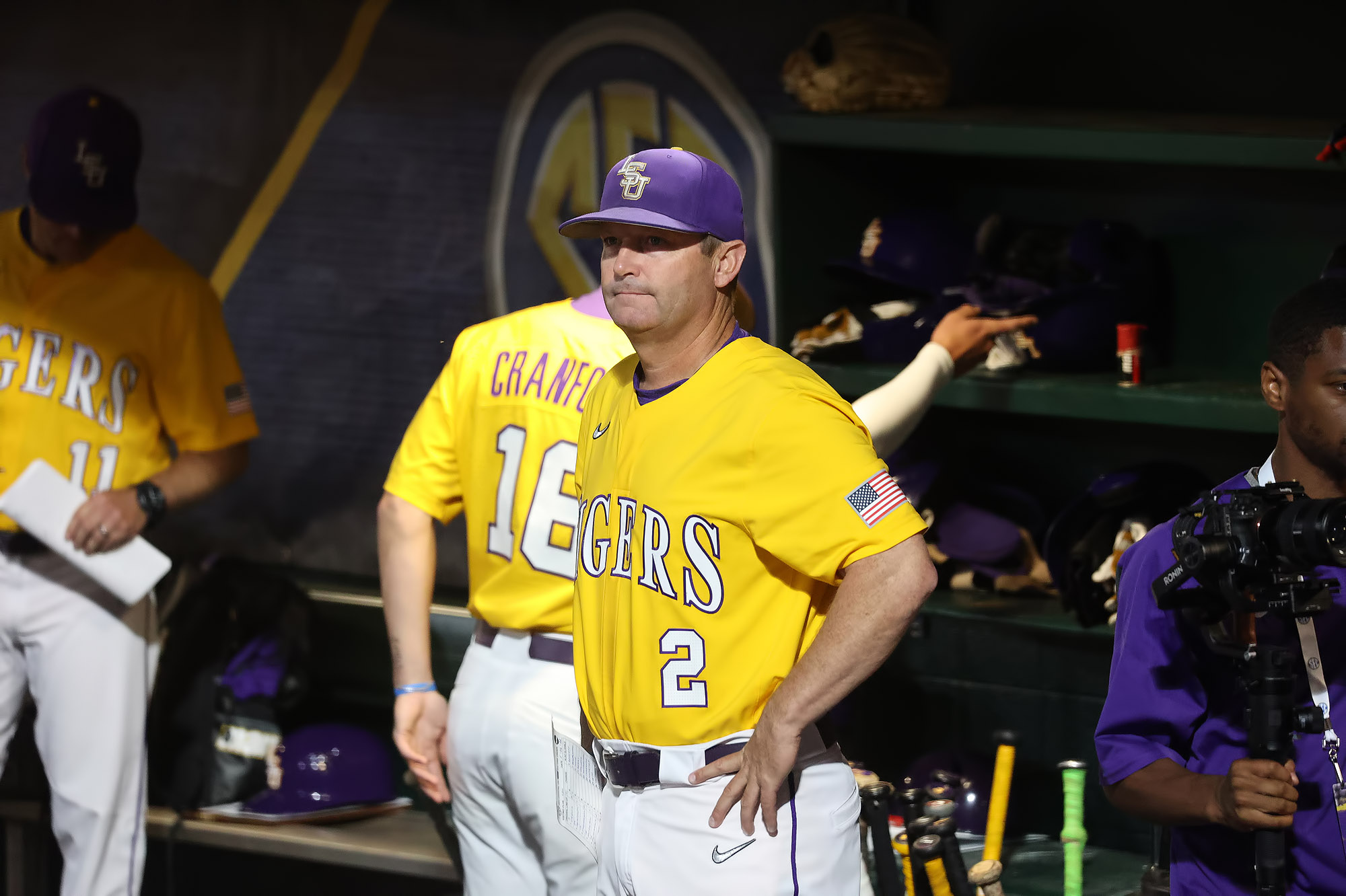
The most revealing thing Jay Johnson said Wednesday had almost nothing to do with Georgia, pitching matchups, injuries or postseason math.
It was about Bobby Knight.
Johnson said he has been reading Knight. Then, in the middle of explaining why LSU has started to look different offensively and emotionally, he admitted something that would have sounded almost unthinkable from a major college coach 20 years ago.
The Bobby Knight deal does not work.
Not with this team.
Maybe not with a lot of teams anymore.
That was not a throwaway line. It was a window into LSU baseball’s season, and maybe into modern coaching itself. Johnson was not simply talking about one book passage or one old coach. He was talking about a model of motivation built around pressure, confrontation, constant correction and the belief that negative reinforcement can sharpen competitive people.
Knight titled one of his books The Power of Negative Thinking, and the idea was not as cartoonish as the caricature. Knight believed coaches should identify what could go wrong, attack weaknesses before they surfaced, resist false optimism and demand a standard that did not bend to comfort. There is logic in that. There is also a cost.
Johnson appears to have found the cost with this LSU team.
He said he was hard on the Tigers when they were 11-1. He wanted them to understand that winning was not the point if they were not playing the right way. He wanted execution. He wanted edge. He wanted them to see danger before danger swallowed them.
Then LSU lost four of five.
“Did not work,” Johnson said.
That admission matters because LSU is still alive now for almost the opposite reason. The Tigers have not survived because fear made them better. They have survived because they finally stopped playing scared.
That is why LSU still has a shot.
Not a comfortable shot. Not a likely shot. A shot.
The Tigers enter the final two SEC weekends at 9-15 in league play, with three games at Georgia and three at home against Florida. Georgia is 38-11 overall, 18-6 in the SEC, 28-7 at Foley Field and riding a six-game winning streak. LSU is not walking into Athens with margin. It is walking into Athens with opportunity.
And danger.
That is the strange thing about this team now. LSU looks more dangerous because it has already been damaged.
Johnson said it directly Wednesday. The Tigers have taken the bullets, been dragged through the mud, been stepped on and are still alive. Then he used the line that should frame the rest of LSU’s season.
“There’s literally nothing to be afraid of.”
In context, Johnson was not declaring LSU fearless because it is dominant. He was saying LSU has already lived through the part that breaks teams. The injuries. The criticism. The offensive stalls. The nine-game SEC losing streak. The fan frustration. The lineup churn. The realization that the defending national champions were not going to coast into May on reputation.
Once all of that has already happened, what is left to protect?
That is the psychological turn. LSU spent too much of this season trying not to lose what it thought it was supposed to be. Now the Tigers are trying to win with what they actually are.
And what they actually are has changed.
Johnson kept circling one word Wednesday: blueprint. The hitters currently taking LSU’s at-bats, many of them freshmen or younger players pushed into bigger roles because of injuries, have found a clearer understanding of how this team has to score.
Not by waiting on one swing.
Not by being hostage to the home run.
Not by assuming somebody with a reputation will rescue the inning.
By executing.
That is why Johnson’s comments about the freshmen and new pieces were so important. He did not stand there and say, “The freshmen saved the season.” Coaches rarely say it that cleanly. But he came close enough.
“You can make an argument we’ve actually played better with some of the injuries and the new pieces in there,” Johnson said.
That is the sentence.
The injuries have hurt LSU. They also forced LSU to stop waiting on the team it thought it had and start playing the team it does have. Omar Serna Jr. has become a stabilizer while playing hurt. The younger bats have simplified the offense. William Schmidt, Marcos Paz and Zac Cowan helped stabilize a weekend rotation and pitching plan against South Carolina. Mason Braun has given LSU functional at-bats. Cade Arrambide has become one of the most important bats in the lineup.
There is a real lesson in that.
Veteran teams can press. Draft-eligible players can carry invisible weight. Defending champions can waste weeks trying to resemble last year’s version of themselves. Freshmen often do not carry the same burden. They do not have enough scar tissue yet. Sometimes they see the field, take the at-bat, trust the plan and play.
That is what LSU has started doing.
It may be too late.
But it is not over.
Fact Box: LSU’s Narrow Path Back To The NCAA Tournament
Credit Hunt Palmer of LouisianaSports.net, who did the useful work this week of crunching the postseason math and laying out LSU’s remaining path clearly. Palmer’s framing is the right one: LSU likely has to fight its way into the top 12 of the SEC conversation, and the Tigers probably need to reach 13 league wins to have a serious NCAA Tournament argument.
| Current LSU position | 14th in SEC pecking order: 9-15 SEC, RPI 55, SOS 22, Q1 record 4-13. |
| Teams directly ahead | Vanderbilt: 10-14 SEC, RPI 68, SOS 30, Q1 record 5-15. Kentucky: 11-13 SEC, RPI 34, SOS 47, Q1 record 6-6. Tennessee: 11-13 SEC, RPI 35, SOS 26, Q1 record 10-8. |
| LSU’s required finish | Go 4-2 over the final six SEC games to reach 13-17. |
| Remaining schedule | Three at Georgia. Three at home against Florida. |
| Best realistic route | Win two at Georgia and two against Florida. |
| Alternate route | Win one at Georgia and sweep Florida. |
| Help needed | Vanderbilt needs to lose at least two of its last six against Missouri and South Carolina. Kentucky needs to drop both remaining series, preferably finishing 13-17 while LSU owns a better late-season profile and the head-to-head series. |
| If LSU finishes 12-18 | The Tigers likely need a meaningful SEC Tournament run in Hoover and more help elsewhere. |
That is the cold math. Palmer laid it out plainly, and there is no reason to dress it up. LSU is still behind the count. The Tigers need to win games against the best team in the league on the road, then beat a Florida staff with enough talent to wreck any weekend. They also need help from Kentucky and Vanderbilt, two teams currently ahead of them in the SEC standings.
But this is where the baseball part matters.
The sweep of South Carolina kept LSU alive. Palmer correctly noted that one weekend cannot erase three bad ones, and LSU should have done more early in league play against Vanderbilt, Oklahoma, Kentucky and Tennessee. That 6-6 mark against that group is why the Tigers are here. The bill has come due.
Still, there is a difference between being buried and being behind.
LSU is behind.
The Tigers need four wins. They need Kentucky to wobble. They need Vanderbilt to waste its softer finish. They need Tennessee or Oklahoma to open another door if the clean path gets messy. They need Hoover to remain available as a safety net, not a miracle chamber.
Most of all, they need the last four weeks to be real.
That is the question entering Georgia. Was the South Carolina sweep merely a struggling team beating a bad offense at home? Or was it evidence that LSU has finally found a workable version of itself?
Johnson sounded Wednesday like he believes in the second possibility.
He talked about mindset. He talked about confidence. He talked about the way players are receiving coaching differently. He talked about showing them successful at-bats, reinforcing execution and catching them doing things right. That is the exact opposite of the Knight caricature.
It is not soft coaching. That is the lazy interpretation.
It is adaptive coaching.
Johnson tried the hard edge. It failed. He adjusted. The staff changed how it delivered information. The players changed how they absorbed it. The young pieces changed the energy. The lineup changed the pressure points. The offense stopped looking quite so desperate for a hero.
That is why Wednesday’s availability mattered.
It was not just an injury update before Georgia. It was Johnson explaining how LSU moved from fear to function.
The Bobby Knight layer makes the whole thing more interesting. Knight’s belief was that negative thinking could prevent failure. Johnson’s discovery with this group seems to be that too much fear of failure was becoming the failure.
There is a subtle but important difference between preparation and dread.
Preparation says: here is what can beat us, so let’s handle it.
Dread says: if this goes wrong, we are finished.
LSU looked like a team living in dread for too long.
Now it looks like a team that has already been told it is finished and decided to keep playing anyway.
That can be freeing.
It does not make Georgia easier. It does not make Florida less talented. It does not change the RPI sheet or LSU’s SEC record. It does not guarantee anything in Hoover. It simply gives LSU the one thing a desperate team needs before the math can matter.
Belief without panic.
That is where Johnson has landed.
The hard part did not harden this team the way he hoped. The injuries did not finish it. The freshmen did not blink. The offense did not completely disappear. The sweep did not solve the season, but it did keep the season breathing.
So now LSU goes to Georgia with a simple assignment.
Win.
Not explain. Not protect. Not apologize for the record. Not replay the nine-game losing streak. Not wait for someone else to save the resume.
Win.
Four times in six SEC games, if the Tigers want to give the committee something serious to discuss.
As improbable as that sounds, it is still a path.
And for the first time in a while, LSU sounds like a team capable of walking it without staring at the edge the whole way.
That is not the same as saying the Tigers will make the NCAA Tournament.
It is saying they are finally playing like they still can.


Be the first to comment