
By TODD HORNE, EXECUTIVE EDITOR
The final scrimmage was closed. The larger message was not.
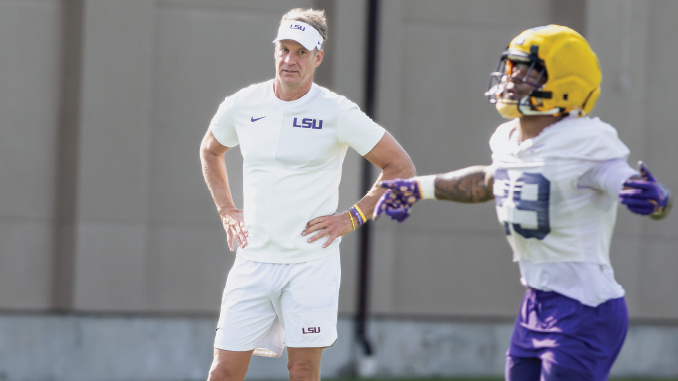
Lane Kiffin ended LSU’s spring football calendar Tuesday the way he has conducted most of his first months in Baton Rouge — with a strange mix of candor, caution and professional detachment. He did not sell fantasy. He did not declare the Tigers fixed. He did not pretend LSU’s expensive new roster is a magic wand.
Instead, Kiffin sounded like the head coach of a football franchise trying to manage a roster in a sport that has become too professional to keep pretending it is not.
That was the real takeaway from Kiffin’s final spring media availability on April 28, 2026, after LSU’s closed final Saturday scrimmage on April 25. Kiffin did provide media access during the spring to several practices and a couple of Saturday scrimmages. But the last scrimmage — the one in which quarterback Sam Leavitt participated in eight seven-on-seven plays — was closed.
That distinction matters. This is not a column about Kiffin hiding an entire spring. It is about how he controlled the most valuable parts of it.
Not the closed workout itself. Not the flashes from Sam Leavitt in seven-on-seven. Not the concern at cornerback. Not even the reminder that LSU spent heavily to rebuild around Kiffin in Year 1.
The real story is this: Kiffin continues to run LSU like an NFL team because the modern version of college football now demands it.
The portal is free agency now
Kiffin said so himself, even if indirectly.
When asked about the absence of a spring transfer portal window, Kiffin said first-year coaches would privately prefer to have one because they have finally had time to evaluate their rosters. Then he described the old portal model for what it had become.
College football, he said, had become like the NFL, “meaning you’re moving through free agency, trying to improve your roster.”
That is not normal coach-speak. That is not a throwaway line. That is the language of roster construction, player acquisition, market correction and personnel departments.
And then Kiffin added the other side of the new reality. Because there is no spring portal window, LSU has nowhere else to go. The Tigers have to develop what they have.
That is the collision point of Kiffin’s first LSU team.
He inherited and assembled a roster in a professionalized college model, but now he has to coach it through a suddenly more restrictive college calendar. In other words, he built through free agency, but now he has to live with the 53-man roster.
Payroll does not guarantee wins
That is why his answers carried so much NFL logic.
When asked about the public reaction to LSU’s massive roster spending — the “$40 million NIL roster” line that has hovered over the program all spring — Kiffin did not confirm or deny the number. But he did answer the premise.
“There’s a lot that goes into a team,” he said.
Then came the more revealing line.
“Wins and losses are never ranked by payroll.”
That could have come from an NFL general manager after a disappointing free-agent class. It could have come from a baseball executive explaining why the highest-spending team does not always win the division. It could have come from any professional coach who understands that money buys options, not chemistry.
Kiffin knows LSU’s roster spending will be used against him. If LSU wins, people will say it bought the team. If LSU loses, people will say it wasted the money.
His answer was not defensive. It was practical.
Money matters. It gives LSU access. It raises the floor. It solves some talent problems. But it does not make players fit together. It does not keep Sam Leavitt healthy. It does not make receivers understand tempo. It does not make corners suddenly become SEC-ready. It does not make an offensive tackle consistent. It does not make the schedule fair.
This is where Kiffin’s thinking separates him from most college coaches. He is not talking about LSU as a collection of stars. He is talking about LSU as a roster ecosystem.
He mentioned quarterback play. He mentioned injuries. He mentioned breaks in games. He mentioned scheduling. He mentioned fit. He mentioned whether players mesh together. He mentioned who the opponent is, when the game is played and whether that opponent’s quarterback happens to be available that week.
That is an NFL coach’s brain applied to an SEC problem.
And he is right.
The lazy way to view LSU in 2026 is to say Kiffin has an expensive roster, so LSU should win immediately. The smarter way is to ask whether LSU has allocated its resources correctly, whether the roster has enough playable depth, whether Sam Leavitt can operate the system, whether the offensive line can protect him, whether the secondary can survive and whether the team can withstand injuries without a spring portal safety net.
Cornerback remains the problem Kiffin would not hide
Kiffin gave a direct answer on one of those questions.
Cornerback depth remains a problem.
When asked whether anyone had stepped up after injuries created more cornerback reps, Kiffin did not dress it up. He said some players did decent things, but “nobody stepped up to make you feel great.”
That is blunt. It is also another NFL-style roster assessment. He did not say LSU has warriors. He did not say the room is full of competitors. He did not hide behind culture language.
He identified a position group that is not where it needs to be and then explained the operational consequence: there is no portal to fix it.
So now LSU must develop the players already on campus, consider position changes, adjust coverages and possibly alter scheme.
That is coaching in the new college football. You do not merely install your system and demand players adapt to it. You evaluate your available personnel and adjust the system to protect weaknesses and maximize strengths.
Kiffin said that, too.
He said LSU has to keep learning its systems, but also make sure it is using players in the right spots and “not just running our system, because that’s what our system was.”
That line matters.
It is the difference between a coach with a playbook and a coach with a personnel philosophy.
Kiffin is not trying to force LSU into a prepackaged identity. He is trying to find the most efficient version of this specific roster. That is what NFL staffs do. They spend the offseason sorting value: Who can play? Who can play multiple roles? Who can survive in space? Who can protect the quarterback? Who can hold up if a starter goes down? Who can be hidden? Who can be featured?
The receiver answer was really a roster-construction answer
That is why Kiffin talked about receivers the way he did.
Kiffin said LSU did not necessarily take the route of spending heavily on one or two elite receivers. Instead, the staff wanted numbers, hoping four to six players emerge. He admitted that approach does not look as exciting when the first unit runs out there, but the tradeoff is the possibility of playing more receivers, lowering snap counts and being stronger later in the season.
Again, that is resource allocation.
It is a cap answer, even in a sport that still pretends it does not have a cap.
Kiffin is thinking in terms of distribution, depth, role definition and late-season durability. He is not chasing the prettiest spring depth chart. He is trying to build a roster that can survive a season.
That same thinking showed up when he discussed injuries and practice volume.
Asked if he wanted another week of spring practice or more offseason opportunities with the team, Kiffin said another week would help. But then he immediately turned to injury risk.
He said he gets concerned about injuries, especially because there is no portal to go to. Then he added the line that exposed the entire new world.
“Now you pay the players so much too.”
That is the sentence old college football still struggles to process.
For decades, coaches could talk about players like unpaid developmental pieces inside a university program. Kiffin is not doing that. He is acknowledging player compensation as part of the competitive equation. If players are being paid significant money, they are assets. If they are assets, their availability matters. If their availability matters, practice structure must account for risk.
That does not mean Kiffin is soft. It means he is rational.
He even suggested college football may eventually go backward and do less in the offseason, especially if a players’ union or more formal contracts emerge. That is another pro-sports thought. Once players have clearer contractual value, teams protect them differently. Workload changes. Injury exposure changes. The offseason becomes more controlled.
That is not Kiffin predicting some distant fantasy. That is Kiffin recognizing the direction of the sport.
Sam Leavitt is being evaluated like a franchise quarterback
College football is not becoming professional. It already is professional in money, pressure, roster movement and expectations. It just has not fully professionalized its rules, calendar or labor structure.
Kiffin is coaching in that gap.
That is why his comments about Sam Leavitt mattered beyond the quarterback position.
Kiffin said Sam Leavitt did a good job in limited seven-on-seven work, throwing a touchdown on his first play and another deep ball that may have gone for a touchdown. But Kiffin spent more time talking about Sam Leavitt’s mental investment than the throws.
He said Sam Leavitt spends significant time around the building, takes the learning seriously and loves the work of football. Then Kiffin made a broader point about players. If he asked every player in the team room whether they love football, every hand would go up. But he said not all of them really do.
Some, he said, love what football gives them — money, gear, attention, social media. Fewer love the actual work.
That was not just a philosophical aside. It was a warning about the modern player economy.
When players are paid, celebrated, ranked, recruited, transferred and marketed earlier than ever, coaches have to determine who loves the work and who loves the lifestyle. Kiffin is not naive about that. He is not romantic about it. He is sorting it.
That is why strength coach Nick Savage appears to matter so much in this build.
Kiffin said players repeatedly mention Savage when asked about the program. They talk about the change in mindset, the work and the feeling that Savage is in it with them rather than simply ordering them through it.
That is culture, but not the fake kind.
For Kiffin, culture appears to mean work habits that translate into performance. It is not posters on walls. It is who stays late. Who studies. Who develops. Who can handle tempo. Who can practice without constant stoppages. Who can be corrected through film. Who can be trusted when the roster cannot be patched through another portal window.
The way LSU practices fits the same theme.
Kiffin was asked about the tempo of team periods and why coaches do not constantly stop practice to correct players after a rep. His answer was revealing. He said stopping for one position coach to correct one player slows everyone down. So LSU coaches effort first, corrects on the fly, uses sideline technology and then coaches off the tape.
That is efficiency. That is volume. That is information capture. That is pro-style process.
LSU is not practicing to make every rep look clean to observers. It is practicing to generate conditioning, mental strain and film. The correction comes through the system.
There is a coldness to that, but also a clarity.
Kiffin is not interested in the old college performance of spring football. He is interested in whether LSU is building a team capable of functioning under pressure in the fall.
Selective access fits the model
That is also why the closed final scrimmage matters.
Kiffin did not shut down the entire spring. LSU provided media access to several practices and a couple of Saturday scrimmages. That matters because the point is not that LSU disappeared from public view. The point is that access was controlled, calibrated and limited around competitive value.
The final Saturday scrimmage, the one in which Sam Leavitt got eight seven-on-seven plays, was closed. Under Kiffin’s model, information is competitive currency. If a portion of practice can be opened without giving away too much, it may be opened. If a personnel development, injury management decision or quarterback evaluation can be protected, it will be protected.
That, too, is NFL behavior.
The public sees some. The operation knows much more.
There will be people who dislike that. LSU fans are used to access, personality, tradition and spectacle. They want to see the team. They want spring storylines. They want certainty in April. Kiffin is giving them some of that, but not all of it.
But he is giving LSU something more valuable if it works.
He is giving LSU an adult football operation built for the sport as it now exists.
And that is the larger point.
Kiffin was not hired merely to call plays. He was hired because LSU needed a coach who understands the new terrain. The transfer portal is not a side issue. NIL is not a side issue. Revenue sharing is not a side issue. Player valuation is not a side issue. Schedule strength is not a side issue. Quarterback protection is not a side issue. Injury exposure is not a side issue.
They are the job.
Modern college football has turned the head coach into a CEO, general manager, cap strategist, recruiter, psychologist, offensive architect and public spokesman. Some coaches are still trying to sound like it is 2006. Kiffin is not one of them.
The schedule answer was playoff-positioning, not complaining
Kiffin understands the absurdity of the current structure. College football wants NFL-level money, NFL-level roster movement and NFL-level pressure, but it still clings to college-style restrictions when convenient. It wants players paid, but not fully contracted. It wants parity, but not uniform scheduling. It wants professional rosters, but not necessarily professional rules.
Kiffin’s first LSU spring sounded like a coach trying to win inside that contradiction.
That is why his schedule comments were not random.
He said college football has not figured out how to properly value schedules. He joked that the same team could go 12-0 against one schedule and 8-4 against another. His point was obvious: in the SEC, LSU may play more NFL-caliber talent in one game than some teams play across much of a season.
That is not whining. That is positioning.
Kiffin is already framing LSU’s season through the lens of strength of schedule, roster attrition and quality of opponent. He knows the College Football Playoff era is partly about winning games and partly about controlling the narrative around the games you play.
That is what elite coaches do now. They coach the team and the perception of the team.
There were still traditional football questions in the transcript. Can LSU tackle? Kiffin said he does not know enough yet because they have not tackled fully. Can the backs handle being tackled? Still unknown. Can the receivers become a true rotation? He can see it, but it is not there yet. Can Weston Davis become consistent at right tackle? He has flashed, but must play down after down. Can LSU’s corners hold up? Not yet a comfortable answer.
Those are real football concerns.
But the context around them has changed.
In old college football, spring was about development, depth charts and optimism. In Kiffin’s college football, spring is about roster audit, risk exposure, asset management and competitive adaptation.
That does not make LSU less emotional. It does not make Tiger Stadium less powerful. It does not make the program less connected to Louisiana.
It simply means the operation beneath the helmet has changed.
Kiffin is not trying to recreate LSU’s past. He is trying to drag LSU into the sport’s present before the present changes again.
That may be uncomfortable for people who still want college football to feel innocent. But LSU did not hire Kiffin for innocence. LSU hired him to win in the marketplace, win in the portal, win with Sam Leavitt, win on Saturdays and win inside a sport that now rewards speed, adaptability and ruthlessness.
His final spring message made that clear.
LSU has talent. LSU has money invested. LSU has Sam Leavitt working back. LSU has young players with high ceilings. LSU has a strength program changing the building. LSU has receivers improving. LSU has serious questions at cornerback. LSU has no portal window to rescue weak spots. LSU has a brutal schedule ahead. LSU has a coach who knows payroll does not guarantee wins.
Most of all, LSU has a coach running the program like the professional football enterprise it has already become.
That is not a criticism.
That is the point.


Be the first to comment