
By TODD HORNE, EXECUTIVE EDITOR
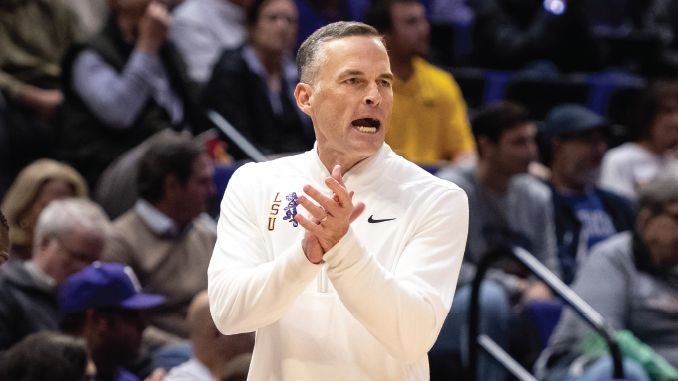
The public debate around Matt McMahon sounds simple.
LSU men’s basketball has struggled. The NCAA Tournament is out of reach — again — barring a miracle run in Nashville at the SEC Tournament. McMahon’s buyout sits around $8 million. So the question becomes obvious: fire him or keep him?
But that question — by itself — misses the larger reality now pressing on LSU athletics.
The Matt McMahon debate is not really about Matt McMahon.
It’s really not even about men’s basketball.
It is about LSU’s new financial structure.
Across the LSU sports ecosystem, a familiar argument has emerged as attendance dwindled late this season and the Tigers again found themselves in a place that has become all too familiar under McMahon — the bottom of the SEC for the third time in four years.
The frustration is understandable.
LSU will eventually make a move, the thinking goes, because LSU has never allowed men’s basketball to sink too low for too long. Sparse crowds and fan apathy eventually force action.
Many fans are still interpreting LSU decisions through the lens of the old financial model.
But in reality, nothing could be further from the truth.
For decades, LSU athletics operated under a simple assumption. When the department believed something mattered — firing a coach, hiring a new one, building facilities, escalating contracts — the money would be found.
If LSU wanted to make a move, LSU made the move.
But LSU is no longer operating under that model.
The economics of college athletics have changed dramatically. Coaching contracts across the SEC have escalated. NIL markets now operate alongside athletic department spending. And the new era of athlete revenue sharing — already hitting athletic department books — adds roughly $20.5 million annually in new costs, with projections rising toward $22 million.
For business leaders, the concept is straightforward. When a company accumulates too many long-term obligations on its balance sheet, every new commitment reduces flexibility elsewhere. The company may still generate significant revenue, but the margin for additional risk shrinks.
LSU athletics now finds itself in a similar position.
Revenue remains strong. But the number of financial commitments the department is already carrying has grown dramatically.
Those new financial realities are colliding with commitments LSU has already made.
Take the Brian Kelly contract as an example.
As explained in my Billion-Dollar Brand analysis, Kelly’s agreement is not a private deal between a coach and a donor. It is a binding employment contract between Kelly and the LSU Board of Supervisors, a public governing body of the State of Louisiana.
That distinction matters.
Because once a public university signs a contract, the obligation belongs to the institution. If the contract is terminated, the buyout must be paid through the university’s financial structure.
Many fans assume that if LSU wants to fire a coach, a wealthy donor can simply step in and pay the buyout.
But that is not how the system works.
Even if donors later contribute money to the athletic department, the liability itself belongs to LSU. The contract sits on LSU’s books.
And once the buyout is triggered, the payment becomes something else entirely.
Once triggered, buyouts become dead money.
Dead money does not recruit players, win games or improve a roster.
It simply sits on the balance sheet.
Buyouts are dead money.
And as coaching contracts across the SEC have grown larger and more guaranteed, those obligations accumulate.
That accumulation is what changes the decision framework for LSU athletics.
There is another theory circulating among fans as well.
Some believe powerful LSU figures — including Governor Jeff Landry, LSU President Wade Rousse and Board of Supervisors chairman Lee Mallett — could ultimately engineer the return of former coach Will Wade regardless of the financial cost.
That belief reflects the same assumption that has shaped LSU athletics for decades: if influential people want something badly enough, the money will somehow appear.
But that assumption belongs to the old financial model.
LSU now operates within a financial structure where major contractual obligations sit on the athletic department’s books and must be carried within its balance sheet.
Influence can shape decisions.
But it cannot erase liabilities.
That reality is why the Matt McMahon debate feels more complicated than a basketball discussion should.
Fans see empty seats and assume LSU will do what it has always done.
But the past is only a reliable guide when the underlying economics remain the same.
And the economics of college athletics are changing rapidly.
LSU athletics is no longer deciding only what it wants to do.
It is beginning to confront what it can afford to carry.


Be the first to comment