
By KACE KIESCHNICK, Tiger Rag Staff Reporter
Over its last two games, LSU was 4-of-9 on its trips to the red zone.
During its latest loss to Texas, quarterback Sam Leavitt threw two interceptions in the red zone. Even settling for field goals in those situations could have generated the six points that would have been the difference in the game, but that does not tell the whole story.
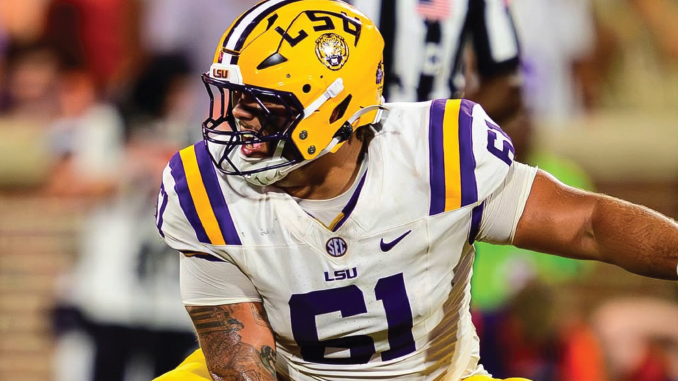
“It’s very easy to point the finger at the quarterback when a team’s not doing well,” fifth-year senior center Braelin Moore said during player interviews on Tuesday. “That’s the first person they point to or the coach, but if you go watch our film, there are a lot of people not doing the right things.”
The Tigers have driven inside their opponents’ 20-yard line 54 times this season, the third most of any team in the nation, but they have come up empty on 10 of those trips and settled for a field goal nine times. Their 81.5% red zone conversion rate is tied for No. 99 in the country while their 64.8% touchdown percentage is No. 51.
That’s not the elite offenses LSU coach Lane Kiffin was known for while at Ole Miss from 2020-25.
“We’re not executing at a high level right now in the red zone, and that’s really plagued us all season,” Moore said. “So, it’s probably really hard on Sam, but we all have his back and we know how great of a player he is.”
Unfortunately for Leavitt, Moore and the rest of the Tigers, the redshirt junior quarterback’s next opportunity to prove his greatness comes against a fearsome defense in Knoxville Tennessee. LSU (6-4, 3-4 Southeastern Conference) visits No. 9 Tennessee (8-2, 5-2 SEC) on Saturday. Kickoff in Neyland Stadium is at 2:30 p.m. on ABC.
The problem for the Tigers this season extends beyond the 20-yard line. In 14 trips inside their opponents’ 40-yard line, the Tigers found the end zone just four times and scored six times in the losses to Texas and Alabama. LSU drives have consistently slowed when the team enters opposing territory, and Moore has an explanation as to why.
“We haven’t really been able to run the ball when the field shrinks,” Moore said. “I think we struggle with that a little bit, and so we found ways to get on the edge of the defense a little bit. And then I think when you’re not running the ball very good, the quarterback’s going to tend to force some things. Everyone plays a part in it. We’re a unit, and so we just keep trying to watch the film and see the things that we’re doing wrong and try to correct it in practice.”
LSU’s rushing attack this season has been leaps and bounds better than the abysmal effort that defined the 2025 Tigers. It ranks No. 48 in the nation and No. 4 in the SEC with 173.5 yards on the ground per game. Lead running back Dilin Jones has taken 185 carries for 838 yards and eight touchdowns in 10 games, ranking No. 4 in the conference in rushing yards and No. 25 in all of college football.
But those gross stats can disguise its true effectiveness. LSU has averaged a respectable 4.35 yards per carry that lands in the middle of the pack in the SEC. The real concern starts when the Tigers need to lean on the run game in situations near the goal line or first down marker. In areas where both sides know the most likely option is to force your way through the trenches and trust your 11 to beat their 11, LSU has been average at best.
In conference play, the Tigers have converted 10 of their 15 attempts (66.7%) on third-and-one or third-and-two. In their four losses, that rate drops to 5-of-9 (55%). In the red zone, LSU has averaged 2.9 yards per carry. Part of the drop-off from the team’s 3.45 overall average can be explained by the limited yardage available near the goal line, but that efficiency ranks No. 75 in the nation. And Kiffin has criticized his guard play since the opener against Clemson.
“Safeties play closer to the box. They got more people up by the line of scrimmage. You got to really want it more than the other teams, and I feel like at times we just haven’t been able to execute in that area,” Moore said.
That congested area of the field is where offensive line play becomes critical, and LSU has just not gotten enough from its front. The unit ranks No. 151 in pass blocking efficiency. In the run game, Moore has earned the highest PFF run blocking grade of the five starters with a 68.4 that is a lowly No. 181 among FBS offensive linemen on a minimum of 100 snaps. Right guard Aliou Bah is next at No. 321, followed by left tackle Jordan Seaton at No. 488, right tackle Weston Davis at No. 694 and left guard William Satterwhite II at No. 796.
“We’re still a work in progress,” Moore said of the interior offensive line. “I think we’ve made tons of strides, because Will obviously didn’t start in the first couple weeks. The first couple weeks of that was kind of just finding the groove, getting on the same page all together. But obviously we still have some things we got to work on.”

Be the first to comment