
Tiger Rag · Todd Horne · Commentary
LSU Can’t Close a Deal
For two minutes and eight seconds Saturday, Tiger Stadium had something to believe in besides its own capacity to make noise.
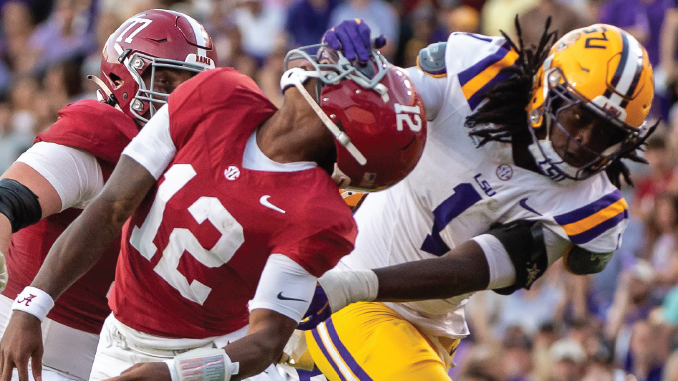
LSU had driven 90 yards, Dilin Jones had scored from five yards out, and the Tigers led Alabama 13–10 with 2:44 remaining in the third quarter. From the press box, the place was going nuts. An afternoon of squandered chances had finally yielded a touchdown, and a crowd that had helped disrupt Alabama’s offense had every reason to expect its next contribution might matter.
Then Rico Scott caught a 57-yard pass on Alabama’s first snap. Keelon Russell escaped for a first down on third-and-nine. Josh Ford appeared inexplicably alone in the front corner of the end zone, where Russell found him for a seven-yard touchdown.
Five plays had consumed LSU’s entire lead. By the time Alabama finished winning 31–13, the Tigers had supplied a more complete explanation of their season than anything Lane Kiffin could offer afterward. They could move the ball, stop the run and summon the stadium. They could get themselves to the point where a game was waiting to be won.
They could not close the deal.
On Sunday morning, the numbers deserve a second look because they make the defeat harder to accept. LSU outgained Alabama 457–285, collected 27 first downs to the Tide’s 13 and ran 81 plays to Alabama’s 53. The Tigers held the ball for 32 minutes and 45 seconds. Those are substantial advantages to carry into an 18-point loss.
Data analyst Jeff Asher, in a finding shared by Fletcher Mackel, placed that contradiction in historical company: LSU was the first college team since West Virginia in 2004 to lose by at least 18 points while gaining 450 or more yards and holding its opponent below 290. That West Virginia team lost 36–17 to Boston College. More than two decades separated the examples. LSU’s waste was exceptional even by the standards of teams that find a way to lose.
The geography makes the failure worse. As Tiger Rag’s Kace Kieschnick reported, LSU ran 49 plays in Alabama territory — 60 percent of its offensive snaps. Eight of its ten possessions reached at least Alabama’s 38-yard line. These were opportunities the Tigers repeatedly created and then failed to finish.
Five of those eight possessions produced nothing: a missed field goal, an interception and three turnovers on downs. LSU’s four red-zone trips yielded one touchdown and ten points. Alabama’s three produced three touchdowns and 21 points. The Tide needed fewer chances and did twice as much with them.
Sam Leavitt completed 35 of 47 passes for 380 yards. Jackson Harris caught 11 for 166; Trey’Dez Green, questionable entering the game, caught 10 for 85. Kiffin recited those kinds of numbers afterward and reached an understandable conclusion: “I wouldn’t think that would equal 13 points.”
Yet there were the 13 points, attached to his team and his offense after two weeks to prepare. Alabama’s aggressive coverage and disguised pressure near the goal line deserved credit. “There’s risk in that. We didn’t make them pay for it,” Kiffin said, as reported by Tiger Rag’s Kace Kieschnick. Alabama was willing to leave openings to force LSU into hurried decisions. The Tigers reached the part of the field where that wager had to be punished and let the Tide collect instead. After two weeks to prepare, that failure belongs to the offensive staff as well as the players.
The defense’s accounting was equally uncomfortable. LSU held Alabama to 79 rushing yards on 29 attempts, a 2.7-yard average. Even removing three closing kneels, the Tide managed only 85 yards on 26 carries. That is very good run defense. Alabama converted only three of 11 third downs, and Blake Baker’s unit had kept the game manageable while LSU’s offense spent the first half producing three points.
But one of those three conversions was Russell’s ten-yard escape on third-and-nine, with LSU protecting its first lead. The season’s most consequential afternoon had narrowed to a quarterback, an open field and a stop the Tigers needed. Russell got the yardage. Ford got the touchdown on the next snap.
That is the distinction the respectable defensive totals cannot conceal. LSU did enough to create the opportunity, then folded when it had something to protect.
Alabama scored 10 points in the first 42 minutes and 16 seconds. Over the next 11 minutes and 21 seconds, it scored 21, reaching the end zone on three of its next four possessions. Those three touchdown drives required nine offensive snaps and covered 118 yards. Russell completed six of seven passes for 103 yards and three touchdowns on them. LSU did not sack him again after taking the lead.
Two of those scoring drives began on LSU’s side of the field, a significant part of the explanation. The first began at Alabama’s 25, immediately after Jones’ touchdown, with the entire stadium available to help the defense. That possession is the one Baker’s unit has to own without qualification: the explosive completion, the lost quarterback on third down and the uncovered tight end.
Ford was wide open in the front corner of the end zone. Alabama had arranged a scoring opportunity that demanded neither a difficult throw nor a contested catch. LSU had nobody there to make either necessary. A seven-yard touchdown should require the offense to beat somebody. Alabama’s design and LSU’s breakdown removed that requirement. Baker’s staff has to answer for a defense that lost the quarterback on third down and the tight end on the next snap.
The Tide had delivered an earlier demonstration on its first touchdown, a one-yard reverse to Ryan Coleman-Williams. He waltzed into the end zone. He could have curtsied. He didn’t.
Against a defense that made conventional rushing difficult, Alabama’s staff found a different way to finish. Later, it found Ford alone. Alabama’s coaches manufactured easy finishes while LSU’s offense kept discovering new complications near the goal line. The difference showed up in the end zones.
LSU’s failures fed one another as the fourth quarter unfolded. After the Tigers were stopped on third-and-one at their own 16, a delay penalty backed up the punt unit. Coleman-Williams returned the punt 32 yards to LSU’s 25. Russell hit Cederian Morgan for a touchdown on the next play.
On LSU’s following possession, Leavitt was sacked twice. The second sack came on fourth-and-ten at LSU’s 25, leaving Alabama the ball at the 18. A nine-yard completion, a five-yard run and a four-yard touchdown pass to Kaleb Edwards finished that possession. Alabama had turned two short fields into 14 points in four snaps without facing third down.
Special teams and the offense had created those circumstances. The defense made no interruption. Short fields explain why Alabama needed so little yardage; they do not explain why every snap moved it closer to another touchdown.
Kiffin’s decision to go for the fourth-and-ten was defensible with LSU trailing 24–13. By then, his team had made desperation a reasonable strategy. The earlier waste was harder to defend, particularly Leavitt’s interception late in the first half, when LSU was in Alabama territory with an opportunity to cut into a 10–3 deficit.
“He had the really poor interception in the first half, which is just trying too much,” Kiffin said. The underneath throw against the zone was available, he explained, with a chance at a field goal to follow. Leavitt pursued more and delivered nothing. LSU finished with four sacks allowed, four failed fourth downs and no passing touchdowns to accompany those 380 yards. There was no Alabama giveaway to offset Leavitt’s interception or Wilson’s later muff. The Tigers surrendered possessions and recovered none.
Even the ending belonged to the same pattern. LSU reached Alabama’s seven and failed on fourth down. The defense then forced a punt, only for Eugene Wilson III to muff it and Alabama to recover. A stop had finally bought another chance, and LSU dropped it.
I picked the Tigers to win. Harris’ performance, Green’s production and the run defense show why the matchup offered legitimate encouragement. What LSU failed to demonstrate was the ability to connect those strengths when the game required it. Saturday became an afternoon in which each unit could point to somebody else’s failure and still have plenty of its own to explain.
Asked what prevented this team from making the winning plays necessary in games like this, Kiffin said, “I don’t know.” Then he said it again: “I don’t know.”
LSU is 6–3. It has lost four straight to Alabama, all by double digits. Kiffin is 0–6 against the Tide as a head coach, and his first LSU team now needs help to reach the playoff. Asked whether he expected this record, he said, “I did not think that, but it is where we are.”
Texas arrives next Saturday, and Kiffin has more to repair than a red-zone package. His offense needs a dependable answer when space runs out. His defense needs to finish the stop after winning the first two downs. His special teams need to return the ball to the offense. At 6–3, the work is specific. So is the responsibility for getting it done.
With 2:44 left in the third quarter Saturday, LSU had the lead and Tiger Stadium had the noise. Two minutes and eight seconds later, Alabama had the lead back.
The crowd had done its part. LSU still owed the finish.


Be the first to comment