
By GLENN GUILBEAU, Tiger Rag Editor
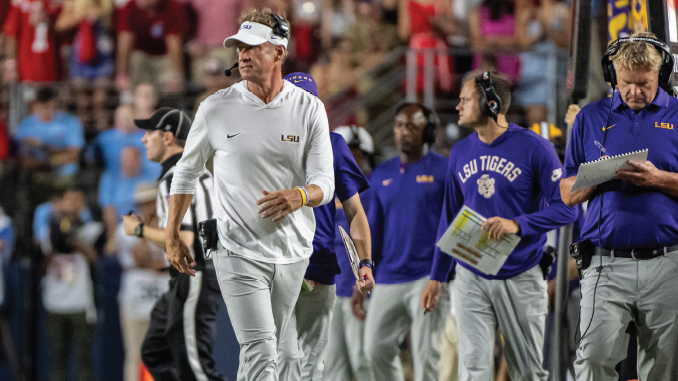
LSU coach Lane Kiffin was still smarting about the officiating in his team’s 35-34 overtime loss at Kentucky Saturday night during his weekly press conference on Monday, particularly Kentucky quarterback Kenny Minchey’s 1-yard touchdown scrum on fourth-and-goal that ended the first half with the Wildcats up 21-17.
Kiffin said he turned that replay into the Southeastern Conference office.
“Yeah, we haven’t got that back yet,” he said. “It is what it is. I didn’t think it was a really well-officiated game on our side.”
The goal-line play was reviewed to see if Minchey’s forward progress had stopped before he crossed the plane of the goal line under a sea of players. Minchey was determined to be “not down by contact,” according to the Kentucky play-by-play report.
Doesn’t look like Kenny Minchey’s forward progress is stopped long enough to say he didn’t score. Judgment call. Seen TDs like this a lot. Guy’s initially stopped for a second, but keeps pushing. And being pushed is legal. https://t.co/Ap0EEOROyT
— Glenn Guilbeau (@SportBeatTweet) October 12, 2026
Replays show Minchey’s forward progress being stopped initially, but he proceeds to push into the pile, which often happens in scrum situations in football for “second-effort” touchdowns or first downs. Replays do not clearly show Minchey under the pile, but they do show running back CJ Baxter pushing Minchey from behind, which is legal. It doesn’t appear that Baxter is pulling Minchey, which would be illegal. That would also be difficult for Baxter, as he is behind Minchey.
By the time, Minchey can be seen on film, virtually his whole body is in the end zone. But the question is if his forward progress stopped.
Forward Progress Rule 2-9-2 in the NCAA Manual states that “forward progress is defined as the end of advancement by a ball carrier or airborne pass receiver, applying to the position of the ball when the ball is declared dead.” But it has always been a judgment call, subject to interpretation, exactly when forward progress is completely stopped.
The play was originally ruled a touchdown, and replays apparently did not show enough to reverse the call.
On Sunday during his weekly teleconference with reporters, Kiffin discussed his conversation with line judge Jake Osgood about Minchey’s 1-yard touchdown push.
“The line judge just said, ‘Being in that situation, there’s just too much at stake,'” Kiffin said. “He said he’d be killed if he would’ve blown the whistle for the play being stopped, even though it appeared to be stopped.”
SEC coordinator of officials John McDaid did not return a call to the SEC offices in Birmingham, Alabama, on Monday afternoon requesting comment and to confirm that Osgood told Kiffin what Kiffin said he told him.
Also still not confirmed are the comments Kiffin made to ESPN on Nov. 30 that Ole Miss fans tried to run him off the road as he drove to the airport in Oxford, Mississippi, to board a plane to Baton Rouge to become LSU’s new coach. Various law enforcement officials never confirmed that accusation by Kiffin, but that would be difficult to do, unless Kiffin took a video of that or if the “Ole Miss fans” came forward.
“My complaint always is, if you would’ve blown that whistle on first down, or if there were 10 minutes left in the game (or first half), for forward progress being stopped, don’t not blow it because it’s such a big play,” Kiffin said on Sunday. “The rules are the rules, so if you see that way, then you see it that way. It all comes down to just blowing the whistle. It is what it is.”
Upon further review, Osgood calling Minchey’s forward progress stopped on that play would not have been as dangerous then as at other parts of the game. It was the last play of the half, so Osgood could have escaped the field easily. It wasn’t like he had to remain on the field for more plays. It was also not the last play of the game when he would have had to negotiate a field full of storming fans.
Plus, it is very hard to believe that Osgood would have made such a strong admission to a coach that he thought “he’d be killed” if he ruled against a Kentucky TD in that moment.
Kiffin was less accusatory on Monday and took up for game officials in general.
“There are other ones (games) that I think are really good (well-officiated), and they miss on the other side,” Kiffin said. “So, that’s going to happen. And over the course of time, it’s all probably going to all even out. But I feel like things were missed (at Kentucky) – a block in the back on the punt return.”
Kentucky took a 14-10 lead in the second quarter on a 55-yard punt return by Brock Coffman. That play was reviewed to see if Coffman stayed inbounds. Replays showed his foot may have just reached out of bounds, but the original call of him not being out of bounds was retained.
“But they happen both ways over time. In the game, it’s not always evened out. They have a hard job,” Kiffin, the peacemaker, continued. “They have a really hard job to do. We watch it all on TV and in slow motion. They don’t always get to do that. They’ve got to make snap judgments.”
Be the first to comment