
By KACE KIESCHNICK, Tiger Rag Staff Reporter
The LSU rushing attack has been all over the place through the first four games of 2026.
First, the Tigers put up more rushing yards than they did in any game last season in the opener versus Clemson (309). Then, all that heralded progress seemed to disappear when Louisiana Tech’s 3-3-5 defense dominated the line of scrimmage. Even Ole Miss presented a tale of two halves: 66 yards on 3.4 yards per carry (ypc) by LSU in the first and 106 yards on 4.4 ypc in the second.
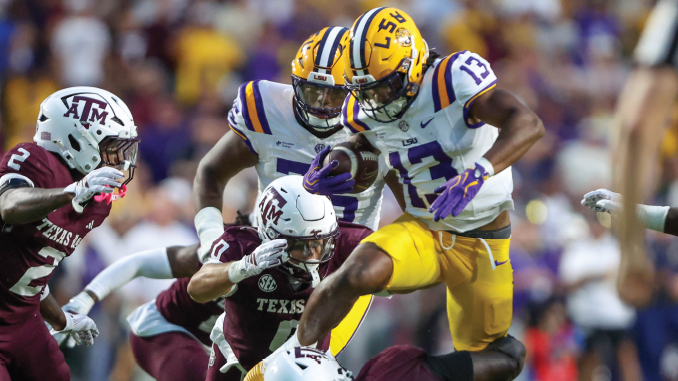
The LSU run game looked the most consistent it has since the first game of the season in the 35-6 win over Texas A&M on Saturday. The numbers again improved as the game went on, and the Tigers relied on the run more heavily to bleed the clock in the second half. But LSU totaled 194 rushing yards and three rushing touchdowns while averaging 5.1 ypc.
Through four games, the Tigers rank No. 29 in the nation and sixth in the Southeastern Conference in rushing with 205.5 yards per game. Lead running back Dilin Jones is No. 31 in the nation and fifth in the SEC with 348 rushing yards on 78 attempts and has four touchdowns. Quarterback Sam Leavitt is tied for fifth in the country with six touchdowns on the ground and has rushed 45 times for 220 yards. No other Tiger has over 100 rushing yards.
When new coach Lane Kiffin arrived in Baton Rouge, the once-proud Bayou Bengals run game laid in hibernation. He pledged to bring back an established traditional run game.
Not just because it is the foundation of a reliable offense. He said it was a mindset. An identity. An offensive belief that my 11 are tougher than your 11, and we can do what we want when we want to.
And so far, LSU’s run game is a major success compared to the previous two seasons. In 2025, LSU finished 124th of 134 FBS schools in rushing with 104 yards a game and last among the 16 SEC programs. In 2024, the Tigers finished 107th in the nation and last in the SEC out of 16 teams with 116.4 yards a game.
But through four games of 2026, the question remains: Can LSU’s offensive line impose its will on opponents when it needs to?
That may depend on what direction the run is going.
After running up and down the field against Clemson, Kiffin still expressed doubts about his interior line. He said the Clemson defensive tackles were not the strength of its defense, and LSU’s guard play needed to be better. After Tech, he said the Tigers struggled with the unique front. Kiffin did not have to say anything after Ole Miss because defensive tackle Will Echoles made those concerns so apparent that Tennessee transfer William Satterwhite II took over the starting left guard spot ahead of Bo Bordelon in the next game against Texas A&M.
A look at the efficiency of the LSU interior run game follows.
Pro Football Focus tracks every rush and sorts them by what direction or spot on the offensive line the carry goes toward. This data actually shows that runs to the A-gaps on either side of the center are actually the second and third most efficient channels on the LSU offensive line. The Tigers have run to the right of the center 23 times, tied for the most common run direction, and average 6.1 ypc. Runs have gone to the gap left of the center 16 times for a less efficient 4.8 ypc.
LSU has been successful running into the heart of the defense so far this season. Even against Ole Miss’s interior defense, the Tigers averaged 5.5 and 4.8 ypc in the A-gaps. The drop off when going to the left side reflects why Kiffin felt it was necessary to make a change at left guard. But LSU has also averaged 4.6 ypc when running to the B-gap between the left guard and tackle.
Runs behind the right side have actually been some of the least common and least efficient. The Tigers have only attempted seven rushes to the right-side C-gap, outside the right tackle or between him and the tight end if one is present, and averaged one yard per carry – the worst of any direction. Runs between the right guard and tackle have averaged 3.1 yards on 16 attempts. There were definite questions of how right tackle Weston Davis could progress after struggling during his redshirt freshman campaign last season, and this small sample size shows those struggles still exist.
There were also questions of how left tackle Jordan Seaton could improve as a run blocker when he came to LSU. The Colorado transfer was one of the top prospects in the transfer portal and is known for being elite in pass protection. But through the first four games of 2026, the data shows he may need to step up his run game. At first glance, the 15 runs to the outside of the left tackle have averaged 6.7 ypc, the best mark of anywhere on the offensive front. But that number drops to 3.9 yards an attempt when a single, 46-yard run by Dilin Jones is excluded, even though you can’t.
The two other directions that tie for the most frequent are the right and left edges, or runs to the outside of an in-line tight end. LSU has rushed 23 times to both outside edges and averaged 4.6 ypc on the left side and 3.8 ypc on the right.
As a whole, the Tigers have had more success running to the left side of the offensive line. Of the 863 total rushing yards tracked by PFF (not including lost yardage from sacks), 355 yards have come on the 70 runs to the left side (5.1 ypc) while 69 right-side runs account for 281 yards (4.1 ypc). The other 227 rushing yards come from jet sweeps and quarterback scrambles, sneaks and fumbles.
The team’s 4.5 ypc overall this season (No. 44 in the nation) is still a marked improvement from last year’s 3.6-yard average (No. 115), but work could still be done to improve the run game, especially on the right side.
The Tigers’ PFF team run blocking game through the first month of the season is a 51.6, which ranks No. 125 in the nation, but the overall rushing grade is No. 63 at a 79.4. Leavitt has produced 152 yards scrambling, and 264 of the powerful Jones’s 348 rushing yards have come after contact.
LSU’s next opponent, FCS McNees State (6:45 p.m. Saturday, SEC Network) is not tracked by PFF.
The Tigers’ opponent on Oct. 10 will be No. 24 Kentucky (6 p.m., ESPN) on the road. The Wildcats’ defense has allowed 122.2 rushing yards per game (No. 60) and is ranked No. 99 by PFF (73.1).
The Tigers’ biggest challenge in October will come on Oct. 17 at home against Mississippi State, which gives up 104.8 yards a game (No. 36) and is ranked 45th by PFF (84.9).
Auburn, which hosts LSU on Oct. 24, similarly has an 82.2 PFF run defense grade that ranks 53rd in FBS, but has allowed 127 rushing yards a game (No. 66).
Be the first to comment