
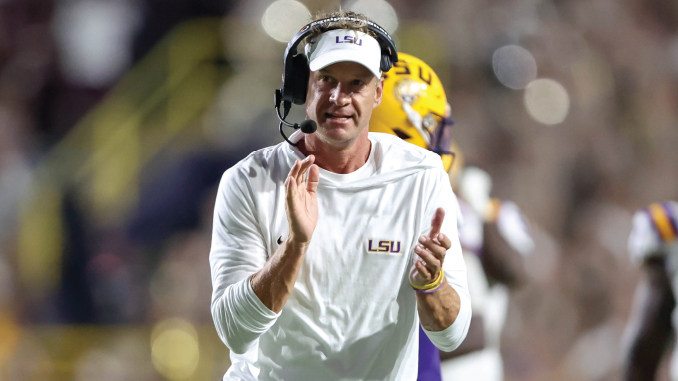
Same Opponent, Same Stadium, Different LSU: The Lane Kiffin Reset Is Real
No. 10 LSU turned its most important game of the young season into a 35–6 domination of No. 23 Texas A&M, providing a near-perfect comparison with the collapse that cost Brian Kelly his job.
The Lane Kiffin Reset needed proof, not branding. Texas A&M supplied the perfect test Saturday night.
Same opponent. Same stadium. Same halftime test. One year ago, the Aggies overpowered LSU 35–7 in the second half of a 49–25 victory that ended Brian Kelly’s coaching career the next day. This time, LSU scored three touchdowns in the third quarter, did not allow one all night and beat Texas A&M, 35–6.
That comparison supplied the clearest proof yet of what Tiger Rag called the Lane Kiffin Reset in its football guide in August. The phrase was not preseason branding Saturday. It was a 29-point victory and a 53-point swing from the margin of the game that ended the previous LSU era.
LSU produced 506 yards and held Texas A&M to 197, a 309-yard advantage. The Tigers averaged 7.7 yards a play to the Aggies’ 3.3 and finished with 20 first downs to A&M’s 11. Sam Leavitt completed 17 of 23 passes for 312 yards, two touchdowns and one interception. Jackson Harris caught six passes for 163 yards and both scores, while Winston Watkins Jr. caught five for 107. Blake Baker’s defense allowed two field goals, one play of at least 20 yards and no touchdowns. LSU had lost three of its previous four games against A&M and had not beaten the Aggies since 2023. This one carried considerably more weight than a September division of wins and losses.
Kiffin opened his postgame press conference by reading the evidence. “That’s a really quality win,” he said. “Win 35–6 and really kind of dominating numbers, 500 yards to 197.” His next sentence explained why the result reached beyond the quarterback, the play caller or the defense: “When those things happen, that’s a lot of people doing things right.”
The preparation pleased him as much as the production. Kiffin said the Tigers accepted his challenge to “forget everything — forget last week, forget rankings,” recapturing the collective excitement and purpose they had carried into the season-opening demolition of Clemson. He had asked for a “suffocating defense” against A&M. LSU delivered one.
This was not technically a College Football Playoff elimination game. In almost every practical way, it was. LSU and Texas A&M arrived 2–1 overall and 0–1 in the SEC after damaging conference losses one week earlier. The winner would leave with every major goal intact. The loser would be 2–2 and 0–2, its championship ambition reduced to arithmetic and wishful thinking before October began. LSU did not escape that pressure. It overwhelmed it on both sides of the ball.
Kiffin reduced LSU’s first month to one blunt assessment: “I think this team has played really well in general but one half of football.” That half came at Ole Miss. The response came seven days later against an opponent with an even more damaging recent history against LSU.
The game’s most revealing individual development came from a quarterback whose body temporarily prevented him from being the quarterback he usually chooses to be. Leavitt injured his left hamstring in the second quarter, went into the medical tent and returned with the leg wrapped. He struggled to bear weight and could no longer trust his legs to rescue him when patience inside the pocket began to feel uncomfortable.
So Leavitt stayed. He set his feet. He allowed routes to clear and worked through progressions that his athletic instinct too often causes him to abandon. The injury did not make him a better passer. It removed the escape route that had sometimes prevented him from showing how good a passer he could be.
“I joked with him, maybe it was the best thing that happened to him, so he can’t run around all the time — set his feet and throw. But Sam did a great job.”
Lane Kiffin to ABC after the game
The press conference supplied the rest of the story. “Sam obviously is very injured,” Kiffin said. He was preparing to remove Leavitt, but the quarterback refused. “He said no way was he coming out,” Kiffin said, calling it a “really gutsy performance.” Kiffin identified it as a hamstring injury and offered only a general timeline: “It’ll eventually come back, but it’ll take a little bit of time.” When asked what he liked most about Leavitt’s passing, Kiffin began with his toughness before mentioning any throw.
Leavitt had prepared for the lesson before his hamstring enforced it. ABC reported that he had worked with his mental coach during the week on cues intended to slow him down, keep him on time and make him trust LSU’s passing structure. His mind supplied the method. His injury removed the alternative.
LSU needed both because its offense did not begin the game with any appearance of dominance. The Tigers went three-and-out on their opening possession, answered with an 82-yard touchdown drive and then surrounded it with more empty series. Leavitt began a third-down slide too early and surrendered a first down he could have reached. On fourth-and-1, LSU deliberately accepted a delay penalty after trying to draw A&M offside, never intending to snap the ball.
Kiffin remained irritated by the slide afterward. “He’s not supposed to do that,” he said. “We show film of that all the time.” LSU had studied examples of quarterbacks costing their teams games by beginning slides near the line to gain. Leavitt believed he had crossed it; Kiffin’s point was that the decision never should have been left that close.
At halftime, Kiffin accurately called the offense “hit and miss.” LSU had two touchdown drives and too many three-and-outs between them. New starting left guard William Satterwhite was called for holding and later wiped out a Harris touchdown by drifting illegally downfield. Yet Texas A&M did not record a sack against either LSU quarterback. Even the final score should not conceal the work that remains.
But A&M’s best possession also revealed how completely LSU could control the terms of the game. The Aggies drove 62 yards in 15 plays and consumed 8 minutes, 8 seconds in the second quarter, running for 48 yards after gaining only 43 on their first three possessions. They reached LSU’s goal line with an opportunity to change the game.
Baker’s defense changed the meaning of the drive instead. Princewill Umanmielen penetrated. TJ Dottery replaced correctly when Marcel Reed threatened to keep the ball. P.J. Woodland prevented Reed from escaping inside the 10. LSU eventually forced Reed to finish the possession as a passer, and an off-target fade left A&M settling for a field goal and a 7–3 deficit.
Leavitt came up limping on LSU’s next possession. The staff treated his hamstring in the medical tent, and he emerged with his mobility visibly reduced. What disappeared from his game was the frantic part.
He converted third-and-7 to Watkins by waiting for a clear-out route to create space. After Satterwhite’s holding penalty produced first-and-20, Leavitt stayed behind sound protection and waited for Watkins to complete a slow-developing deep crossing route. Watkins reached halftime with 86 receiving yards. Leavitt then found Harris in the back of the end zone, where the Hawaii transfer used his frame to shield Rylan Humphrey and give LSU a 14–3 lead.
Watkins did the sustaining work. His five catches on six targets produced 107 yards, and 42 came after the catch. He converted third-and-5 on LSU’s first touchdown drive, converted third-and-7 on its second and aligned outside, in motion and in the backfield. With starting tight end Trey’Dez Green unavailable, Watkins did not merely inherit more targets. He became the movable answer who kept LSU’s offense on the field until its rhythm arrived.
Harris supplied the damage after that rhythm arrived. His six catches on eight targets produced 163 yards, 69 after the catch. He used his body to win the first touchdown, then disappeared behind A&M’s fourth-down overreaction for the 57-yard score that broke open the game. His third touchdown was erased by Satterwhite’s penalty, but Harris still averaged 27.2 yards per reception and scored twice. Watkins repeatedly extended LSU’s possessions. Harris repeatedly ended them.
Kiffin had told Harris to expect the responsibility. The coach said he spoke to the Hawaii transfer as soon as Green was ruled out and challenged him to step forward. Harris had impressed the staff without receiving many opportunities, Kiffin said, showing on LSU’s practice field the same traits that had attracted the Tigers to “a big, sleek outside receiver” in the portal. Without Green — normally the offense’s clear leader in targets — LSU leaned more heavily on four-receiver sets and found Harris ready for the work.
Harris had received another challenge from Jarvis Landry, the former LSU receiver who reminded the position group that LSU’s season and offense would depend upon its receivers making plays and living up to the standard established by Landry, Ja’Marr Chase, Justin Jefferson and the stars whose names surround them. Harris said the message settled into the room. His own patience had been tested after he transferred from Hawaii, where he caught 49 passes for 963 yards and 12 touchdowns last season. “The work is the work regardless,” Harris said. He could not know when it would pay off. Saturday night, it did.
LSU’s domination was not confined to Leavitt and his receivers. The Tigers rushed 38 times for 194 yards and three touchdowns, averaging 5.1 per carry, while A&M managed 91 yards on 33 attempts. Dilin Jones carried 14 times for 63 yards and LSU’s first touchdown. Harlem Berry added 58 yards on seven carries after Kiffin gave him the opportunity to work as LSU’s No. 2 back. “He responded well,” Kiffin said. Landen Clark ran nine times for 41 yards and two touchdowns after replacing the injured Leavitt.
LSU carried a 14–3 lead into halftime, a circumstance that could not be separated from the previous two meetings. The Tigers led A&M 17–7 in 2024 and lost 38–23. They led 18–14 last year before the Aggies took over Tiger Stadium and ended Kelly’s tenure. Another halftime advantage placed the old failure directly in front of Kiffin’s team, and the Tigers ran through it.
Baker attacked the first third down of the second half instead of protecting an 11-point lead. Dottery occupied the protection, Tamarcus Cooley timed the overload and reached Reed untouched for a sack. A&M punted, and LSU answered with the play that contained the entire night.
On fourth-and-1, LSU presented the direct-snap look to Dilin Jones that Kiffin had already placed on film. The Tigers shifted their tight ends. A&M shifted toward Jones. The snap instead went to Leavitt, who faked the handoff and found Harris alone behind a defense defeated by its own certainty.
The 57-yard touchdown made it 21–3. It was more than fourth-down aggression. It was self-scout transformed into deception, Kiffin using LSU’s own tendency as A&M’s trap.
Harris knew what was coming as soon as the call arrived. LSU had rehearsed the play throughout the week, he said, and his heart began beating faster because he knew it would work. That certainty said as much about the Tigers’ preparation as the open field in front of him.
Kiffin admitted he almost denied himself the moment. LSU’s defense was playing so well that he initially planned to punt. “I caught myself at the last second,” he said, remembering that the Tigers had held the play for weeks for precisely that situation. “That’s not kind of how we roll. It’s not how we talk to our team, of being conservative.”
Then Kiffin attached the decision to LSU’s new identity. “This is who we are,” he said. “We go for it. We’re aggressive. We take shots in those situations even though we’re ahead.” He even acknowledged that such decisions were “probably part of why we were hired here.”
The Aggies soon faced fourth-and-1 at their 34. Umanmielen stayed disciplined on the read, refused to chase the false key and forced Reed to hand off. Davhon Keys, left unblocked, filled the path and made the stop. LSU converted the sudden change into another touchdown, with backup quarterback Landen Clark following a pulling guard on power and Malachi Thomas sealing the edge in Green’s absence.
One fourth down showed LSU anticipating what A&M expected. The other showed LSU trusting every defender to perform his assignment. Together, they turned a controlled 14–3 game into a 28–3 demonstration of preparation, execution and force.
Reed had tormented Baker’s LSU defenses for 170 rushing yards and five touchdowns in the previous two meetings. LSU’s answer did not begin during Texas A&M week. “We discussed that in January,” Kiffin said. Baker and his staff spent part of the offseason building a plan for the mobile quarterback who had twice broken LSU’s defense. “This didn’t start this week,” Kiffin said. “That game plan was unique.”
Saturday, LSU made Reed play quarterback without allowing him to become a runner. He completed 10 of 26 passes for 106 yards, no touchdowns and one interception. Four LSU sacks for 41 yards left him with minus-13 net rushing yards on 10 attempts. Cooley came free from the secondary. Deuce Geralds chased him down from the interior. Umanmielen compressed the edge without opening Reed’s preferred exit. A&M never developed a counter.
Kiffin singled out Geralds, a true freshman producing in a sport increasingly stocked with veteran transfers. “There aren’t many stories like that out there anymore,” Kiffin said. “Everyone’s portalized.” Geralds’ ability to contribute immediately became another small proof that LSU’s rebuild was not limited to the players it purchased from other college programs.
The defense also refused to give the Aggies artificial life. Texas A&M safety Marcus Ratcliffe intercepted a tipped Leavitt pass and gave the Aggies possession at LSU’s 40. They gained four yards and settled for a 53-yard field goal. Tamarcus Cooley later intercepted Reed, and when A&M eventually replaced him with Brady Hart, reserve cornerback Michael Turner Jr. intercepted Hart. The Aggies finished 10-of-27 passing with two interceptions. Neither LSU’s starters nor its backups allowed them into the end zone.
“I’ve not been around this many significant injuries early in the year like this,” Kiffin said. The roster’s response encouraged him, but the accumulation concerned him. Kiffin understood that even the deepest portal class cannot indefinitely absorb the loss of players as important as Green, Spears and Weeks.
Kiffin made sure the quarterback story did not overshadow the game’s foundation. “Really, defensive story today, holding them to two field goals,” he told ABC. He called it “a good SEC win against a quality team” and a response to the devastation of losing a game at Ole Miss that LSU believed it could have won.
The coach resisted the suggestion that Ole Miss had been LSU’s Super Bowl. “It wasn’t our Super Bowl,” Kiffin said. “So, we got to the next day.”
That next day arrived with LSU 3–1 overall and 1–1 in the SEC, its championship possibilities intact. This was not a desperate team surviving an essential game. It was a ranked team administering a two-sided beating to another ranked team while playing without Green and Spears, losing Weeks for the night, sending Watkins to the sideline injury tent and operating with its quarterback on one healthy leg.
Kiffin also made the victory belong to the people who had watched A&M empty Tiger Stadium a year earlier. He called Saturday’s crowd “awesome” and “electric,” then noted the reversal waiting at the finish: the Aggies’ fans were the ones gone at the end. “It was good payback,” Kiffin said. “Happy for our fans.”
ABC repeatedly called it “the reset right here at home.” The description fit because the evidence was not abstract. It was the same opponent, the same stadium and the same halftime test that had exposed LSU one year earlier. A&M had once taken over the second half, overpowered LSU and ended its coach’s career. This time, LSU owned the second half, overpowered A&M and gave the Lane Kiffin Reset its first definitive proof.
Be the first to comment