
TigerRag.com Analysis
TigerRag.com-Adjusted PFF Grades Reveal LSU–Ole Miss’ Pressure Points
Lane Kiffin identified the stresses awaiting LSU in Oxford. A snap-weighted analysis of PFF grades shows where Ole Miss can apply them—and where the Tigers can answer.
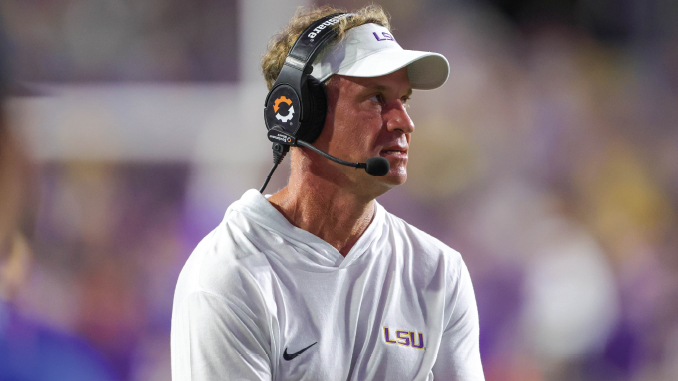
Lane Kiffin walked into his Monday press conference carrying two versions of LSU’s trip to Oxford.
One was the spectacle waiting outside the lines. No. 7 LSU against No. 8 Ole Miss. Kiffin returning to the stadium where he built the winningest team in school history, only to leave before it entered the College Football Playoff. Pete Golding, his former defensive coordinator, sitting in his old chair. A Vaught-Hemingway Stadium crowd preparing to make every LSU possession sound personal.
The other version was football stripped of its emotion: protections, personnel groupings, leverage, pressure packages and individual matchups. Kiffin tried to steer his players toward that one.
“You just get to go play. The pressure’s not on you.”
Lane Kiffin on what he told LSU’s players Monday
The Pro Football Focus grades from each team’s second game explain where the football pressure will come from. Ole Miss brings the higher-graded quarterback, running back, receiving corps and offensive line. LSU counters with substantially better grades at safety, linebacker and along the interior defensive line.
Ole Miss will try to move LSU’s defensive strength away from the middle and force its cornerbacks to defend open grass. LSU will try to use tight end Trey’Dez Green to attack Ole Miss’ weakest safeties. Golding will attempt to reopen the protection problems Louisiana Tech uncovered, while LSU defensive coordinator Blake Baker must disturb an Ole Miss quarterback who looked almost untouched against Charlotte.
Kiffin addressed several of those fault lines Monday without seeing TigerRag.com’s calculations. His assessment of LSU’s offensive line was harsher than its adjusted grade. His description of Ole Miss’ backfield was more lavish than the numbers required. His explanation of Golding’s tactical advantage went directly to the way Ole Miss may attack LSU’s protection.
The grades and Kiffin’s words arrived at many of the same places.
The first collision: Kewan Lacy against LSU’s defensive spine
Kiffin recruited Trinidad Chambliss and Kewan Lacy to Ole Miss, developed them inside his offense and rode them to an 11-1 regular season before leaving for LSU. Now they are waiting for him in Oxford.
He did not pretend they are ordinary returning starters.
“They return two Heisman candidates. How often does that ever happen in the same backfield?”
Lane Kiffin on Trinidad Chambliss and Kewan Lacy
Chambliss completed 23 of 26 passes for 225 yards and two touchdowns against Charlotte. PFF gave him a 91.3 overall grade and a 91.0 passing grade. Deuce Knight played only 15 snaps but finished at 91.9 overall, including an 86.7 rushing grade.
Lacy carried 13 times for 87 yards and two touchdowns. His 82.0 overall grade included an 85.7 rushing grade across 37 snaps.
The TigerRag.com adjustment gave the Ole Miss running backs an 80.4 rushing grade. LSU’s defensive front produced a 69.9 adjusted run-defense grade against Louisiana Tech.
If the analysis stopped there, Ole Miss would own the game’s clearest matchup advantage. The players standing on the other side prevent such a simple conclusion.
Linebacker TJ Dottery played 40 snaps against Louisiana Tech and earned a 95.1 overall grade. He graded at 94.0 in coverage, 79.2 against the run and 83.3 in tackling while producing six tackles, four stops, two pressures and two forced fumbles without missing a tackle.
Defensive tackle Deuce Geralds earned a 92.3 overall grade and created four pressures in 29 snaps. Safety Tamarcus Cooley finished at 87.4 overall and 88.7 in coverage. Linebacker Whit Weeks graded at 82.6 overall, 81.1 against the run and 75.2 in coverage.
TigerRag.com’s adjustments placed LSU’s interior defensive line 14.9 points ahead of Ole Miss’ group, 74.9 to 60.0. LSU also held a 74.5-to-68.9 adjusted advantage at linebacker.
That places Ole Miss’ most dangerous offensive player on a direct path toward LSU’s highest-graded defenders.
The first few carries should begin revealing how Ole Miss offensive coordinator John David Baker intends to reroute that path. Ole Miss can widen its formations, pull Dottery away from the box with a receiver or tight end and force Weeks to hesitate at the mesh point. Chambliss can leave the ball with Lacy, pull it and run, or rise behind the same action and throw into the space LSU’s linebackers just vacated.
LSU cannot allow the multiplicity of the play to neutralize the physical advantage of its personnel. Dottery and Weeks must diagnose without drifting. Geralds must prevent the interior line from climbing cleanly to the second level. Cooley must arrive as a final defender without becoming a permanent extra man in the box.
If LSU repeatedly commits a safety to stopping Lacy, Ole Miss will have forced the Tigers to use one of their greatest strengths as a patch. Chambliss would then gain the isolated outside matchups he wants.
Lacy’s grade says Ole Miss should hand him the game. Dottery’s says LSU should make him carry it through the hardest portion of the field.
Trey’Dez Green can force Golding to reveal his defense
When LSU’s offense became disjointed against Louisiana Tech, Green kept appearing as its most reliable matchup answer.
The 6-foot-7 tight end played 70 snaps, earned a 73.8 overall grade and led LSU’s regular offensive contributors with a 79.4 receiving grade. He is too large for most safeties to handle comfortably at the catch point and too athletic for many linebackers to carry through the seam.
Ole Miss’ individual safety grades turn that challenge into LSU’s clearest offensive opening.
Edwin Joseph earned a 45.2 overall grade and a 35.1 coverage grade against Charlotte. He allowed three completions on four targets for 35 yards and a touchdown. Anthony Robinson III graded at 52.7 overall and 58.2 in coverage. Andy Jaffe finished at 53.9 overall and 60.4 in coverage.
The TigerRag.com adjusted overall grade for LSU’s tight ends was 69.5. Ole Miss’ safeties finished at 61.4. LSU’s receivers and tight ends combined for a 66.0 adjusted receiving grade, while the Ole Miss secondary produced a 64.3 adjusted coverage grade.
The unit matchup slightly favors LSU. Green’s individual grade against Ole Miss’ struggling safeties suggests a more dangerous mismatch.
Imagine LSU breaking the huddle with Green attached to the formation, then sending him across before the snap. If a safety travels with him, quarterback Sam Leavitt receives a strong indication that Ole Miss is in man coverage. If a linebacker widens, LSU can run into the space he abandoned or send Green vertically beyond him. If both defenders react, Kiffin has displaced two pieces of the defense before the ball moves.
Kiffin can also split Green outside and make Ole Miss choose whether to cover him with a smaller cornerback or rotate a safety toward the boundary. Either choice alters the coverage available for LSU’s wide receivers.
Golding has spent years watching Kiffin create such dilemmas. He also spent three seasons hearing Kiffin identify the defensive tactics that bothered him.
Golding was “hearing me say what I don’t like to play against.”
Lane Kiffin on his former coordinator’s tactical advantage
Green gives Kiffin a way to make Golding declare his answer first. The tight end’s most valuable contribution may occur before Leavitt receives the snap, when his location forces Ole Miss to disclose who intends to cover him and which portion of the field has been weakened to do it.
Louisiana Tech left Golding a map to LSU’s protection problems
LSU’s offensive line produced a 70.1 TigerRag.com adjusted pass-blocking grade against Louisiana Tech. Ole Miss’ defensive front managed only a 60.3 adjusted pass-rush grade against Charlotte.
Read alone, those numbers suggest LSU should be able to protect Leavitt in Oxford.
Kiffin watched something else.
“Not real good. Five sacks, a lot of negative plays.”
Lane Kiffin’s assessment of LSU’s offensive line
The apparent contradiction disappears when the individual assignments and the sequence of the game are examined.
Left tackle Jordan Seaton played 77 snaps and earned an 89.1 pass-blocking grade. Center Braelin Moore graded at 70.5 in pass protection and 71.2 as a run blocker. LSU’s line did not collapse across all five positions.
The failures were concentrated.
Left guard Bo Bordelon finished with a 57.5 overall grade. Right guard Aliou Bah graded at 60.8. Right tackle Weston Davis earned a 43.3 overall grade, 61.8 in pass protection and 40.2 as a run blocker across 73 snaps before leaving with an injury.
LSU’s difficulties became especially visible near the Louisiana Tech goal line. The Tigers reached first-and-goal at the 6 and gained one yard on consecutive direct runs before Leavitt was sacked. Another possession reached first-and-goal at the 2. LSU lost two yards on the first play and surrendered another sack on the second.
A third trip inside the 3 produced a one-yard loss, no gain and an eight-yard sack.
LSU could move the ball between the 20s. It finished with 528 yards. But when the field contracted and Louisiana Tech no longer had to defend every horizontal and vertical possibility, LSU could not consistently create movement or protect its quarterback.
Kiffin eventually sent the ball around the defense because LSU could not drive through it.
“We didn’t execute on assignments,” he said.
That diagnosis should interest Golding even more than the five sacks. Physical deficiencies can require better players. Assignment deficiencies can be recreated with formation, movement and disguise.
Golding can show six potential rushers and send four. He can place defenders in both interior gaps, force Moore to set the protection, then drop one defender while bringing another from the edge. He can make Bordelon and Bah exchange a looping defensive lineman and a delayed linebacker in the noise of an opposing stadium.
He also can target LSU’s running backs.
Dilin Jones earned a 65.0 overall grade but only a 27.2 pass-blocking grade over nine protection snaps. The sample is limited, but the problem is too obvious to hide from a coach who already knows Kiffin’s protection system.
If Jones releases immediately, Ole Miss can bring pressure through his vacated side. If LSU keeps him in, Golding has removed a receiver without committing an extra rusher. If the back and offensive line read the pressure differently, Ole Miss may create another free path to Leavitt.
Sean Thompkins Jr. offers LSU one possible adjustment. He played only 16 snaps in relief of Davis but earned a 72.3 overall grade, a 77.7 pass-blocking grade and a 69.1 run-blocking grade. Kiffin must decide whether that was encouraging work after the outcome had been settled or evidence that LSU’s rotation should change before facing Golding.
Louisiana Tech forced LSU to improvise. Golding will try to force LSU to remember—with Vaught-Hemingway roaring—which protection answer Kiffin installed for every look his former coordinator can present.
Princewill Umanmielen returns with LSU’s best chance to disrupt Chambliss
While Leavitt prepares for pressure from a familiar defensive system, Chambliss enters the game behind the stronger pass-blocking performance.
Ole Miss produced a 75.3 TigerRag.com adjusted pass-blocking grade against Charlotte. LSU’s defensive front finished with a 66.4 adjusted pass-rush grade against Louisiana Tech.
Ole Miss left tackle Terez Davis earned an 84.9 pass-blocking grade. Right guard Patrick Kutas finished at 83.7, and right tackle Connor Howes graded at 81.2. Center Brycen Sanders, at 64.3, was the more accessible portion of the line.
Those grades should encourage Ole Miss to establish a pocket and allow Chambliss to work through the progression. LSU cannot give him the same calm platform Charlotte provided.
Defensive end Princewill Umanmielen represents LSU’s best chance to disturb it.
Umanmielen recorded six pressures and three sacks against Louisiana Tech while earning a 75.9 pass-rush grade. Geralds supplied four pressures from the interior. Kolaj Cobbins produced a 91.6 pass-rush grade and two pressures, although he rushed only four times.
The limited sample around Cobbins prevents LSU from treating 91.6 as a guarantee. It also gives Baker another piece Ole Miss must identify when LSU breaks the huddle.
Umanmielen’s return supplies its own layer of narrative. He played for Golding last season. He knows the tackles now preparing to block him, and they know his preferred rushes. Dottery also came from Ole Miss and has practiced against much of the offense he will be asked to diagnose.
Baker can use that familiarity by moving Umanmielen before the snap rather than leaving him fixed against Ole Miss’ highest-graded tackles. LSU can walk Dottery or Weeks into an interior gap, place Geralds over Sanders and make the center determine which threat deserves help.
If Ole Miss squeezes the protection inward, Umanmielen receives more room outside. If a guard turns toward Geralds, a linebacker can attack the abandoned gap. LSU does not need to produce a procession of sacks. It needs to make Chambliss move his feet before he intends to.
A quarterback graded at 91.0 as a passer is unlikely to be defeated by coverage alone. LSU must change the clock operating inside his head.
Ole Miss will try to make LSU’s cornerbacks play without a net
TigerRag.com’s broad receiving-versus-coverage adjustment gives LSU a slight advantage. Ole Miss’ wide receivers and tight ends combined for a 66.5 adjusted receiving grade, while LSU’s secondary produced a 69.4 adjusted coverage grade.
The security in that number resides largely at safety.
LSU’s safeties earned a 76.6 TigerRag.com adjusted overall grade, 15.2 points better than Ole Miss’ group. LSU’s cornerbacks finished at 62.4. Ole Miss’ wide receivers carried a 70.1 adjusted overall grade.
That creates the matchup Ole Miss will spend the night trying to isolate.
Caleb Cunningham earned an 84.4 overall grade and an 81.9 receiving grade against Charlotte. Deuce Alexander graded at 78.8 overall and 77.3 as a receiver. Chambliss has the accuracy to find either player if LSU gives him a clean first read.
Ole Miss can begin with Lacy beside Chambliss and three receivers spread across the field. If LSU keeps two safeties deep, Lacy runs into a lighter box. If Cooley descends toward the line, Chambliss looks outside. If a cornerback plays with excessive cushion to protect against the deep ball, Ole Miss takes the easy completion and asks Cunningham or Alexander to create yards after the catch.
Every LSU response opens a second Ole Miss question.
Cooley and the other safeties cannot rescue the corners on every snap without surrendering something elsewhere. The pass rush must keep the coverage from becoming a prolonged test. The cornerbacks must survive the first movement of the route. Dottery and Weeks must prevent short throws and quarterback runs from becoming free alternatives.
Ole Miss will not need to beat LSU’s entire secondary at once. It will search for one cornerback standing too far from the help.
Special teams may become important without favoring either team
The closer the matchup becomes, the more likely one hidden yard or missed kick will acquire enormous weight.
The punting grades are virtually identical. LSU’s Grant Chadwick earned a 61.5 punting grade, while Ole Miss’ Oscar Bird finished at 61.6. Neither performance suggests a dependable field-position advantage.
Ole Miss held the stronger field-goal grade. Lucas Carneiro earned an 80.2, compared with 69.1 for LSU’s Scott Starzyk. LSU had the better kickoff grade, with Starzyk at 78.2 and Carneiro at 74.9.
The margins are narrow enough that special teams should not determine how either coach constructs the game plan. They are meaningful enough to shape the final possession.
If LSU’s red-zone difficulties continue, Starzyk may be asked to preserve points after another drive stalls. If Baker’s defense forces Chambliss backward but cannot finish a stop, Carneiro could allow Ole Miss to score without solving LSU’s defense completely.
Neither team enters with a special-teams advantage large enough to cover failures elsewhere. In a one-possession game, one ordinary grade can still be attached to the night’s decisive play.
The game will turn on which strength is dragged into uncomfortable space
Ole Miss owns the more impressive offensive portfolio. Its TigerRag.com adjusted advantages at quarterback, running back, wide receiver and offensive line range from 4.3 points to 9.1. LSU’s best offensive opening is concentrated around Green and the Ole Miss safeties assigned to account for him.
LSU’s defensive strength is more imposing. Its safeties held a 15.2-point TigerRag.com adjusted advantage over Ole Miss, its interior defensive linemen held a 14.9-point advantage and its linebackers led by 5.6.
Ole Miss must pull those players away from the center of the field, where they were dominant against Louisiana Tech. LSU must keep them close enough to Lacy to control the run without leaving its cornerbacks alone against Chambliss and his receivers.
Kiffin must use Green to force Golding to declare his coverage. He must keep Leavitt upright long enough to attack the answer. Baker must use LSU’s interior defenders to disrupt a pocket protected by Ole Miss’ highest-graded offensive unit.
Golding knows the pressures Kiffin dislikes. Kiffin knows the Ole Miss personnel better than any opposing head coach could. Both can spend the week constructing counters to counters until the plans become too elaborate for the players who must execute them at game speed.
Kiffin eventually reduced the reunion to its most basic truth: Golding will not make any tackles, and Kiffin will not throw any touchdown passes.
The PFF grades identify who may make those tackles, who may throw those touchdowns and which players each coach will spend Saturday trying to protect.
Kiffin already knows where the pressure is coming from. LSU’s trip to Oxford will be decided by whether his players recognize it when it arrives.
Be the first to comment