
By KACE KIESCHNICK, Tiger Rag Staff Reporter
The future of college football could be decided in a Baton Rouge courtroom on Thursday. Judge William Jorden will hold a preliminary injunction hearing in Louisiana’s 19th Judicial District Court set to begin at 11 a.m. at 300 North Boulevard downtown.
The lawsuit it pertains to is not unlike dozens that have been filed against the NCAA across the country. A group of athletes, in this case 42 of them, who exhausted their fourth and final season of collegiate eligibility in the spring are suing the NCAA for the right to play a fifth season.
The NCAA approved a new age-based eligibility model last June that gives all student-athletes going forward the chance to play five seasons of college athletics in five years. That clock starts when the athlete first enrolls full time in college or turns 19 years old, whichever comes first. The “five-for-five” model does away with traditional redshirts and medical waivers with limited exceptions, such as religious missions, maternity leave or active duty military service.
This new model will be applied for all incoming classes beginning with the class of 2027. All currently enrolled athletes, the classes of 2023-2026, can choose to apply either the five-for-five model or the old set of eligibility rules, whichever is more beneficial to each athlete. However, since the policy was approved on June 23, the day after the final game of the College World Series and conclusion of the 2025-2026 athletics season, class of 2022 athletes who completed their four seasons of eligibility this past school year were not granted the same fifth season.
LATEST UPDATE:
That exclusion led to a flood of lawsuits from class of 2022 athletes and their lawyers who believed they were entitled to another year of eligibility like their former teammates. Many athletes in the classes before them were granted a fifth season of eligibility due to the shortened COVID 2020-2021 season. Considering that current and future classes now enjoy five seasons of eligibility, the class of 2022 felt they were unfairly singled out as the only group to be held to the four-year standard because of the poor timing by the NCAA. They were caught in the middle.
“They have a constitutional right to be treated fairly and equitably just as everyone else, and that is where the problem lies,” Tony Clayton, one of the attorneys representing the athletes in the Louisiana case, told Tiger Rag Radio on Tuesday night.
The athletes brought their grievances to court and argued the NCAA’s arbitrary, inconsistent and poorly timed rule violated antitrust law. John Holden, an associate professor in the Department of Business Law and Ethics at the Kelley School of Business at Indiana University, broke down their argument during an interview on WWL’s “First News with Tommy Tucker” on Tuesday.
“Antitrust law basically prohibits schools combining together to make rules that restrict competition,” Holden said. “The argument here is essentially that the NCAA or SEC schools (under the NCAA umbrella), whatever they may be, have come together and restricted market access from the players.”
This is the legal issue brought forward by the 42 athletes in Louisiana court, and it is fundamentally no different than the others like it across the nation. Where the litigation drastically deviates from the precedent set by its counterparts, however, is the professional experience of some of its plaintiffs in the Louisiana suit and the scope of the temporary restraining order issued by Judge Jorden on Aug. 19.
Named in the lawsuit are a handful of former college football players who went on to sign professional NFL contracts after exhausting their eligibility. While previous state level and national injunctions won in court allowed athletes to return for a fifth season or even forced the NCAA to reopen the transfer portal to accommodate them, none permitted athletes who had moved on to professional leagues to come back to college. That was the line in the sand in Louisiana.
When Judge Jorden granted the plaintiffs the temporary restraining order (TRO) to temporarily return to college sports, enter the transfer portal and begin team activities, he ruled in this way. Since the athletes were not eligible for another collegiate season when they made the decision to go pro (before the rule passed in June), they should not be subject to the same rule as if they made the choice to sign a professional deal in a normal year without the new rule soon to come. That was their only option if they wanted to continue their athletic career. The other option of another year was not yet available.
“In January of this year, those young folks had to make a choice,” Clayton said. “They couldn’t play college anymore. They weren’t allowed to have their fifth year. So, they went to try out for the pros. They had to enter the draft and dip their toes into this professional arena. Well, five months later, the NCAA decides upon itself to say, ‘You know what, I will give everybody five years with the exception of these student athletes from 2022.’ That’s not fair.”
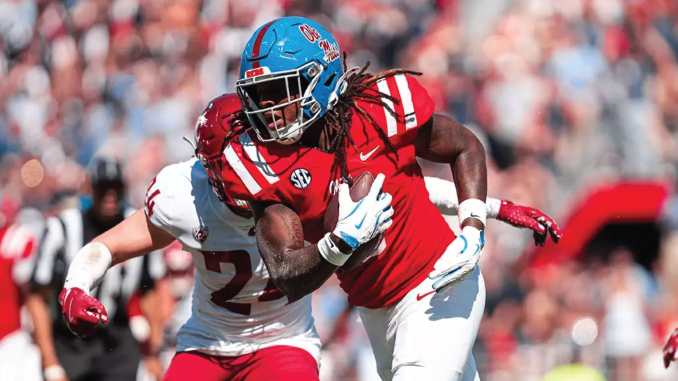
Judge Jorden’s ruling allowed former Ole Miss tight end Dae’Quan Wright, who was on the roster of the Cleveland Browns but only for a brief time, and former Ole Miss defensive tackle Zxavian Harris, who was on the Saints’ roster also very briefly before being cut, to commit to LSU and coach Lane Kiffin. Each played last season for Kiffin during the regular season before he left to become LSU’s coach and became the most polarizing person in college football, even though multiple other coaches agreed to new jobs during the 2025 regular season.
“We don’t put any energy into it,” Kiffin said on the SEC teleconference on Wednesday. “We’re not in it. So, this is a lot of athletes from a lot of different sports from a lot of different states in a hearing tomorrow (Thursday). We’re waiting to get more information tomorrow and more guidance from the SEC.”
Shortly after the TRO was granted, the Southeastern Conference announced a new policy prohibiting member schools from rostering players who previously declared for the NFL, NBA or WNBA draft and did not appropriately withdraw, signed a professional contract in any of those leagues or was listed on a roster in them.
The following day, SEC university presidents voted 15-0 (LSU President Wade Rousse abstained) to approve punishments for any school that violated the bylaws. The team that rostered a former professional as defined by the policy would be subject to a fine equal to 50 percent of the team’s annual operating budget and a half-season suspension of the head coach and the university’s voting privileges in SEC decisions would be revoked.
The Louisiana lawsuit was then amended at request of the plaintiffs’ lawyers to name the SEC and commissioner Greg Sankey as defendants along with the NCAA. The athletes involved are now no longer just seeking a fifth season of eligibility, but also a blockage of the SEC’s new bylaws.
After being added to the lawsuit, Sankey backed down and agreed to comply with the TRO and refrain from enforcing the new SEC rule. Wright and Notre Dame transfer Junior Tuihalamaka, who is a plaintiff in the case but never signed an NFL contract, signed with LSU, enrolled and began practicing with approval from the SEC.
“I don’t think they’re doing any niceties by complying to the court order,” Clayton said pointedly. “That’s just the rule of law. That’s what we do in this country.”
On Wednesday night, the SEC came out strong heading into Thursday’s hearing:
On Thursday, the athletes are hoping for a preliminary injunction that would restore their eligibility for the 2026-2027 season. Such an injunction would not be a final ruling. But it would be an acknowledgment that the players have a reasonable chance of winning the lawsuit and would suffer harm if the NCAA and SEC are allowed to prevent their return or enforce any punitive damages on the athletes or schools signing them while they await a trial.
“The harm to the players is pretty obvious,” Holden said. “They’d effectively miss out, particularly those that have left NFL rosters (by being cut), if they don’t play and don’t have access to NIL money. Then they are going to be harmed, so that harm is obvious. The NCAA is going to have to overcome that, and the SEC is going to have to overcome that and show that, despite this, they should prevail over the players.”
If the players are awarded a preliminary injunction, attorneys would be allowed to do discovery, depose the defendants and prepare for trial. That process could last well into and even beyond the college football season, diluting the impact of the resulting trial, if there ever even is one.
“The clock is ticking here, and the courts aren’t immune from knowing that’s happening,” Holden said. “No one wants this uncertainty going into the season, so this is a pressing matter. And I do expect that we hear something shortly after the hearing on Thursday, if not immediately. We might not get a written decision for a couple of hours or perhaps even a couple of days, but I expect that we get some additional information coming out of that hearing.”
Holden said that he expects the SEC would seek an immediate appeal for emergency relief if the ruling does not go their way. But they would be tasked with proving what harm could be caused by not granting the relief and by letting one player – Dae’Quan Wright – play after only spending all of a few weeks on the roster of an NFL team as a deep reserve who was cut.
But there is no telling what will happen.
“I’ve long given up on trying to predict what courts are going to do,” Holden said. “It’s a little tough to say how things are going to turn out. We’ve sort of seen these rulings go both ways, so it really seems kind of fifty-fifty as to how this is likely to go. Certainly, the fact that a TRO was granted is not necessarily indicative of a final result, but the timeline is short. The NCAA is going to have to come in and show that they have harm if this isn’t lifted.”
And that appears difficult as the issue centers on only one player.
Clayton is confident his clients will receive a favorable ruling.
“I had an old law professor who once told me that, ‘Clayton, if you don’t have the law on your side, scream the facts. If you don’t have the facts, scream the law. If you don’t have either, just scream.’”
It appears that Sankey and a growing number of fans, media and school officials who seem to have it out for public enemy number one Kiffin and/or LSU have been doing most of the screaming.
“Here,” Clayton said, “we have the law and the facts.”
Be the first to comment