
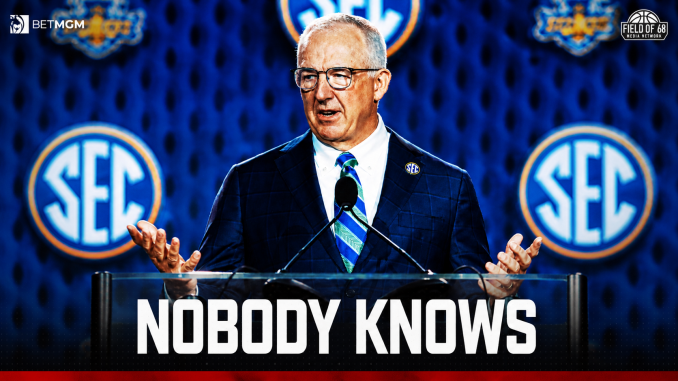
The SEC Will Comply. Now We Find Out Where Its Authority Ends.
Tuesday night on Tiger Rag Radio, somewhere between temporary restraining orders, fifth-year eligibility, professional contracts, transfer portals and rules that seemed capable of changing between commercial breaks, I borrowed an answer from comedian Nate Bargatze.
Nobody knows.
It was funny because it was true.
Five days later, Louisiana Gov. Jeff Landry was telling ESPN almost the same thing: the rules keep changing and “no one even knows what the actual rules are.” Then the NCAA distributed a memo to its membership documenting nearly 60 lawsuits challenging Division I eligibility rules, including 24 filed in a single week.
And Saturday morning brought the latest development, one that matters immediately to LSU:
Yahoo Sports’ Ross Dellenger reported Saturday that the conference and Commissioner Greg Sankey have communicated through attorneys that they will comply with the order. Attorney Darren Heitner subsequently reported the same.
That does not mean the SEC has abandoned its rule. It does not mean LSU tight end commitment Dae’Quan Wright or defensive line commitment Zxavian Harris has received some permanent declaration of eligibility. It does not decide the lawsuit. And it certainly does not mean the SEC agrees that a Louisiana judge ultimately possesses the authority to tell the conference whom its members may put on the field.
It means something narrower, but enormously important:
There is a court order. The SEC will obey it.
For the moment, the conference will not use the extraordinary punishment structure it adopted this week to prevent covered athletes from returning.
That is where this remarkable story sits Saturday morning. And it is almost exactly where the question we were asking Tuesday night eventually led.
Not: Does the SEC have a rule?
Not even: Can the SEC make a rule?
The question was always harder than that.
By Thursday, that question was the central subject of a Tiger Rag column examining the league’s newly adopted professional-athlete restrictions. The SEC plainly could legislate within its conference. What remained unresolved was whether that authority would survive once athletes obtained judicial relief under NCAA rules and the conference attempted to make that relief unusable through sanctions against the schools employing them.
Then the courthouse answered — temporarily.
East Baton Rouge Parish District Judge William Jorden amended an existing temporary restraining order Friday to include the SEC and Sankey. The order prevents the conference, for now, from using its new former-professional rule to punish schools, coaches or the covered athletes for acting within the relief granted by the court. A preliminary-injunction hearing is scheduled for Thursday, Sept. 3, two days before LSU opens against Clemson. Reuters reported.
The sequence is worth following carefully because college sports has been moving so quickly that yesterday’s hypothetical keeps becoming today’s lawsuit.
The SEC voted this week to prohibit athletes from returning to conference competition after crossing certain professional thresholds, including signing professional contracts, appearing on professional rosters or failing to withdraw properly after entering specified drafts. Then it constructed penalties meant to ensure nobody was tempted to challenge the rule casually: a half-season suspension for the head coach, loss of conference voting rights, a fine equal to 50 percent of the affected sport’s annual operating budget and additional sanctioning authority for the commissioner. Reuters reported.
Those penalties were important because they shifted the enforcement target.
The SEC did not necessarily have to win an argument directly with Dae’Quan Wright.
It could make LSU afraid to play him.
A player might possess a court order saying the NCAA could not deny him another season, but LSU would still have to decide whether putting him on the field was worth risking Lane Kiffin for half a season and exposing the athletic department to an extraordinary financial penalty.
That was the leverage.
Friday, the Louisiana court temporarily took it away.
Saturday, the SEC said it would comply.
None of this proves that the conference’s underlying position is legally wrong. But it does demonstrate something fairly fundamental about institutional power: writing a rule and possessing the practical ability to enforce it are not necessarily the same thing.
That is becoming a national problem.
The NCAA’s memo Friday puts numbers around what has otherwise felt like a succession of disconnected eligibility controversies. According to Chief Legal Officer Scott Bearby, nearly 60 lawsuits have been filed challenging Division I eligibility rules. Twenty-four were filed this week. The litigation involves 322 former student-athletes, 184 of whom currently have some form of active judicial relief. Another 138 do not. The largest groups receiving relief are men’s basketball players, with 96, and football players, with 45.
Then Bearby wrote perhaps the most revealing sentence in the document:
That is precisely what is happening.
The lawsuits are following the enforcement chain.
When the NCAA denies eligibility, athletes sue the NCAA. When a court restrains the NCAA and a conference attempts to impose another restriction, lawyers move toward the conference. When the commissioner possesses sanctioning authority, the commissioner gets added too.
The Louisiana case now includes the SEC and Sankey.
The Texas case does as well.
Dallas County Judge Martin Hoffman entered a 14-day temporary restraining order Friday protecting 41 plaintiffs and restricting the NCAA, SEC and Sankey from using professional activity to stop covered athletes who otherwise would qualify for the additional season contemplated by the order. A further hearing is scheduled for Sept. 11. Reuters reported.
And Friday night, Ohio supplied something even more useful than another hypothetical.
Patrick McQuaide, Villanova’s quarterback, had already obtained judicial relief in his dispute with the NCAA. His underlying eligibility case is not the same as Wright’s or Harris’. McQuaide’s argument involves whether his 2022 junior-college season should count against his NCAA eligibility.
But what happened afterward is strikingly familiar.
The Patriot League independently decided McQuaide could not participate in conference games. Villanova appealed. The conference denied the appeal. According to McQuaide’s attorney, using him could have forced Villanova to forfeit games.
There was one problem.
The Patriot League had not been a defendant in McQuaide’s original case.
So McQuaide sued the Patriot League.
Friday, an Ohio judge granted a preliminary injunction specifically naming the conference and preventing it from stopping McQuaide from playing. Hours later, Villanova started him against William & Mary. The Philadelphia Inquirer reported.
That ruling does not control anything happening Thursday in Baton Rouge. Different court. Different conference. Different athlete. Different underlying eligibility argument.
But the architecture is awfully difficult to miss.
Athlete wins relief against NCAA.
Conference attempts independent enforcement.
Conference becomes defendant.
Court restrains conference.
Athlete plays.
The NCAA’s own legal department now says cases increasingly are moving in precisely that direction.
There is, nevertheless, a serious argument on the SEC’s side.
Attorney Tom Mars made one version of it by comparing conference membership to joining a homeowners association. Members voluntarily submit themselves to rules. LSU did not wake up Tuesday morning surprised to discover that it belonged to the Southeastern Conference. The university has agreed for decades to conference governance, revenue arrangements, competition standards, disciplinary procedures and voting mechanisms.
That contractual authority is real.
Nebraska coach Matt Rhule offered the competitive argument. Rhule said this week that players who have gone through professional training, NFL preparation and a professional camp can return substantially improved. He worries about what happens when athletes move into professional football and then cycle back into college competition.
That concern is also real.
College football cannot indefinitely become a revolving door in which players exhaust eligibility, enter professional organizations, get released, return to college for another season, get paid again and repeat the process whenever litigation opens another window.
There needs to be an endpoint.
The SEC is not irrational for wanting one.
But a sensible policy objective does not eliminate the legal questions surrounding how it is imposed, particularly upon athletes who made career decisions under rules that subsequently changed.
That is the Class of 2022 problem in its simplest form.
An athlete reaches what everyone understands to be the end of his college eligibility.
College is over.
So he does what football players do when college is over. He pursues professional football.
Then the eligibility framework changes.
Other athletes from the same general class may suddenly have access to an additional season.
But the athlete who acted upon the rules that existed when his college career ended is told he cannot receive the same opportunity because he went professional.
Why did he go professional?
Because college athletics told him his eligibility had expired.
Courts are now being asked to decide what the governing institutions did not adequately resolve before changing the system.
And that has produced a remarkable contradiction.
Rhule himself said this week that college football should quit hiding behind the NIL label when describing what top programs are spending on players.
“It’s just payroll,” he said, estimating that elite rosters can approach $45 million.
So modern college football has payroll, agents, revenue sharing, player contracts, general managers, roster limits, multimillion-dollar personnel budgets and open-market recruiting competition.
Then everyone gathers around a table and tries to determine where, precisely, professionalism begins.
That was why the other question raised here earlier this week was not rhetorical.
Signing an NFL contract certainly looks professional.
Receiving hundreds of thousands of dollars to play college football also looks rather different from the amateur model whose vocabulary we continue using.
That does not make the two legally equivalent. It demonstrates why a regulatory system built around a clean amateur-professional boundary is struggling in an enterprise where the boundary itself has become increasingly difficult to describe.
The NCAA’s Friday memo documents the result.
Nearly 60 lawsuits.
Three hundred twenty-two plaintiffs.
One hundred eighty-four athletes with active relief.
Hearings stretching from South Carolina to California.
One court grants an injunction. Another court denies one. An appellate court stays another. An athlete files somewhere else. A conference passes a rule. The conference becomes a defendant. Another judge restrains it.
And the football season is beginning while everyone is still litigating who gets to play in it.
Landry has called for the U.S. Senate to intervene. There is already legislation in Washington aimed, among other things, at restoring national uniformity to parts of college athletics. Tiger Rag examined that legislation months ago because the underlying problem was never merely NIL or the transfer portal. College sports has been moving toward a moment in which Congress, the NCAA, conferences and courts would have to determine who actually possesses governing authority in the revenue-sharing era.
That theoretical argument has now arrived in Baton Rouge.
Thursday morning, the SEC will enter Judge Jorden’s courtroom with substantial contractual authority over LSU and its other member institutions.
It also will enter after telling attorneys that it intends to comply with his current order.
That is not capitulation.
The SEC can argue Thursday that the temporary order goes too far. It can defend the integrity of its rule. It can argue that member institutions knowingly consented to conference governance. It can challenge whether the court possesses the power to restrict independent SEC eligibility standards. It can ultimately prevail.
But Saturday morning gives us at least one answer we did not have Tuesday night.
The SEC adopted the rule.
The SEC created the penalties.
The players followed the enforcement mechanism into court.
The court reached the SEC.
And the SEC will comply.
So perhaps the question has evolved.
It is no longer whether the SEC possesses authority. It unquestionably does.
Authority is not established by making the punishment enormous. Nor does contractual authority become unlimited because member institutions once agreed to be governed.
Ohio demonstrated that Friday.
Louisiana is testing it now.
And Thursday may determine whether the boundary Judge Jorden has temporarily drawn remains in place long enough for LSU to put players such as Wright and Harris on the field without fearing punishment from its own conference.
Tuesday night, the answer was nobody knows.
Saturday morning, we know a little more.
The SEC has a rule.
The SEC has authority.
And, for now, the SEC has encountered an authority it has agreed to obey.
Thursday, we find out whether that lasts.
Be the first to comment