
These Players Didn’t Leave College. College Left Them.
The SEC wants to punish 2022 signees for taking NFL opportunities after the NCAA told them their eligibility was gone. That’s not integrity. That’s convenient amnesia.
The SEC found the culprit in college football’s latest eligibility mess Monday night.
Apparently, it is the player who believed the NCAA.
After a videoconference of its presidents and chancellors, the conference issued a stern statement declaring that college athletics should be populated by college athletes, not former professionals.
Fair enough.
Then came this:
“Individuals who choose to leave college athletics, sign professional playing contracts, and compete professionally should not then be permitted to return to college competition.”
Sounds perfectly reasonable.
It also skips the most important fact in the entire controversy.
These players didn’t necessarily choose to leave college athletics.
College athletics told them they were finished.
That is not semantics. It is the center of the case.
The players now holding temporary restraining orders are largely members of the 2022 entering class, athletes who played four seasons under the rules that existed when they arrived. When the 2025 season ended, their eligibility was exhausted. Four seasons. Done. Thanks for playing. Good luck with the rest of your life.
So some of them did what football players do when college football is no longer an available option.
They pursued professional football.
Then the NCAA changed the rules.
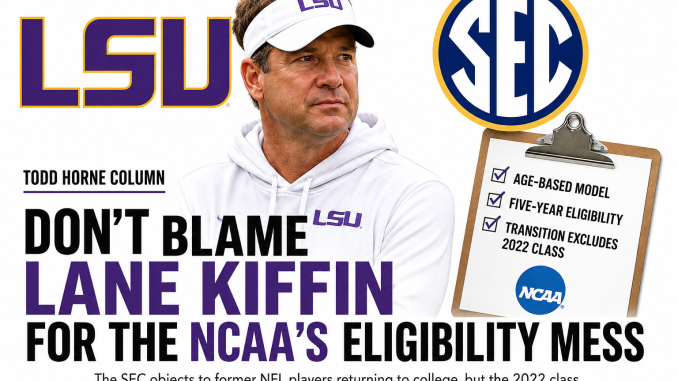
On June 23, the NCAA Division I Cabinet approved a sweeping new age-based eligibility model, commonly described as “five-for-five,” although the NCAA itself notes that the shorthand is imperfect. Under the new structure, athletes who enter college at the traditional age generally can compete throughout a five-year eligibility period instead of being limited to four seasons of competition. The NCAA explained the new eligibility model here.
There was a catch.
The NCAA specifically excluded athletes who had already used what, under the old rules, was their final season during the 2025-26 academic year.
In other words, if you were standing inside the building when the NCAA changed the rule, you might get the benefit of the new rule.
If the NCAA had already escorted you outside, locked the door and told you your eligibility was gone, too bad.
That is the 2022-class problem now bouncing around courtrooms.
And it makes the SEC’s statement sound considerably less tidy.
Apparently They Needed a Crystal Ball
Consider two players.
Both enroll in college in 2022.
Both play four seasons.
Both finish the 2025 season believing — because the NCAA rules say so — that their college careers are over.
Player A gets an NFL opportunity. He signs a contract, reports to camp and tries to make a roster.
Player B gets no NFL offer. Maybe he keeps training. Maybe he starts graduate school. Maybe he gets a job selling insurance. Maybe he goes home and wonders what comes next.
Then the NCAA adopts a system under which, had it applied to them, both players could have been eligible in 2026.
They sue.
A court temporarily restores eligibility.
Under the SEC’s logic, Player B can come back.
Player A cannot.
Why?
They entered college together. They played the same number of college seasons. Their eligibility expired on the same schedule.
One difference:
Somebody in the NFL wanted Player A.
That’s it.
Apparently the equitable solution is to reward the player who had nowhere else to play and punish the player who was good enough to get a professional opportunity.
Call it whatever you want.
I’m having trouble calling that competitive equity.
I’d probably call it eligibility by unemployment.
The SEC says allowing former professionals back into college sports would “reduce opportunities for high school and current college athletes.”
That concern is legitimate. Rosters are finite. Scholarships are finite. Playing time is finite. A 22- or 23-year-old physically mature player returning after an NFL training camp could absolutely take a roster spot from an 18-year-old freshman.
Fine.
Write a rule.
Write it prospectively.
Tell every college athlete entering the system today that signing a professional playing contract permanently terminates his remaining collegiate eligibility. Put it in 40-point type. Make the player initial the page.
I could support that.
What you cannot reasonably do is tell a player in January that his eligibility is exhausted, watch him pursue the NFL because you told him there was no college football left for him, change your eligibility structure in June and then condemn him in August for having believed you in January.
The SEC would apparently have preferred that these players turn down NFL contracts on the possibility that the NCAA might change its mind six months later.
They needed an agent, a financial adviser and, evidently, a crystal ball.
I Understand Breiden Fehoko. He’s Still Missing the Point.
Former LSU defensive lineman Breiden Fehoko, a member of the Tigers’ 2019 national championship team, was considerably less diplomatic than the SEC Monday.
Reacting to former Ole Miss defensive lineman Zxavian Harris’ decision to join LSU, Fehoko wrote on X:
“I want LSU to win but this ain’t the way.”
Then he went directly at Lane Kiffin and his staff.
“I don’t care if the ‘rules’ allow it. Integrity/amateurism all gotta count for something bro.”
I understand the instinct.
I respect Fehoko enough to take the argument seriously.
I just think he’s wrong.
Integrity certainly ought to count for something.
But amateurism?
College athletics has spent the last five years holding a funeral for amateurism and apparently forgot to tell everyone where it buried the body.
Schools now directly share millions of dollars in revenue with athletes. NIL compensation is legal. Collectives have become marketing operations, recruiting operations and, occasionally, something resembling payroll departments wearing fake mustaches. Transfer recruiting occurs with numbers attached. Agents negotiate college opportunities. Congress is considering legislation establishing a federal compensation and governance framework.
And now, precisely when LSU finds a legal roster advantage somebody doesn’t like, we’re digging “amateurism” out of the attic?
Come on.
More importantly, Lane Kiffin did not create this.
He did not write the old eligibility rule.
He did not exclude the 2022 class from the transition to the new rule.
He did not grant the temporary restraining order.
He did not reopen the transfer portal.
And he did not make these players legally available to recruit.
A Louisiana judge did that temporarily, and the larger eligibility issue remains in litigation. The TRO involves a group of 2022-class athletes who were denied another season under the NCAA’s transition rules, including players who had already pursued NFL opportunities after their college eligibility expired under the previous system.
Kiffin simply looked at the board.
There were players on it.
He recruited them.
Of course he did.
His explanation Monday was essentially the only answer a major college football coach can give: if the courts make these players eligible, they are going to play somewhere, and LSU made the decision to recruit them.
You can dislike the rule.
You can dislike the court ruling.
You can dislike what college football has become.
But asking LSU to voluntarily refuse legally eligible players while Alabama, Texas, Georgia, Texas A&M, Ole Miss or anybody else remains free to recruit them isn’t integrity.
It’s unilateral disarmament.
Nobody hired Lane Kiffin to finish first in the SEC sportsmanship hypothetical.
They hired him to win football games.
The SEC’s Statement Actually Makes the Players’ Argument
Here is where Monday night gets really interesting.
The SEC concluded its statement by saying:
“The current confusion around national eligibility standards emphasizes the need to advance the Protect College Sports Act.”
On that point, the conference may be more right than it realizes.
Yes.
There should be one national rule.
Yes.
Players should know exactly how long they are eligible.
Yes.
Schools should know whom they may recruit.
Yes.
Professional status should have a clear effect on collegiate eligibility.
Yes.
The courts should not be effectively creating different eligibility standards depending on whether somebody files in Louisiana, Colorado, Ohio or somewhere else.
This is chaos.
Congress can address it.
But Monday’s SEC statement also demonstrates why a national rule has to be clear before the player makes the decision.
The league wants to make this a morality play about college athletes choosing to become professionals and then deciding they would rather come back.
That would be a much easier argument.
It just isn’t what happened here.
Dae’Quan Wright didn’t leave college with another season of NCAA eligibility sitting in his pocket and suddenly decide Tiger Stadium sounded more fun.
Zxavian Harris didn’t abandon an available fifth college season for the NFL and then ask for a mulligan.
These players were told their four-season eligibility had been exhausted.
They acted accordingly.
Only afterward did the NCAA adopt a new eligibility model under which similarly situated athletes with eligibility remaining could potentially compete for a fifth year. The NCAA’s own transition table says athletes who used their final season during 2025-26 receive no additional eligibility under the new model.
That’s the issue the SEC statement never addresses.
Maybe the courts ultimately decide the NCAA has every right to draw that transition line.
Maybe the TRO disappears.
Maybe Wright never plays a snap for LSU.
Maybe Harris doesn’t either.
Those are legal questions still being resolved.
But don’t rewrite the chronology.
And don’t turn the players into villains because the NCAA changed the rules after their clocks hit zero.
LSU Is Exploiting the Mess. Good.
There is another uncomfortable truth here.
LSU is exploiting this situation.
Absolutely.
So would I.
And so would virtually every serious football program in America once a player it needed became legally available.
College football spent years constructing this environment. Courts tore apart old restrictions. NIL became legal. Revenue sharing arrived. Transfer rules loosened. The NCAA lost lawsuit after lawsuit. Conferences demanded federal protection. Schools assembled general managers and personnel departments. Coaches became roster CEOs.
Then Lane Kiffin showed up and treated the system exactly like the competitive marketplace everyone created.
And everybody suddenly became shocked that Lane Kiffin was acting like Lane Kiffin.
That part is almost funny.
The better question isn’t why LSU is recruiting these players.
The better question is why LSU wouldn’t.
If somebody wants the answer to be because the rules prohibit it, fine.
Pass the rule.
If Congress wants professional contracts to permanently end college eligibility, put it in the Protect College Sports Act.
If the SEC wants its own prohibition and can legally enforce one, adopt it.
But make the rule before the decision.
Don’t expire a player’s eligibility, send him into the professional marketplace, change the eligibility system after he gets there and then lecture him about the sanctity of college athletics when a judge lets him back through the door.
Because these players didn’t walk away from a fifth season.
They were told they didn’t have one.
The NCAA changed the rule.
The courts noticed.
Lane Kiffin noticed faster.
And now the SEC would prefer everyone forget how we got here.

Be the first to comment