
TIGER RAG NEWS SERVICES
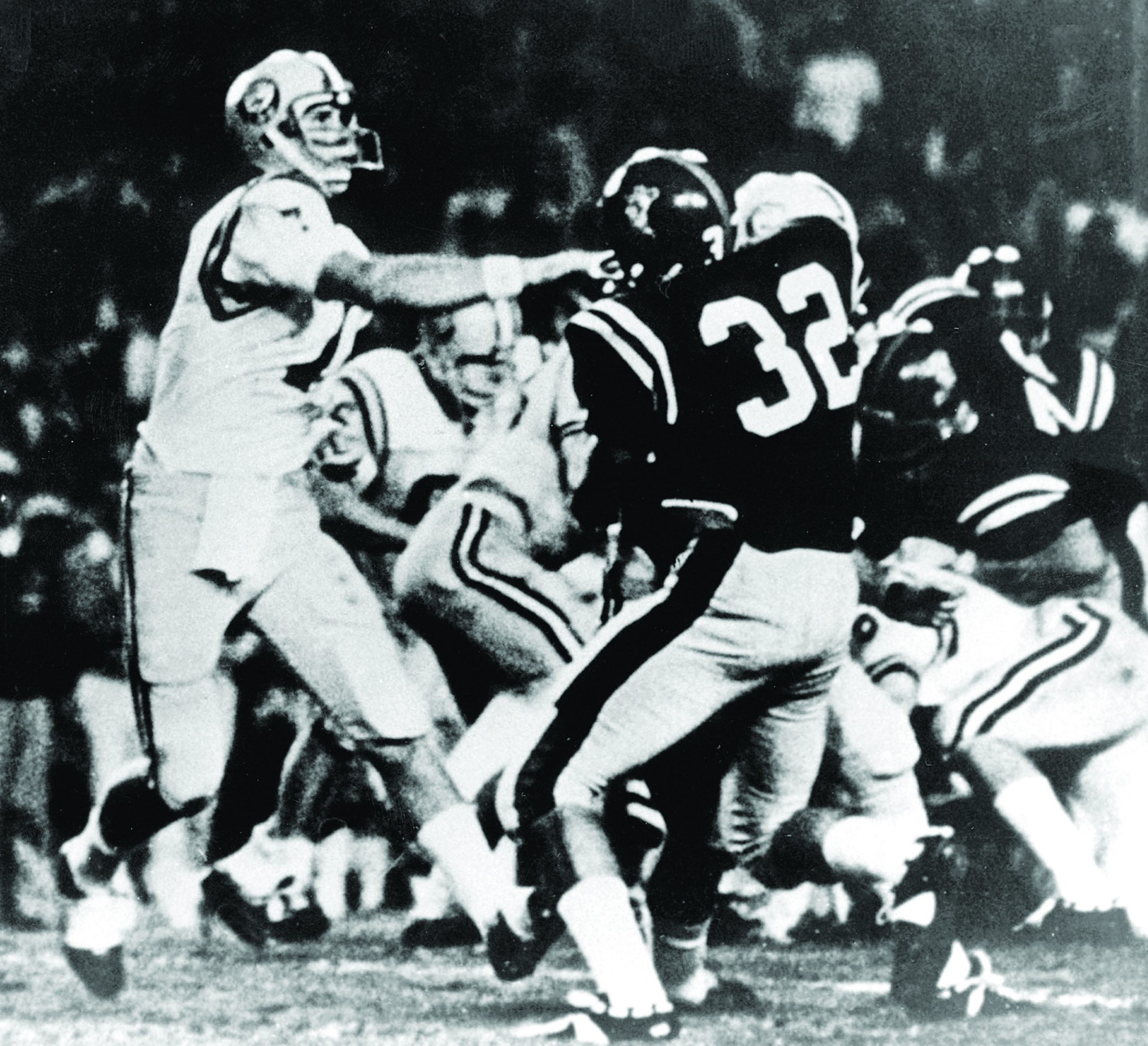
LSU quarterback great Bert Jones, the first All-America quarterback in LSU history in 1972 and the Tigers’ last NFL MVP in 1976, will have his Tigers’ No. 7 jersey ceremoniously retired this season at Tiger Stadium, the school announced on Wednesday.
The LSU Athletic Hall of Fame Committee unanimously approved Jones’ jersey retirement, which will be on Nov. 14 when LSU hosts Texas.
The No. 7 worn by Jones will join running back and 1959 Heisman Trophy winner Billy Cannon’s No. 20, defensive back Tommy Casanova’s No. 37, running back/kick returner Jerry Stovall’s No. 21 and running back Charles Alexander’s No. 4 as ceremoniously retired jerseys in the LSU football program and in the stadium.
All retired jersey numbers are displayed on the façade in the south end zone of Tiger Stadium. Only Cannon’s No. 20 is no longer worn by LSU players. The other numbers are ceremoniously retired only.
“I had no idea that there was anything in the works so this is totally unsuspecting,” Jones said. “I have been the beneficiary of a lot of good things and received a lot of accolades and a lot of awards, but this is at the top of the list. To be hung up in Tiger Stadium, where my father played, my brother played and cousins played, is special. And what’s even equally as special is that I will be up there with my LSU roommate Tommy Casanova.”
Jones and Casanova, a defensive back and return specialist from 1969-71, had his jersey retired in 2009. Jones and Casanova are both members of the College Football Hall of Fame. Jones is also a member of the LSU Athletics Hall of Fame and the Louisiana Sports Hall of Fame.
A native of Ruston, Jones compiled a record of 26-6-1 from 1970-72 as LSU’s quarterback, leading the program to three bowl games and the 1970 SEC Championship. During his three seasons at LSU, the Tigers won nine games each year.
He capped his career as the school’s record holder at the time for passing yards (3,255), touchdown passes (28), attempts (418) and completions (220). In 1972, Jones became the first quarterback in LSU history to top the 3,000-yard mark for passing yards in a career.
Jones also set the school mark for passing yards in a game (242 vs. Alabama, 1972) and passing yards in a season (1,446 in 1972). His 14 passing TDs in 1972 was a school record and he became only the sixth player in program history to pass for three touchdowns in a game, doing it three times – vs. Auburn, 1972, vs. Texas A&M, 1972 and vs. Tulane, 1971.
After directing the Tigers to a 9-2-1 mark in 1972, Jones became the first player in LSU history to earn first-team All-America honors as a quarterback. He went on to finish fourth in the Heisman Trophy voting that year.
FROM THE TIGER RAG VAULT: Jim Engster On Bert Jones
Nicknamed “The Ruston Rifle,” Jones earned first-team All-SEC honors as a senior in 1972 after leading the league in completion percentage (51.8), touchdown passes (14), total yards (1,464) and TDs responsible for (18). LSU finished the year with a 9-2-1 mark which included wins over Texas A&M, Wisconsin, Auburn, and Ole Miss.
Jones went on to be selected No. 2 overall in the 1973 NFL Draft by the Baltimore Colts. During his 10-year NFL career, Jones appeared in 102 games with 96 starts. He led the Colts to an 11-3 regular-season mark in 1976 on his way to earning NFL MVP honors by the Associated Press – one of only three LSU players to do so. Running back Jim Taylor (1954, 1956-57 at LSU) of the Green Bay Packers won the A.P. NFL MVP in 1962, and quarterback Y.A. Tittle (1944-47 at LSU) of the New York Giants won it in 1963.
A neck injury forced Jones to retire from the NFL following the 1982 season after passing for 17,766 yards and 122 touchdowns in a career that spanned nine years with the Colts and one season with the Rams.
Jones became LSU’s first consensus All-America quarterback in 1972 when he threw for a school-record 1,446 yards and 14 touchdowns in leading the Tigers to a 9-2-1 mark and a berth in the Astro-Bluebonnet Bowl. Jones was named the National Player of the Year in 1972 by the Sporting News and finished fourth in the Heisman Trophy balloting following the season.
In 1971, Jones threw three TD passes and ran for another score as the Tigers knocked off once-beaten and seventh-ranked Notre Dame, 28-8, in Tiger Stadium in national prime time telecast on ABC on November 20.
A year later, Jones led the Tigers to a last-second game-winning touchdown when he found Brad Davis in the corner of the endzone for the winner over Ole Miss, a victory that kept LSU’s undefeated record intact at 7-0.
Following his LSU career, Jones was picked No. 2 overall in the 1973 NFL Draft by the Baltimore Colts where he spent nine years. Jones earned NFL MVP honors and a spot in the Pro Bowl in 1976 after throwing for 3,104 yards and 24 touchdowns in leading the Colts to an 11-3 mark and a playoff berth.
Jones finished his 10-year NFL career starting 96 regular season games and throwing for 18,190 yards and 124 touchdowns.
After his NFL career, Jones served as an outdoors show host on ESPN for 10 years. He’s also a former chairman of the Louisiana Wildlife and Fisheries Commission and is active in fundraising for the Cystic Fibrosis Foundation with his annual golf tournament as well as the Boys Scouts of America.
Jones graduated from LSU in 1983 with a degree in Business Administration.

Be the first to comment