
By JASON PUGH, Written for the Louisiana Sports Writers Association
NATCHITOCHES – “When you build a house, you don’t build it from the roof down. You build it from the foundation up.”
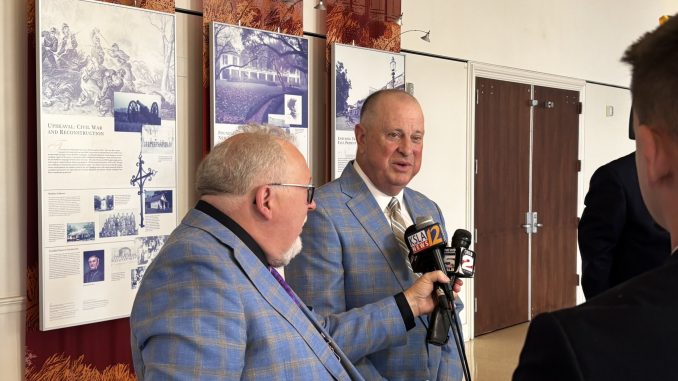
With that little bit of “ol’ country boy common sense,” Dewain Strother, one of the nation’s leaders in all-time high school girls basketball coaching victories, summed up what he and the rest of Louisiana Sports Hall of Fame Class of 2026 espoused throughout Saturday night’s induction ceremonies inside the Natchitoches Events Center.
Strother was one of eight competitive-ballot inductees who were joined by a pair of Distinguished Service Awards in Journalism recipients, the Dave Dixon Louisiana Sports Leadership Award honoree and just the third Louisiana Sports Hall of Fame Ambassador Award electee in history who added their sterling resumes to the state’s shrine for its top athletes and sports journalists.
Strother’s remark regarding foundations was tied to the beginning of the Florien High School girls basketball team, which began play in the 1983-84 season with little fanfare and a grand total of four wins.

“That was about the time Title IX was hot for women’s sports,” Strother said. “They gave me the opportunity to start it. I knew I took on a big job, but I used some ol’ country boy common sense. There was a group in the eighth grade I was looking at, and I knew they could be a good team. We used some of the high schoolers to mold them. We won only four games that first year, and I thought, ‘I’m gonna get fired.’ The next year we were district champs.”
The step-by-step building process Stother instituted reached its zenith with a 48-0 state championship season in 1990-91 – the first of Strother’s six state championships at Florien, a Class B program that he built into a juggernaut. One year after that title, Florien started five players who would eventually play Division I basketball.
While Strother built a program that he led to 1,235 victories – the second most nationally among girls high school basketball coaches – former LSU men’s basketball coach John Brady had to rebuild a once-proud Tiger program while following legendary coach Dale Brown.
Brady came to Baton Rouge from Samford University, a mid-major program in Birmingham, Alabama, but the roots of his landing in Baton Rouge began decades earlier in Starkville, Mississippi, where Brady was a graduate assistant at Mississippi State.
“You go through life and you don’t know who you’ll meet and where they’ll show up later,” Brady said. “I went to Mississippi State as a GA and the other graduate assistant was Joe Dean Jr. We became great friends, and I’d go to Joe’s house and spend the weekend with the Dean family. (Joe Dean Sr.) was the guy who helped get guys jobs, made calls for them. I had to be successful for the opportunity for Joe (Sr.) to hire me. The relationship I made with Joe Dean Jr. led me to knowing his father. Twenty years later, I’m the head coach at LSU. It’s funny how life works and the twists and turns along the way.”
Following a Louisiana legend like Brown was not an easy transition, but Brady did it his way, relying on his basketball mantra to mold an LSU team on probation into an SEC championship team.
“John had a saying, ‘Responsibility plus accountability equals success,’” said Brady assistant Kermit Davis, who eventually became a head coach at Middle Tennessee and Ole Miss.
That equation – and the signing of Fair Park High School standout Stromile Swift – ignited a turnaround on the court and helped Brady truly start building a program that dealt with the loss of six scholarships across a three-year period.
And “Brady Ball” began rolling with T-shirts and the like as displayed in the Louisiana Sports Hall of Fame now.
Brady Ball bounces into La. Sports Hall of Fame. That’s John Brady on the right. pic.twitter.com/5nzsk7iVBq
— Glenn Guilbeau (@SportBeatTweet) June 27, 2026
Despite the sanctions, the foundation was in place for the building that would crest with a magical 2005-06 season where a group of six players from within a 50-mile radius helped Brady take the Tigers to the Final Four – a joyride that included an upset of top-ranked Duke and came just months after Hurricane Katrina ransacked the Louisiana Gulf Coast.
“That team, the top six players were from within 50 miles of Baton Rouge,” said Brady, who led the Tigers to a pair of SEC championships and three NCAA Tournament berths. “They had grown up playing with each other or against each other, and they had a really special bond. Every one of them was touched by the tragedy of Katrina, and I think that brought them even closer together.”
A similarly close bond between siblings helped deliver a signature moment for the LSU women’s basketball team when it landed Sylvia Fowles, a 6-foot-6 standout from Miami.
Brought to LSU by coach Sue Gunter, who promised Fowles nothing more than the opportunity to complete for playing time, Fowles teamed with fellow Louisiana Sports Hall of Famer Seimone Augustus to usher in the golden era of Tigers women’s basketball – one that included four straight Final Four appearances.
“In my home visit, (Gunter) told me she wasn’t starting me as a freshman, that I had to earn it,” said Fowles via a Zoom call from Chicago where her Portland Fire were preparing for a WNBA game against the Chicago Sky. “That motivated me to be around her. I was signed, sealed and delivered after hearing her say you had to work for everything you want.”
Fowles, who is now an assistant coach with the Fire, averaged a double-double at LSU before a prolific WNBA career with the Chicago Sky and Minnesota Lynx where she averaged 15.7 points and 9.8 rebounds per game in her career.
Four Olympic gold medals, two WNBA titles and a spot of the WNBA’s 25th Anniversary Team highlighted Fowles’ career.
Fowles did her share of scoring, but not quite to the point a young Kathy Holloway did at now-defunct Poland High School.
Holloway, the Dave Dixon Louisiana Sports Leadership Award winner, established a long-standing Class C state tournament record by scoring 86 points across two games while at Poland.
A lifelong love of basketball led Holloway to continue laying the foundation for that feeling of generations of basketball players in central Louisiana, first as a head coach at Tioga High School then as the first female president of the Louisiana High School Coaches Association, achieved in 1986, and as the president of the National High School Athletic Coaches Association in 1992.
“Title IX was passed in 1972,” said Julie Wilkerson, one of four high school All-Americans Holloway coached at Tioga who went on to play at Louisiana Tech and was at the ceremony Saturday. “That energized someone like Mrs. Holloway.”
Following her gilded administrative career, the NSCA in 2021 created the Kathy Holloway Women of Inspiration Award that honors a female “that has promoted female athletics by either coaching, serving, supporting or leading high school female athletic programs that focus on changing lives and inspiring women to strive for greatness.”
As a quarterback at then-Jesuit High School in 1976, John James Marshall became a state champion, throwing the game-winning screen pass in the title game.
That trophy may have portended athletic greatness, but Marshall’s trophy case now overflows with innumerable awards from the Louisiana Sports Writers Association, an organization Marshall served as president of before his 30th birthday.
His writing prowess is just one of the tools in a multi-faceted toolbox that helped lead Marshall to the Distinguished Service Award (DSA) in Sports Journalism.
The LSU G.O.A.T. of Sports Writing – @gilebreton stops at @LaSportsHall in Natchitoches.https://t.co/yVkYfykK0b
— Glenn Guilbeau (@SportBeatTweet) June 26, 2026
Gil LeBreton, former famed columnist at the Fort Worth-Star Telegram, started his career after using the G.I. bill to pay his way through LSU after serving in the Vietnam War. He launched a 54-year career at the New Orleans Times-Picayune and Baton Rouge Advocate before the Star-Telegram. He became the only winner of Sports Writer of the Year in Texas and Louisiana. His career included covering 27 Super Bowls and 16 Olympic Games.
In much the same way, LeBreton’s writing was appointment reading, former New Orleans Saints wide receiver Joe Horn’s showmanship was part of the reason even casual fans were watching the team at the turn of the century. In six seasons with the Saints, Horn was a four-time Pro Bowler whose celebrations helped cement the wide receiver from Itawamba Community College in franchise lore.
Horn, who was unable to make Saturday’s ceremony, hauled in 94 passes for 1,340 yards and eight touchdowns in 2000 as the Saints clinched their first NFC West championship. Across a five-year span from 2000-04, Horn averaged 87 catches, 1,259 yards and nine touchdowns across 79 games.
Across from Horn during those NFC West – and eventually NFC South – battles was another member of the Class of 2026, Atlanta center Todd McClure, a first team All-American at LSU in 1998 who started since his freshman season in 1995.
A three-sport star at Central High School, McClure with tailback Kevin Faulk and coach Gerry DiNardo led the rebirth of an LSU program that had six straight losing seasons from 1989-94.
“It helped to have Alan Faneca (an All-American guard who became Pro Football Hall of Famer with Pittsburgh) next to me teaching me the ropes,” McClure said. “Coach DiNardo told me in ’95 I had a chance to make the NFL. For a freshman, for him to put those thoughts in my mind, meant a lot.”
McClure and many offensive linemen during his career had plenty of respect for Monroe native Pat Williams. After playing at Texas A&M and going undrafted, Williams grinded his way into the NFL and established a lengthy, often-dominant career at nose tackle with the Buffalo Bills and Minnesota Vikings, earning three Pro Bowl berths and a remarkable 37 game balls.
While Williams’ work went on in the trenches, one swing propelled Warren Morris into college baseball immortality.
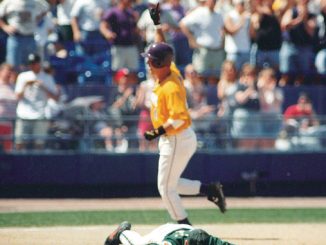
Morris, an Alexandria native who played at Bolton High School before heading to LSU, delivered perhaps the most iconic moment in College World Series history when he launched a first-pitch curveball from Miami closer Robbie Morrison over the right-field wall at Rosenblatt Stadium in Omaha, Nebraska, for the first CWS-clinching, walk-off home run in history on June 8, 1996.
“Coach Skip Bertman used to tell us you can’t be afraid to fail,” Morris said. “All I can do is the best I can do. I’m going to be aggressive. That’s why I hit the first pitch.”
Morris was honored with the Ambassador Award, joining national sports broadcaster Tim Brando and legendary Grambling baseball coach Wilbert Ellis in past years as the only winners of that award.
“Warren embodies everything you want a citizen to be as far as work ethic, integrity and compassion,” LSU baseball sports information director Bill Franques said.
To cap the whirlwind following his home run, Morris – along with LSU coach Skip Bertman – was part of the 1996 U.S. Olympic baseball team, which won a bronze medal in the Atlanta Games.
“Just incredible,” Morris said of the Olympic experience. “It doesn’t get talked about enough. I still get goosebumps thinking about it, walking out on the field in Atlanta with 50,000 people chanting, ‘U-S-A.’ I’m as proud of representing my country as anything I ever did in athletics.”
Former Louisiana-Lafayette catcher Jonathan Lucroy understood what Morris meant. A Florida native whose No. 21 jersey was retired this past spring at UL Lafayette, Lucroy was part of the gold-medal-winning Team USA squad in the 2017 World Baseball Classic.
Last and and most was former Northwestern State men’s basketball coach Mike McConathy, the state’s all-time record holder in college basketball victories.
“Mike McConathy stood up at his first press conference and talked about bringing Northwestern State basketball back to where it was when his dad and uncles played here,” longtime NSU sports information director and Hall of Fame chairman Doug Ireland said. “I thought, ‘This guy’s from Mars. You can’t do that here.’”
But he did.
Two years after arriving in Natchitoches following a 16-year, 352-victory career at Bossier Parish Community College, McConathy’s 2000-01 Demon team was in the NCAA Tournament – a first for the program. Then, never did that light shine as bright on Northwestern as it did on March 17, 2006, when McConathy’s second NCAA Tournament entry stunned third-seeded Iowa on Jermaine Wallace’s last-second corner 3-pointer. That shot that still graces most March Madness intros during NCAA Tournament season.
Before McConathy was done, he won 682 career games – the most in Louisiana college basketball history, and the most on Mars.

Be the first to comment