
By GLENN GUILBEAU
Tiger Rag Editor
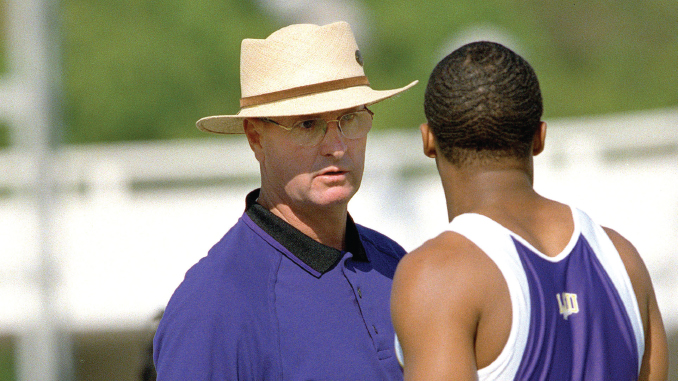
Not long after Nick Saban was introduced as LSU’s football coach on Nov. 30, 1999, he walked into LSU men’s and women’s track coach Pat Henry’s office to introduce himself.
Saban was impressed with Henry, because he was a national championship coach, which was an understatement even then.
And Saban was recruiting a senior from Opelousas High named Devery Henderson, who was one of the top running backs in the nation, but ridiculously had not been recruited much by previous LSU football coach Gerry DiNardo. Henderson was also a track star, and DiNardo only wanted him to play football. So Henderson was headed to track power Arkansas and not track power LSU. Saban was open minded and fine with two-sport athletes, and with Henry’s help, he was able to convince Henderson to sign with LSU in the class of 2000.
Saban, 48 at the time, had no national championships yet and only two seasons of more than eight wins in six years as a head coach at Toledo (9-2 in 1990) and Michigan State (9-2 in 1999).
Henry, also 48 at the time and three months older than Saban, already had a 19-0 lead on Saban in national championships – 21-0 if you count his national junior college titles at Blinn College in Texas in 1986 and ’87. Henry had already won seven NCAA women’s indoor national championships at LSU from 1989-97, 10 consecutive women’s outdoor titles from 1988-97 and two NCAA men’s outdoor titles in 1989 and ’90.
It is some 27 years later, and while Saban won seven national championships from 2003-20 with the first one at LSU and the next six at Alabama for the most in college football history, he never even fingernail-scratched Henry before Saban retired after the 2023 season at age 72.
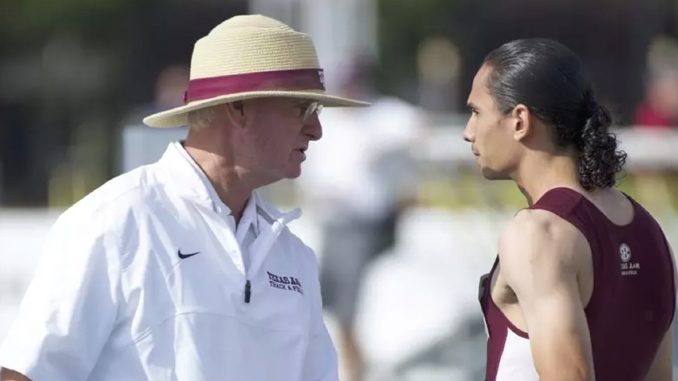
Henry won his 37th and final NCAA track national championship in men’s outdoor in June of 2025, which was his 10th overall for Texas A&M. He just announced his retirement after this past season last Tuesday after 54 seasons as a coach at age 74.
He won 27 national championships at LSU from 1988-2004 – 2 in men’s indoor (2001, 2004), 3 in men’s outdoor (1989, 1990, 2002), 10 in women’s indoor (1989, 1991, 1993, 1994, 1995, 1996, 1997, 2002, 2003, 2004), and 12 in women’s outdoor (1988-97, 2000, 2003).
Henderson, by the way, was on the men’s 2001 men’s indoor national championship team. That season, he ran the then second-fastest 60-meter time in LSU history at 6.72 seconds and ran on the Tigers’ NCAA-qualifying 4×100 relay team. Then in 2003, he caught 53 passes for 861 yards and 11 touchdowns in helping lead LSU to its first national championship in football since 1958 under Saban, who expertly moved Henderson from running back to receiver before the 2002 season as he did with under-utilized running back Josh Reed in 2000. Henderson became an All-SEC player and a second round pick of the Saints, while Reed was a second round pick of Buffalo. Each had sigfinicant NFL careers as did defensive end and first round pick Marcus Spears, whom Saban moved from tight end at LSU in 2001.
After the 2004 season, A&M came calling for Henry and LSU and athletic director Skip Bertman decided not to match the significant salary increase the Aggies offered. Henry also wanted major facilities upgrades that LSU did not agree to do.
Just six months later, Bertman, who had won five national championships himself as LSU baseball coach, decided not to get into a bidding war to keep Saban at LSU as well. He had a much better chance of keeping Henry. If Bertman had matched what Miami Dolphins’ owner Wayne Huizenga paid Saban, which was $4.5 million a year, or offered more, Saban, who made $2.3 million in his last salary at LSU in 2004, wouldn’t have stayed anyway. At the time, the Fairmont, West Virginia, native thought his life dream was to be an NFL head coach. When he realized that wasn’t it, he was Alabama’s coach by 2007. And the rest is history.
Henry, a native of Albuquerque, New Mexico, got a significant upgrade in salary and facilities at A&M.
“Texas A&M has an excellent tradition in track and field, and I look forward to the challenge ahead,” Henry said as he took over at Texas A&M in 2004. “I like (athletic director) Bill Byrne’s vision. He is dedicated to being the very best, and I look forward to working with him. I appreciate the many outstanding track athletes at LSU, my coaches and the administration. But the timing is right for a new challenge.”
Bertman promoted assistant coach Dennis Shaver, who won the 2008 women’s outdoor national title and the men’s outdoor 2021 national championship, and remains coach.
But, like Saban, he won’t be able to dent Henry.
Few have. Henry retired after 54 years of coaching with the most NCAA championships by a track coach in history with 37. In all NCAA sports, he trails only Jim Steen’s 50 national titles in Division III swimming and diving at Kenyon College in Gambling, Ohio, from 1976-2012, and the late Arkansas track and cross country coach John McDonnell, who won 40 NCAA titles with 29 in track and 11 in cross country from 1972-2008.
“It’s very difficult to talk about 54 years of coaching, but I can talk about the best 22 years,” Henry said in announcing his retirement this week. “I have been truly blessed to be the coach here at Texas A&M. Our ten national championships and 19 final four finishes are a big part of my 22 years, but being a part of Texas A&M has made it the best years of my career. This is a special place with many wonderful people. Our athletes are provided with the best facilities, academic and medical support. The success of our program is about our ability as a staff to recruit great talent. But great talent is never happy unless they get better. The ability to help an athlete get better is about having a great staff, a staff dedicated to being the best. I have had great assistants who work hard and smart. We have been cohesive in our message.”
Henry’s last salary at Texas A&M was approximately $331,000. A couple or three LSU football analysts make that much around getting coffee.
And considering the ridiculous amounts of money in the several millions being paid to unproven 18-year-olds out of high school now via Name, Image & Likeness-related collectives and other sources, or in other words laundering, Henry was on a major discount.
Looking back to 2004, Bertman should’ve gotten more money for Henry and facilities and kept his starter in the game.
But in the end, for a brief shining period from late 1999 and into the summer of 2004, LSU had, arguably, the three greatest NCAA coaches of all time in their respective sports at the same time who would go on to produce 49 NCAA national championships – Henry with 37 (27 at LSU from 1988-2004), Saban with 7 (1 at LSU in 2003 season) and Bertman with 5 (all at LSU from 1991-2000).
And you can add four more for Bertman, who as athletic director, hired four coaches who went on to win national championships at LSU – Henry’s replacement Dennis Shaver in track in women’s outdoor (2008) and men’s outdoor (2021), Saban’s replacement Les Miles in football (2007 season), Paul Mainieri in baseball (2009) and Chuck Winstead in golf (2015).
Be the first to comment