
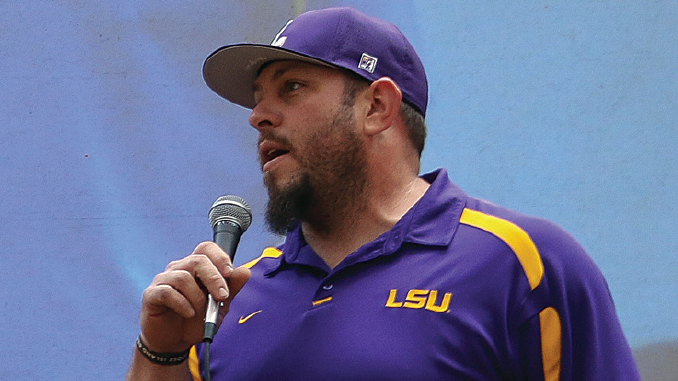
(First in a series on Louisiana Sports Hall of Fame inductees – Natchitoches, June 25-27.)
By ROBIN FAMBROUGH, Written For the Louisiana Sports Writers Association
Todd McClure vividly remembers the day he got put in his place by one of his high school
coaches.
“I thought, ‘Why is he doing this?’ ” McClure recalled. “I wasn’t just mad … I was really angry. I
was a tight end and a defensive lineman.
“Those guys get their names called out on the loudspeaker. The only time you hear an offensive
lineman’s name is when they commit a penalty.”
Central High offensive line coach Randy Blanchard did it anyway. Blanchard had McClure play
center for the first time – presumably for one day.
The sophomore did what he was told. And it changed everything, clearing a path for McClure to
become an All-America football player at LSU, a 14-year mainstay in the NFL with the Atlanta
Falcons and now a member of the Louisiana Sports Hall of Fame.
On Saturday, June 27 in Natchitoches, McClure will be part of a 12-person class enshrined.
To attend, visit LaSportsHall.com or call 318-238-4255.
All-Pro honors somehow eluded McClure, a fact one of his former head coaches with the
Falcons, Mike Smith, calls a misnomer.
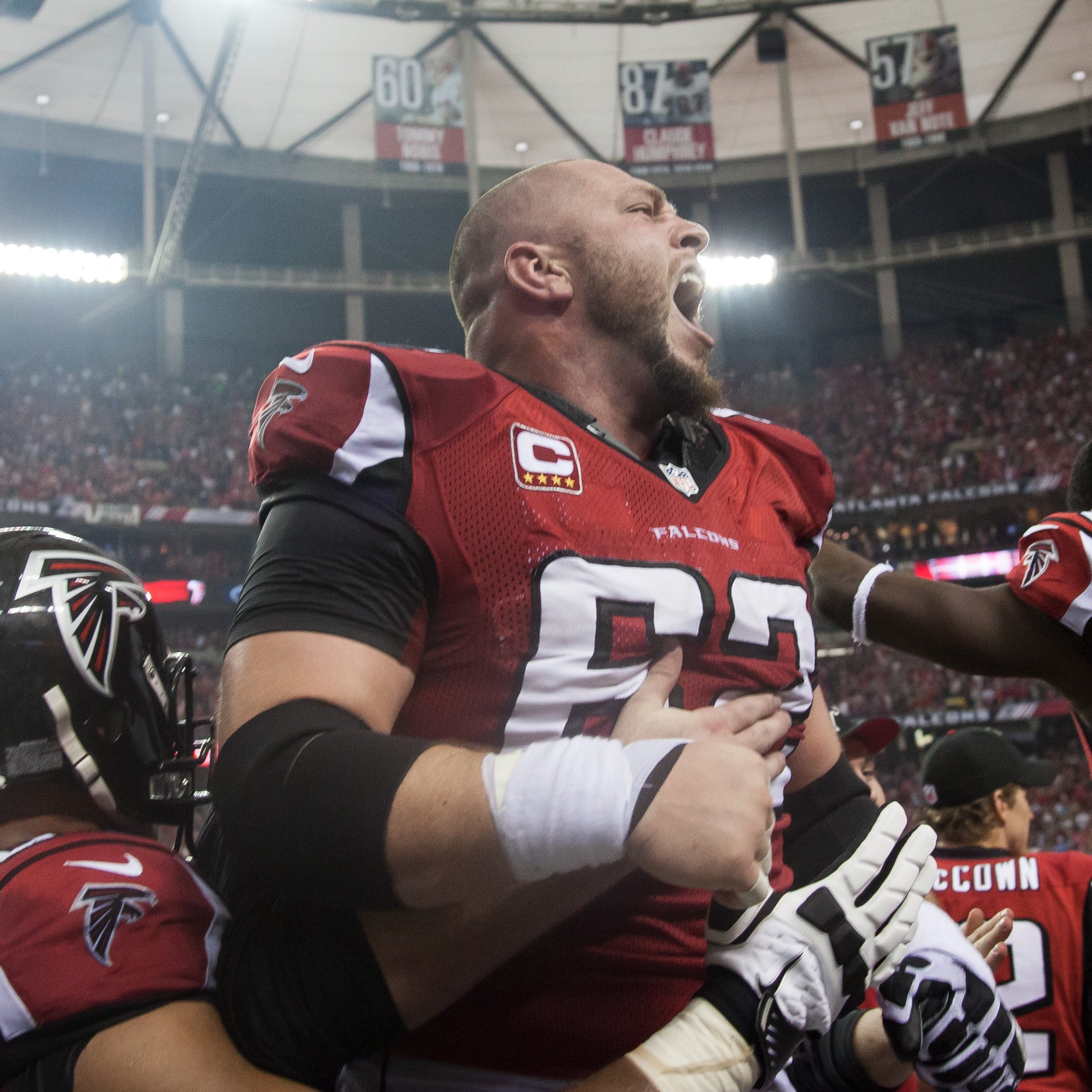
“In my opinion, Todd was an All-Pro … without question,” Smith said. “People believe wide
receivers and running backs are the most important players around a quarterback. But really, it’s
the center and not just because of snap exchanges.
“The blocking calls and pretty much everything goes through the center. Todd was a master of
that and also the best teammate I ever coached. As a blocker, he was a technician who knew all
the angles and leverage.”
The 2026 LSHOF induction is hardly McClure’s first honor. He was inducted into the Falcons’
prestigious Ring of Honor in 2022. At LSU, he was a two-time All-SEC selection and earned
first-team All-America honors from the American Football Coaches Association in 1998.
Booked – Jay Johnson will be on statewide Tiger Rag Radio tonight talking portal:https://t.co/rlWxXWb3r9
— Glenn Guilbeau (@SportBeatTweet) June 16, 2026
Awards are merely window dressing for McClure, who built a career on an old school, multi-
sport upbringing. McClure was a leader and a “glue guy” for each team he played for.
That “glue guy” moniker offered multiple meanings for critics of undersized linemen. At 6-2, 290
pounds, did not fit the prototype of an NFL lineman. But McClure stuck to his craft relentlessly
as he fine-tuned skills in order to adapt and excel.
How good was he? Remember that youthful observation about offensive linemen and
penalties? Consider this – McClure was called for just 22 penalties in 198 regular-season
games during his NFL career.
That’s an average of 1.7 penalties per year. McClure didn’t have a single penalty called on him
in the 2011 season.
And it started at practice with an order from Blanchard, best known as the Central baseball
coach who won four straight Class 4A state titles with McClure as his All-State catcher.
“There wasn’t a whole lot else Todd could do at tight end that day,” Blanchard recalled. “So, I
told him to move over to center. He did not like it one bit and I knew it. But I said, ‘You never
know when you might have to play there.’ Of course, he did. What a career.
“Now I will tell you this, if Todd would have gone with baseball instead, I think he could have
made to the Major Leagues as a catcher. I really do. He was that good.”
However, then-LSU football coach Gerry DiNardo was enamored with McClure after watching
him play basketball for Central. After that, he still played tight end, but also took enough snaps
at center so the film could be dubbed to VHS tapes that were sent to college football coaches.
GERRY DINARDO LOVED TODD MCCLURE
“DiNardo loved him and told him to keep playing basketball because it would help his footwork
so much,” former Central basketball coach Gary Duhe said. “Todd was just an all-around
athlete. I give his dad a lot of credit because he had him play point guard in Biddy Basketball
even though he was a bigger kid.
“Most people probably remember him as a 6-foot-2 guy guarding 6-9 Lester Earl (Glen Oaks
star) in the (Class 4A) championship game for Central. He did that probably as well as anybody.
But he also brought the ball upcourt against the press because he was our best ballhandler.”
Each all-around multi-sport skill certainly helped shape McClure’s destiny. Equally important
was his upbringing and a lineage ingrained into the sports history of Central, a small town in a
mostly rural area just outside Baton Rouge.
By the time he was in college, McClure’s words to teammates resonated like those of a coach
for good reason. His grandfather Archie and father, Leo McClure, were coaches at Central.
During Leo McClure’s stint as an assistant coach and later head men’s basketball coach at
Southeastern Louisiana University, McClure, his older brother Trey and younger brother Tanna
had unfettered access.
The McClures were ball boys and sat in the SLU locker room every day, including game days.
“That’s where I saw how things were supposed to be done,” McClure said. “I saw what
leadership looked like from players and coaches every day when my dad coached at
Southeastern.
“We saw things up close. That’s where I saw what being a good teammate looked like. For us,
that was the only way for things to be done. That was the expectation and it shaped who I am,
no question.”
THE MCCLURE WAY
The McClure way also meant being a multi-sport athlete. All three were three-sport athletes at
Central.
Trey McClure played for two Skip Bertman-coached national championship baseball teams and
is fourth on LSU’s career home runs list while Todd, who is 14 months younger, made a name
for himself in football. Tanna McClure later played baseball at SLU.
Their mother, Brenda, was a two-sport standout at Central. Sundays were often spent helping
maternal grandfather Jewel Wilson mend fences and tend to animals on a family farm. Those
experiences led McClure to build his own ranch/farm in Zachary after his NFL retirement.
“I give so much credit to both sides of my family,” McClure explained. “There were lessons
learned. I’m fortunate to have my grandmother (Carmel McClure) watch not only me and my
brothers play, but also our children. It’s a blessing.”
Building a post-NFL life based on his family roots and competitive values made sense for
McClure because he did it before – first during a transformative period for LSU football and
again in the NFL.
Being called a great teammate or a leader is often dismissed as an antiquated atta-boy cliché
by many people in today’s society.
McClure provides an example of why that should not happen, a point his former LSU
teammates eagerly explain.
“We played against each other in middle school and I always followed his career,” former LSU
linebacker Markeith Spears said. “Todd was one of the first guys to commit to LSU early in our
senior year. And I figured if it was good enough for him, it was good enough for me.
“But I did not know Todd as a person until we got to LSU. I was so nervous before my first start
our freshman year. Todd calmed me down. He walked me through it, telling me, ‘You know what
to do … just play hard like you always do.’ That’s compassion and leadership.”
ALAN FANECA LOVED PLAYING NEXT TO TODD MCCLURE
Former LSU star lineman Alan Faneca, a Pro Football and LSHOF member, adds, “Todd was
absolutely the best guy to play next to (for three years) … somebody you love to go to battle
with each day. He was always absorbing information. You just wanted to play with him.”
Former LSU quarterback Herb Tyler notes, “The amount of trust we all had in Todd was based
on seeing the amount of work he put in. All of us gained trust from the upper classmen in part
because of him. He was the anchor of the line and the guy who made it all go.”
McClure was drafted in the seventh round of the 1999 NFL Draft by the Falcons. He tore his
ACL during a training camp. A tough break like that has ended many careers. But not
McClure’s.
“I remember a trainer telling me it was a torn ACL and then he left me in this area by myself,”
McClure said. “I wasn’t sure what would happen next … was it (football) over for me?”
McClure learned there were two options. If the team offered an injury settlement, he would be
released. If the Falcons placed him on injured reserve, McClure would get his chance.
“Pretty soon I found out I made an impression on people,” McClure said. “They had talked about
me and what I had done in meetings for the offense and defense. So, they put me on IR. I got to
work rehabbing, watching film … everything I could do.”
McClure honed his skills for reading sideline signals and the body language of defenders,
looking for a “tell” that would give away game plans or tendencies.
STARTED 159 OF 160 GAMES IN ATLANTA
The following season, McClure became a fixture for the Falcons, starting 159 of 160 games
through the bulk of his career. Again, he built bonds and trust with teammates and coaches.
The fact that one of McClure’s first offensive line coaches in Atlanta was north Louisiana native
Al Miller did not hurt, either. Miller nicknamed McClure Mud Duck. The nickname stuck and so
did McClure.
Michael Vick and Matt Ryan were among McClure’s Atlanta quarterbacks. He blocked for
LSHOF running back and former Catholic High-Baton Rouge star Warrick Dunn.
“Todd and I were teammates for eight years,” former Falcons lineman Tyson Clabo said. “I still
consider him to be my brother, even though we haven’t played together in quite a while. That’s
how special the bond is.
“As a player, he was something else. I would be standing in the huddle trying to catch my breath
after a play and Todd would get in my face to tell me something he saw from the sideline or
about the defensive alignment.”
Clabo laughed as he explained that the Falcons drafted other centers over the years, figuring
they could replace McClure.
Some potential replacements were cut. Others got moved to new positions.
“Management talked about wanting to be bigger and faster on the offensive line over the years
when I was the coach,” Smith said. “It was a different story in our building. We knew Todd was
always the guy … our guy.”
Be the first to comment